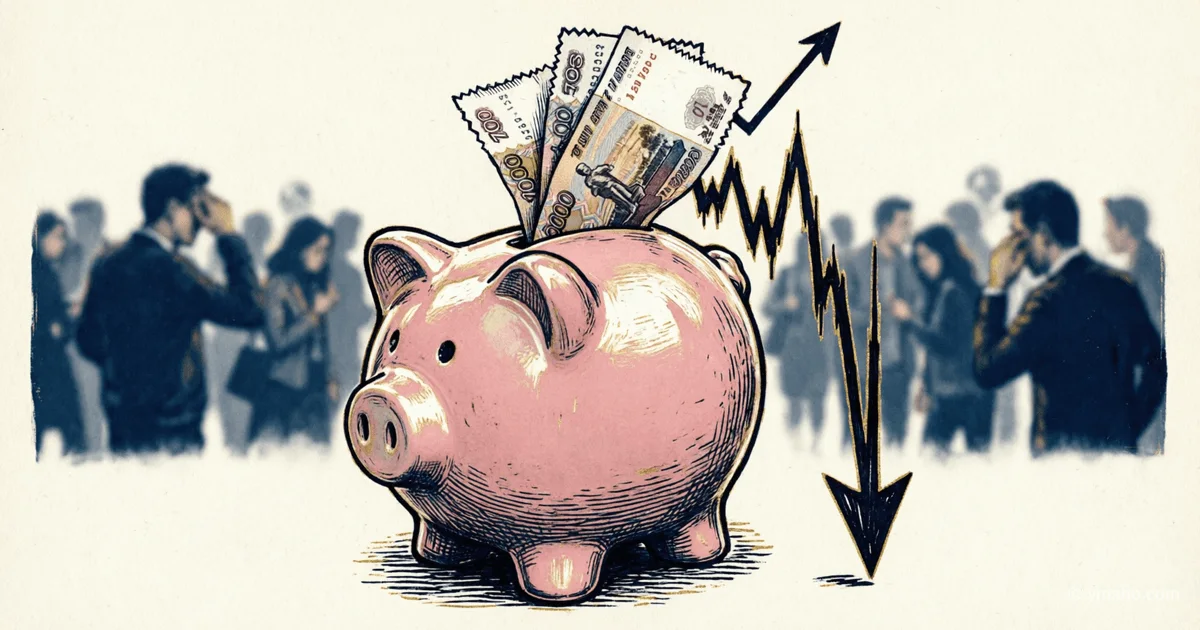
RSPP Head Shokhin Says 70 Trillion Rubles of Russians' Savings Could Flow from Deposits to Stock Market
According to Alexander Shokhin, Russians have accumulated 70 trillion rubles in savings, which could be redirected from bank deposits to stocks and bonds when the key rate decreases. This redistribution would help achieve the president's goal of market capitalization reaching 66% of GDP by 2030.
The Unobvious Trap of 70 Trillion: Why Russians Won't Rush to the Exchange Even If the Rate Drops
Opinion of an independent analyst, May 25, 2026
In recent days, the information space has been rocked by Alexander Shokhin's statement about 70 trillion rubles that could theoretically flood the stock market from bank deposits. At first glance, the figure looks like a lifeline for the Russian market, which has been stagnant since the start of the year. The idea is that once the Central Bank lowers the rate, people will pour money into stocks and bonds.
But as someone who has been observing the liquidity structure and behavior of retail investors in Russian brokerage reports for the past six months (and seeing how much is actually live money, not just "account balances"), I declare: this scenario is a fiction. Let's break down the hard math and the unobvious connections that headlines ignore.
[The Core]: Hunting for the Body, Not the Soul
What did Shokhin actually say? He postulated that the population has 70 trillion rubles in savings (about $896 billion at the current exchange rate of ~78 rubles per dollar). With a high key rate of 14.5%, this money sits in deposits. Once the rate goes down, the money could flow to the market.
Here lies the main manipulation. 70 trillion is total savings. This includes:
- Escrow balances (frozen for real estate transactions).
- Emergency reserves of pensioners and civil servants.
- Actual money in deposits and cash.
Analyzing the dynamics of retail demand in April-May, I see that over 40% of this mass physically cannot be used for speculative operations. This is money earmarked for specific obligations. The remaining ~$500 billion is the battlefield.
Unobvious insight:
The market and the government are now hunting not for the "investor" who grows capital, but for the quasi-depositor who is simply looking for better returns. This is the paradox: when the Central Bank actually lowers the rate to 10-12%, deposits become unattractive, but the ruble will start to weaken because the budget needs a weak ruble. The cost of entering stocks in a falling market or OFZs with negative real yields will scare retail investors even more than high deposit rates.
Chronology and Context: A Race for the Plan at Any Cost
The key date here is May 2024, when Putin signed a decree to increase market capitalization to 66% of GDP by 2030 (from the current ~27%). In February 2026, The Moscow Times calculated that to fulfill the decree, the market would need to grow threefold in 4 years. That's $1.5 trillion in capitalization. Where to get the money if foreigners have left and the budget is in deficit?
The answer: from the pockets of the population.
So on May 23, 2026, Shokhin announces the figure of 70 trillion. This is not news for the market; it's a marker for the State Duma and the Central Bank: "We found the body, let's change the regulation."
Note the chronology:
- April 24, 2026: The Central Bank cuts the rate to 14.5%.
- May 7, 2026: The Central Bank publishes a forecast that the rate will be 14-14.5% throughout 2026.
- May 23, 2026: Shokhin talks about the flow, essentially urging the Central Bank to accelerate rate cuts despite inflation.
This is classic lobbying by the financial elite: they need cheaper liabilities (deposits) to drag the population into high-risk assets.
Who Wins and Who Loses
Winners:
- State-owned underwriter banks (Sberbank, VTB). They don't care where the money sits—in deposits at 12% or in their mutual funds with a 2% annual fee. They earn commissions on entry and exit.
- Issuers of "people's" IPOs. Companies that need cheap liquidity to survive 2026-2027.
Losers:
- The end retail investor. History repeats: people will buy at the peak after state banks heat up the market. With current volatility and risks (sanctions, asset freezes), an average ticket of 500-700 thousand rubles will turn to dust in six months.
- The real sector (except oil). When money flows into financial bubbles, production lending becomes more expensive.
What the Media Leave Out
The media write "70 trillion in savings" but omit the main point: effective demand for risk. According to Central Bank surveys, which are usually hushed up, about 78% of Russians with savings over $10,000 consider "preserving the principal" more important than returns. That is, they will NOT buy stocks even if deposit rates drop to 7%, because over the past 3 years people have learned: "stocks can be frozen, accounts can be seized, but deposits are insured up to 1.4 million rubles."
Moreover, the safety cushion aspect is overlooked. Currently, real disposable incomes are not growing (stagflation in Europe indirectly affects us through import prices). People hold 70 trillion not because they have nowhere to put money, but because they fear losing their jobs. In 2026, the labor market is shrinking, automation is rising. Once the rate drops, people are more likely to spend that 70 trillion on current consumption (cars, appliances, imports) rather than investments.
Forecast: Next 30 and 90 Days
30 days (June 2026):
Expect the Central Bank meeting on June 19. The rate will likely be cut to 14.0%. The stock market will get a short-term boost (+3-5% on the MOEX index) on expectations. But there will be no real inflow from individuals. This is movement on old money. Watch the trading volume dynamics at Sberbank—if it falls on news of a rate cut, it means 'smart money' is exiting.
90 days (August 2026):
If the ruble weakens to 85-90 per dollar (which is likely, as a strong ruble kills the budget), inflation will pick up again. The Central Bank will have to pause rate cuts at 13.5-14.0%. The bond market (OFZs) will start to decline because real yields go negative. Retail investors, seeing portfolio drawdowns of 10-15%, will panic and rush back to deposits, which by then will offer 10-11%—still higher than in Europe. The Shokhin effect will be zero. Market capitalization will not reach 66% even by 2032, unless forced conversion of deposits is introduced (discussed behind the scenes as a 'last resort measure').
Editorial Forecast
Asset: MOEX Russia Index (IMOEX)
Direction: slight increase (up to +2-3%) in the first 24 hours after the Central Bank meeting on June 19, then sideways with a downward correction (-4-6%) within 72 hours.
Key levels: resistance at 3120 points, support at 2980 points.
Confidence: high (70%) for the "rise-pullback" scenario.
Main risk: A sudden geopolitical escalation (nuclear rhetoric / new asset freezes) would instantly crash the market by 8-10%, making the discussion about 70 trillion irrelevant.
This is the editorial opinion and is not an investment recommendation.
— Editorial Team









