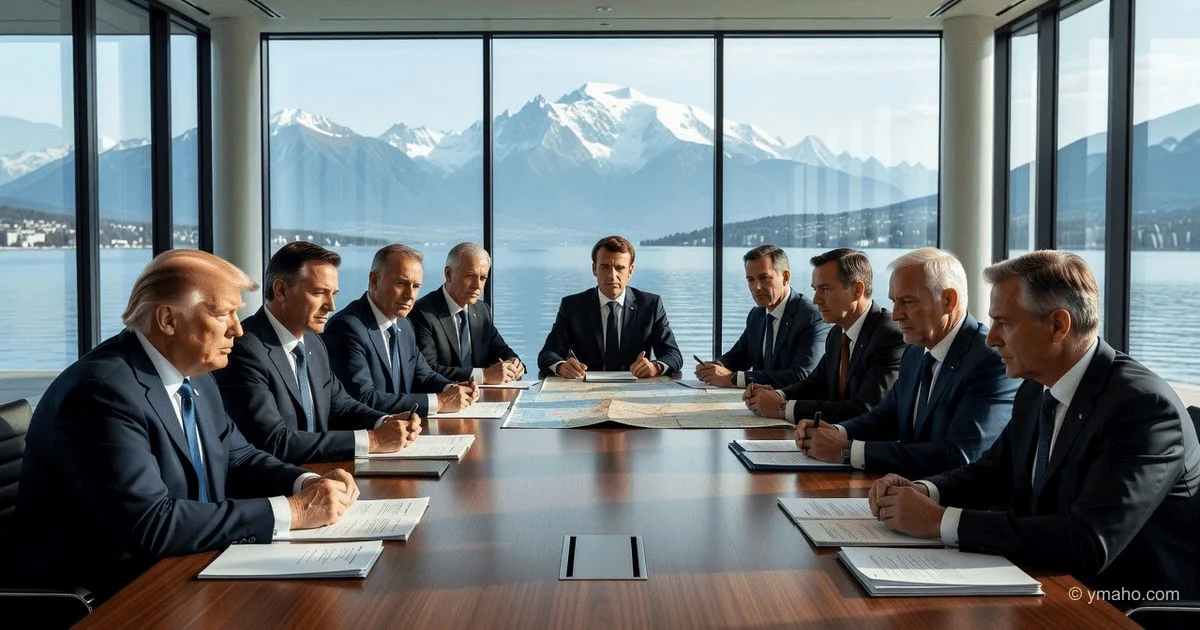
G7 Expresses Unity on Ukraine and Charts a Turn Toward Economic Sovereignty from China
The G7 summit in Évian-les-Bains, France, concluded with a joint statement supporting Ukraine's territorial integrity and an agreement to strengthen sanctions against Russia. Leaders also announced a strategic course to reduce dependence on China for critical minerals and rare earth metals.
Strategic Pivot of the G7: Évian-les-Bains as a Point of No Return
Key insight that markets are missing: The summit in Évian-les-Bains was not just another G7 meeting, but a moment when the collective West, for the first time in decades, took on legally binding commitments to deglobalize key economic sectors. The statement to reduce China's share in imports of critical minerals to 60% by 2030, with a target of 50%, is not a political declaration but a signal to launch mechanisms of trade quotas and price floors that fundamentally change the structure of global raw materials trade. Markets have yet to price in this tectonic shift, continuing to trade along old patterns.
The Essence: What Is Really Happening
The G7 adopted an unprecedented package of decisions that can be divided into two blocks—military-political (Ukraine and Russia) and economic-structural (China and critical minerals). While the first block largely continues existing trends, the second represents a true revolution in international trade policy.
On the Ukraine track, G7 leaders reaffirmed "unwavering support" for Ukraine's sovereignty and territorial integrity. Donald Trump, whose presence at the summit drew particular attention, took a tougher stance toward Moscow, stating that "Russia must make a deal" and hinting at the possibility of reimposing sanctions on Russian oil under favorable market conditions. This came as a surprise to European leaders, who expected a softer line from Trump.
However, the key event of the summit was the agreement on critical minerals. G7 leaders agreed to create a platform for policy coordination, data sharing, and crisis response with an expanded role for the International Energy Agency (IEA). The target is to reduce dependence on a single supplier outside the G7 and partner countries for rare earth elements and permanent magnets to below 60% by 2030, with a final goal of 50% "as soon as possible."
This is not just words—it launches concrete mechanisms: pilot projects for lithium and nickel, expansion to five new minerals annually with a focus on rare earths, and creation of harmonized interoperable mechanisms. G7 countries will also explore the possibility of introducing "subsidies for price differences, joint purchasing instruments, and trade instruments such as quotas and price floors."
Timeline and Context
To understand the scale of what happened, it is necessary to trace the chronology of events leading to this decision.
In 2025, China imposed large-scale export restrictions on most critical minerals and rare earth products, severely disrupting global supply chains and demonstrating the vulnerability of Western economies to a single supplier. China controls 90% of global production of processed rare earths and magnets, making its position critically dominant.
In response, the G7 began preparing for diversification. At the summit in Évian-les-Bains (June 16-17, 2026), a decisive step was taken. Interestingly, the US-Iran agreement to restore navigation in the Strait of Hormuz, also announced at the summit, created favorable conditions for strengthening sanctions against Russia—cooling global energy prices allowed the G7 to impose new restrictions without the risk of a sharp rise in fuel prices.
| Parameter | G7 Statement | Target | Timeline |
|---|---|---|---|
| Share of a single supplier (outside G7) | Reduction to <60% | 50% "as soon as possible" | 2030 |
| Pilot minerals | Lithium and nickel | Expansion to 5 new annually | Starting 2026 |
| Investment in projects | 195 projects | $74 billion (€64 billion) | Since early 2026 |
| US Strategic Reserve | Project Vault | $12 billion | 2026 |
It is worth noting that 195 projects worth $74 billion have already been announced since the beginning of 2026. This indicates that work is underway not only at the level of political statements but also at the level of real investment.
Who Wins and Who Loses
In this new reality, new groups of winners and losers are emerging, with a significantly different landscape from the usual.
Winners: Mining companies and producers of critical minerals outside China. Australia, Canada, and African countries with rich rare earth deposits gain strategic priority. The policy of "price floors" guarantees them minimum return on investment, and subsidies for price differences reduce risks. Shares of such companies will receive a long-term growth multiplier.
Winners: Processors and manufacturers of permanent magnets in the US and EU. Creating closed supply chains from extraction to finished product means these sectors will receive government support and protection from Chinese dumping. The $12 billion Project Vault in the US is just the beginning.
Losers: Chinese exporters of rare earths and magnets. Import quotas into G7 countries and joint purchasing mechanisms will lead to a reduction in Chinese exports. Potential introduction of tariffs and non-tariff barriers will further reduce the competitiveness of Chinese products in Western markets.
Losers: European consumers, at least in the short term. Building a new supply chain requires enormous investment and time. During the transition period, the cost of critical minerals for European industry may rise, hitting electronics, automotive, and defense manufacturers.
Losers: The Russian oil and gas sector. New sanctions, including expanding the "shadow fleet" under UK sanctions to 600 vessels and Canadian restrictions, aim to reduce Moscow's revenues from energy exports. This puts additional pressure on the Russian budget and war economy.
What the Media Are Not Saying
Behind the scenes of the summit, three important nuances remain that change the perception of events.
First: the contradiction between ambitions and realities. The goal to reduce China's share to 60% by 2030 looks ambitious, but analysts at Benchmark Mineral Intelligence already point out that in processed rare earths and magnets, China controls 90% of global production. Achieving this target in four years is virtually impossible without a radical technological breakthrough or accelerated launch of dozens of new projects. The real goal is not to reach 60% by 2030, but to create an institutional infrastructure that allows a gradual reduction in dependence over the 2035-2040 horizon.
Second: internal resistance among G7 members. Diplomatic sources report that G7 members are skeptical of Trump's proposal to regulate prices through mechanisms like "price floors." Europe fears that such tools will lead to higher costs for its own industry and market distortion. This means that even within the G7, there is no full consensus on methods to achieve the goals, and implementation will be accompanied by fierce political battles.
Third: strategic linkage with Iran and Russia. The summit clearly demonstrated that the US-Iran agreement on the Strait of Hormuz became a trigger for strengthening sanctions against Russia. The drop in oil prices after the restoration of navigation created a "window of opportunity" to pressure Moscow. Emmanuel Macron called it a "strategic awakening," emphasizing that all decisions received unanimous support, including from the US. This means that geopolitical blocs are becoming more coordinated than ever in recent years.
Forecast: Next 30 Days and 90 Days
Next 30 days (until mid-July): Markets will gradually begin to price in the new realities. Shares of mining companies, especially those working with lithium and nickel, will get a growth boost on expectations of long-term contracts with G7 governments. Watch companies in Australia and Canada—they will be the first beneficiaries of the "strategic awakening." Prices for rare earths, especially neodymium and praseodymium, may start a downward correction on expectations of reduced Chinese exports, but this will be temporary—in the medium term, demand will remain high.
Next 90 days (until September): Key events will revolve around implementation. The US is expected to propose legally binding agreements with Japan and the EU as early as this month. This will be a test of the coalition's strength—can the collective West move from declarations to concrete trade agreements? Brussels will announce the creation of the first joint reserve of critical minerals with a focus on tungsten, rare earths, and gallium. This will become a new growth driver for companies involved in processing and recycling these materials.
By the end of September, we will see the first real results: signing of initial contracts between G7 governments and mining companies, announcements of new processing projects, and the beginning of strategic reserve formation. This will lead to a gradual but steady rise in prices for assets related to critical mineral supply chains outside China.
Editorial Forecast
Asset: Lithium (spot market price). Direction: Up in the next 72 hours on news of joint purchasing mechanisms and the launch of the G7 pilot project for lithium. Key levels: Nearest resistance at $14,500 per ton; a break above this level opens the way to $15,200. Confidence level: medium (60%). Main risk: China may take retaliatory measures, including massive lithium supplies to the market to drive down prices and undermine the economic viability of Western projects. Watch for official statements from China's Ministry of Commerce in the next 48 hours—they will be a key signal for the market.
Disclaimer: The editorial opinion is not an investment recommendation. Markets are highly volatile; always conduct your own research before making decisions.
— Editorial Team