Functional Gummy Candies Gumitide Become a Viral Healthy Lifestyle Trend
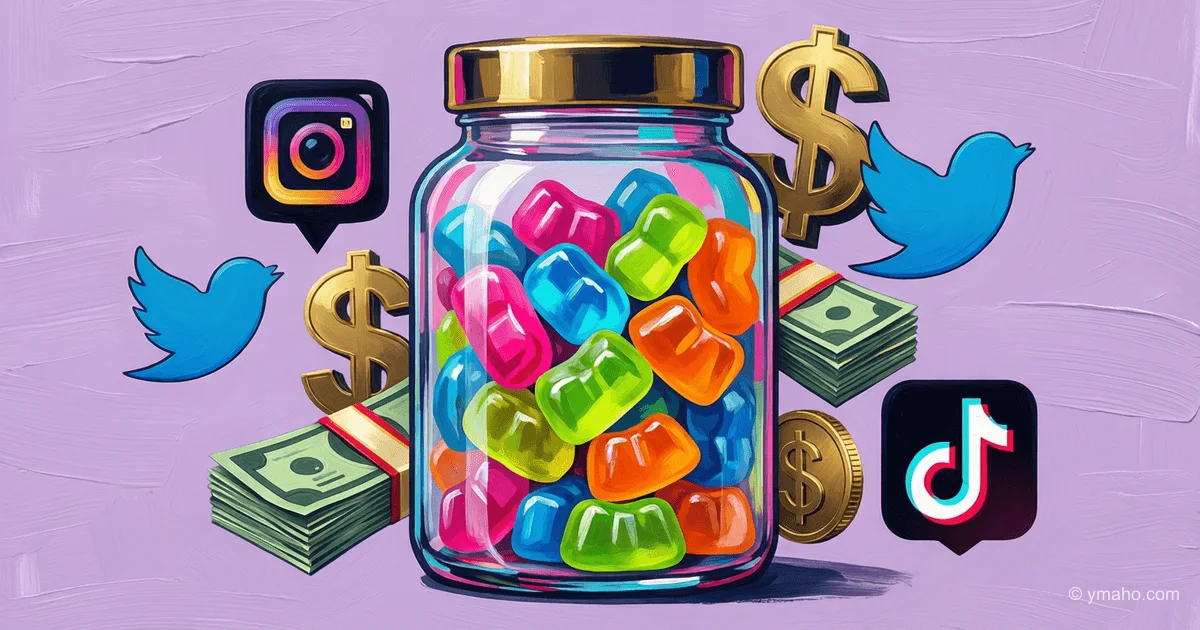
A new trend in the wellness segment — shifting from capsules and powders to convenient and tasty chewable supplements for metabolism, energy, and beauty support, popularized on social media.
Headline: The Chewable Revolution: How Gumitide and Company Turned Supplements into Candy and Made $2.1 Billion
[The Gist]: What's Really Happening
When the news writes about Gumitide as a "viral wellness trend," it creates the impression that some startup invented a genius gummy candy and the world went crazy. Journalists see TikTok videos and talk about a "format shift."
In reality, the essence is deeper and more cynical. Gumitide is not a unique product. It is the face of an entire industrial revolution that has been quietly unfolding over the past 5 years. The functional gummy supplements market reached $2.138 billion in 2025 and is projected to grow to $4.083 billion by 2032. That's nearly doubling in 7 years.
But the insider knows the key point: the shift from capsules to gummies is not about convenience. It's about removing the psychological barrier of "I'm taking medicine." A capsule or powder is a ritual of a "sick person." A gummy candy is a ritual of "someone treating themselves to a healthy dessert." And this shift in perception is worth billions of dollars.
Gumitide is positioned as a product for metabolism, energy, and beauty. Its formula: apple cider vinegar and BHB salts (beta-hydroxybutyrate). Sounds scientific. But the dosage is a proprietary blend with a total weight of 525 mg. No one knows how much apple cider vinegar and how much BHB salts are in it.
And here's where it gets interesting. Studies show that for apple cider vinegar to have any effect on blood sugar levels, you need 750–1500 mg of acetic acid, not just "vinegar" as an ingredient. And to induce ketosis with BHB, you need about 10 grams. In Gumitide, the total volume is 525 mg. That means dosages are 5–20 times lower than studied amounts.
But who talks about this on TikTok? No one. Because Gumitide doesn't sell results. It sells a ritual. And that's genius.
Timeline and Context
2020–2022 — The aesthetics of "gummy bears" and "jelly blushes" start gaining traction on Pinterest and TikTok. People love everything soft, bouncy, and tactile.
2023–2024 — The functional gummy market in the US and Europe grows 15–20% annually. Capsule supplements lose ground to the "candy" format.
February 2025 — Pinterest officially names "Gimme Gummy" one of the top trends for 2026. Searches for "gummy bear aesthetic" increase by 50%, "jelly blush" by 130%.
April 2026 — Analysts report: the global functional gummy market was $2.138 billion in 2025. The top 3 manufacturers control 37% of the market.
May 2026 — Gumitide (also known as Gumatide and Jelly Tide) explodes on social media. The product is distributed through Instituto Experience in Florida. Price: $49 to $79 per bottle (30 gummies — a one-month supply). 60-day guarantee, but refunds only after 30 days of use.
May 22–23, 2026 — First investigations appear. Journalists ask: what's actually inside? It turns out the label does not disclose individual dosages. 525 mg proprietary blend — that's all that's known.
May 26, 2026 — You receive the news. But behind the virality is not just Gumitide. It's an entire trend picked up by hundreds of imitators.
Who Wins and Who Loses
Winners:
- Manufacturers of functional gummies (TopGum, SCN BestCo, Piping Rock). Their factories are running at full capacity. The B2B ingredients market for gummy supplements grew 40% year-over-year. Cost per gummy: $0.10–$0.20. They sell it for $1.60–$2.60 ($49–$79 for 30 pieces). Margins: 800–2000%.
- Social commerce platforms (TikTok Shop, Instagram Shopping, Amazon). TikTok algorithms especially favor visually appealing products. Gumitide and its analogs get millions of free views through affiliates and influencers. Amazon takes a 15% commission, but it's still cheaper than traditional advertising.
- Distributors and affiliates. Influencers earn 20–40% commission per bottle sold. One viral video can generate $10,000–$20,000 in income. Multi-level marketing (MLM) is unofficially but actively used.
- Packaging manufacturers. Bright jars with labels like "Metabolism," "Energy," "Beauty" sell better than any other designs. Packaging accounts for 30% of success in this category.
Losers:
- Traditional manufacturers of capsules and powders (especially unflavored). Young consumers (25–40) simply stop buying them. "Swallowing capsules" is unpleasant. "Eating a candy" is pleasant. Sales of old formats dropped 10–15% in Q1 2026.
- Pharmaceutical supplements with clear dosages. They have high production costs, strict quality control, and cannot compete with "proprietary blend" on price. Because when you don't disclose the dosage, you can put a microscopic amount of active ingredient.
- Manufacturers of desserts and regular candies. Mars, Nestlé, Hershey — their sweet sales are declining. Because consumers say: "Why would I eat plain sugar? I'll take a 'healthy candy' with apple cider vinegar." Meanwhile, Gumitide has 2 g of carbs per serving, 1 g of which is added sugar. That's not much healthier than a regular candy.
- Consumers. They pay $50+ for a jar of sugar with a microscopic amount of vinegar and BHB salts that will have no clinically significant effect. But they don't know that.
What the Media Isn't Saying
Non-obvious Insight #1: Gumitide is repackaged "apple cider vinegar + BHB" that has been sold in capsules for years at $20.
Compare. A bottle of apple cider vinegar capsules on Amazon costs $19.95. It contains 120 capsules of 600 mg each. Gumitide costs $49–$79 for 30 gummies of 525 mg proprietary blend (including BHB and vinegar together). So you pay 3–4 times more for less active ingredient and less transparent composition. The price difference is the cost of packaging, flavor, and marketing. And people are willing to pay.
Non-obvious Insight #2: The real "viral" is not the product, but the word "Tide" in the name.
Gumitide, Gumatide, Jelly Tide — note the suffix. It references semaglutide (Ozempic, Wegovy), the best-selling weight loss drug of recent years. Functional gummy manufacturers deliberately use naming that associates with GLP-1 agonists. It's a "natural GLP-1 alternative" that can be bought without a prescription. The consumer hears "-tide" and thinks: "Oh, like Ozempic, but natural and in gummy form." Genius. And completely misleading. Apple cider vinegar and BHB have no connection to GLP-1.
Non-obvious Insight #3: "Proprietary blend" is a legal way to deceive.
In the US and Europe, supplement manufacturers can avoid disclosing exact dosages of each ingredient by combining them into a "proprietary blend." This was originally designed to protect trade secrets (so competitors couldn't copy the recipe). But in practice, manufacturers put 500 mg of cheap filler (e.g., pectin or sugar) and 25 mg of active ingredient into the blend, and label it as "proprietary blend 525 mg: apple cider vinegar, BHB." It's not a lie. It's an omission. But the consumer thinks they're getting 525 mg of active ingredients, when they're actually getting 25 mg of active ingredient and 500 mg of sugar and gelling agent. And it's completely legal.
Forecast: Next 30 Days and 90 Days
30 days (end of June 2026):
- Amazon and TikTok Shop will review the "weight management gummies" category. The most blatant "magical" claims will be removed. But Gumitide and its clones will remain because their wording ("metabolism support," "energy") is vague enough to avoid bans.
- The first major investigation from Consumer Reports or a similar organization will appear. Headline: "You're Paying $70 for Sugar with Vinegar." Gumitide will temporarily lose 20–30% of sales, but the trend will return in 2 weeks because consumers have short memories.
90 days (end of August 2026):
- A major player (likely Nestlé Health Science or Unilever) will announce the launch of its own line of "functional gummies" with transparent dosages and clinical studies. Price: $30–$40 per jar. They will try to legitimize the category and kill cheap imitators.
- The European regulator (EFSA) will issue a warning about "proprietary blends" in weight loss supplements. It will recommend disclosing dosages of each ingredient. Some manufacturers will adapt, others will move to the US market where rules are looser.
- The functional gummy market in the Asia-Pacific region will show 20% quarterly growth. China, Japan, and South Korea will outpace North America in growth rates due to "kawaii" culture and love for chewy textures. Korean brands will launch "collagen gummies" and "probiotic gummy bears."
Insider's Bottom Line: Gumitide is not a product. It's a marker of an era. An era when people want to get health in dessert form. When they are willing to pay 4 times more for sugar if the jar says "metabolism." The functional gummy market will grow to $4 billion by 2032. But 80% of products in this market will contain active ingredients in homeopathic doses. And that's okay. Because the wellness industry doesn't sell health. It sells the feeling that you're doing something good for yourself without effort. And a gummy is the perfect vehicle for that feeling. Swallowing capsules is work. Eating a candy is joy. And as long as humanity chooses joy, the market will grow. Even if that joy is just sugar with vinegar for $70.
— Editorial Team