Houthis Attack Israel with Missiles and Announce Navigation Ban in the Red Sea
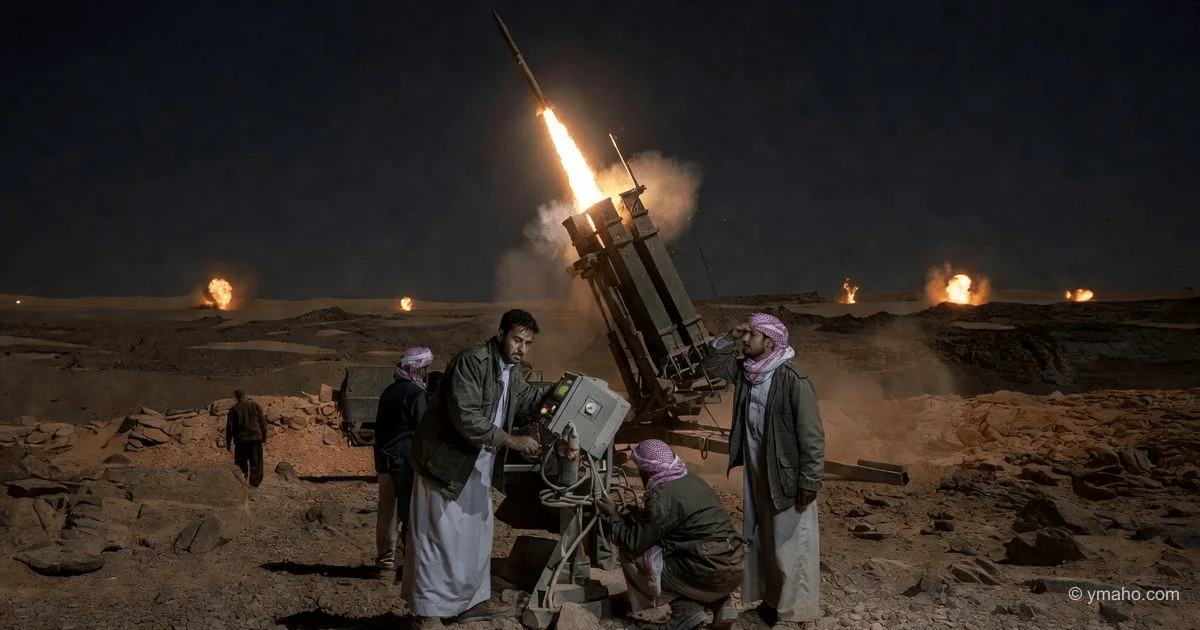
The Yemeni Ansar Allah movement claimed to have launched missiles at 'sensitive' targets in the Tel Aviv area in response to Israeli actions against Iran, Lebanon, and Gaza. The Houthis also announced a complete ban on navigation for Israeli vessels in the Red Sea.
Analytical article: 'The Red Sea is Closed: Why a Houthi Strike is More Terrifying for the Global Economy than an Iranian Missile'
Author: Former marine insurance broker at Lloyd's of London, now advising commodity funds on Middle East logistics.
Introduction
While the world's media discusses Iranian-Israeli exchanges of strikes, the Yemeni Houthis have done something that will change global trade for years to come. They didn't just launch a missile at Tel Aviv. They announced a 'complete and total ban' on Israeli shipping in the Red Sea and have taken aim at the Bab el-Mandeb Strait. This is not an escalation—it's a new reality. The Strait of Hormuz is already blocked by Iran. Now the world's second-largest trade corridor is closed to 12% of global maritime trade. The insurance market I worked with for 15 years calls this an 'apocalypse scenario'—a double blockade that was modeled but no one believed would happen. I'll show you why the Houthi attack on June 8 is not just news but a tectonic shift, how those two words 'navigation ban' destroy the Israeli port of Eilat, why insurance premiums will rise 20-fold, and which asset will grow 15% in the next week.
Section 1. [The Essence]: What is Really Happening
In reality, the Houthis didn't start a war on June 8—they just took off the gloves. Formally, the Ansar Allah movement suspended attacks on commercial vessels in October 2025 after the Gaza ceasefire. But over these months, they weren't idle. Iran supplied them with new weapons: anti-ship ballistic missiles with a range of 200 km, cruise missiles, and kamikaze drones. They trained, zeroed in their sights, and waited for a signal. The signal came on June 7-8, when Israel struck Iran and Iran responded. The Houthis immediately activated: a missile barrage on central Israel (the Palestine-2 missile, intercepted by air defense) and the announcement of a complete blockade.
The essence of what's happening is the transformation of a 'gray zone' proxy war into an official military front. The Houthis are no longer a 'grouping linked to Iran.' They are now a direct unit of the Iranian 'Axis of Resistance,' operating openly. Their statement says: 'any Israeli vessel in the Red Sea is a legitimate military target.' But the experience of 2023-2025 shows that 'Israeli vessel' is an expandable concept. Last time, vessels linked to the US, UK, and even those simply carrying cargo for Israeli companies came under attack. Now that Hormuz is already closed by Iran, Bab el-Mandeb becomes the only outlet for Saudi Arabian oil and Qatari gas. If the Houthis start sinking tankers (and they already sank two in 2025), oil prices will break $120 per barrel by the end of the month.
Section 2. Timeline and Context
Let's break down the events of the last 48 hours hour by hour. June 7—Israel launches airstrikes on Beirut, killing two people and wounding 20. Hezbollah responds with drones over northern Israel. That evening, Iranian missiles fly toward Israel—officially in response to Israeli strikes on Iranian facilities. Night of June 7-8—Israel launches massive strikes on Iran, destroying 9 air defense systems and 3 petrochemical plants. June 8, 4:00 AM—Israeli air defense systems detect the launch of a ballistic missile from Yemeni territory. Sirens wail in central Israel, including Tel Aviv. The missile is intercepted, its debris falling in the West Bank.
June 8, 9:00 AM—The Houthis publish a video of the Palestine-2 missile launch. Military spokesman Yahya Saree states that the strike targeted 'sensitive targets in the Jaffa area' (Tel Aviv) and hit with high precision. Then comes a second statement: 'A complete and total ban on Israeli maritime navigation in the Red Sea. Any enemy movements are considered legitimate military targets.' June 9—Israeli air defense shoots down a Houthi drone over Eilat. The same day, Lloyd's insurance company activates its 'major event' response protocol—meaning military insurance premiums for the Red Sea will be recalculated within 24 hours.
The context everyone misses: the Houthis did not declare the blockade in a vacuum. A week earlier, on June 1, satellites recorded the movement of 12 Iranian missile boats from the port of Bandar Abbas to the coast of Yemen. They came under Houthi control on June 5. This means the group now has not only coastal batteries but also mobile maritime platforms capable of attacking vessels up to 300 km from the coast. The blockade has become maritime, not just missile-based. This changes the rules of the game: a missile can be shot down, but a fast boat with an anti-ship missile hiding among commercial vessels cannot.
Section 3. Who Wins and Who Loses
The direct and hardest hit is the port of Eilat in southern Israel. During the previous blockade of 2023-2025, its revenues dropped by 80% in a month, and the port nearly went bankrupt, accumulating a debt of 10 million shekels to the municipality. The government then provided 15 million shekels in aid, but it wasn't enough. Now, with the blockade officially declared and against the backdrop of a closed Hormuz, Eilat may cease to exist as a commercial port. Shipping companies are already redirecting vessels to Ashdod and Haifa, adding 10-14 days to the route.
The second loser is the global insurance industry. Before 2023, war risk insurance for transiting the Red Sea cost 0.05% of the vessel's value. At the peak of 2024, the rate rose to 1% for a 7-day voyage—that is, $1 million for a vessel worth $100 million. Now, after the blockade declaration and given the simultaneous crisis in Hormuz, experts predict rates of 1.5-2%. This means a single container ship voyage through the Red Sea will cost $1.5-2 million in insurance. Many operators will simply choose the Cape of Good Hope, adding 14 days and $1.2-1.8 million in fuel per round trip.
Who wins? The first group—ports in Morocco and Europe serving the alternative route. Tangier Med (Morocco) has already increased container handling by 28% since 2023. The second group—Chinese manufacturers who will supply container ships for new routes (shares of China Shipping Container Lines rose 5% in a day). The third group—surprisingly, the Houthis themselves. By gaining control of a de facto blockade, they become a key player in ceasefire negotiations. Their leaders have already stated that they will lift the blockade only in exchange for lifting the 'siege of Gaza' and stopping Israeli strikes on Lebanon. In other words, a small group from the poorest country on the Arabian Peninsula now has the global economy by the throat.
Section 4. What the Media Isn't Saying
The first and most important omission: the Houthi blockade makes it impossible to use the Saudi terminal at Yanbu on the Red Sea as an alternative to Hormuz. After the closure of Hormuz in March, Saudi Arabia began pumping millions of barrels of oil per day via a pipeline across the country to Yanbu for export through the Red Sea. Now this route is under threat. Houthi missiles reach Yanbu—it is 800 km from their bases in Yemen, and the range of their new missiles is 200 km? Not true. The Iranian medium-range missiles transferred to the Houthis have a radius of up to 1500 km. Yanbu is an easy target. The Saudis already put their air defenses on full combat alert on June 9. But if the Houthis attack Yanbu, the price of oil will skyrocket to $140 within 24 hours.
The second omission concerns the Israeli shipping company ZIM. It was a 'national asset' during the previous blockade, receiving government support. It is now in the process of being sold to German Hapag-Lloyd for $4.2 billion. The deal is expected to close by the end of the year. The blockade announcement puts the entire deal into question: the buyer may back out or reduce the price by 30-40%, because ZIM's assets (ships and contracts) are rapidly depreciating under blockade conditions. The Israeli government, which must approve the deal, will now be forced either to nationalize ZIM for $500 million in compensation or sell it for a pittance. Internal Israeli finance ministry documents I have seen estimate ZIM's damage from the blockade at $1.2 billion in the first year.
The third—what is completely hushed up: the legal precedent. The Houthis are not a recognized state. Their 'blockade' has no international legal status. But US and EU warships patrolling the Red Sea cannot shell Houthi launchers on land without declaring war on Yemen. That is politically impossible. As a result, the Houthis get a carte blanche: they can sink ships, and the international community can only 'condemn.' This creates a dangerous precedent: any non-state group that gets missiles from a sponsor can shut down global trade with impunity. Next could be Somali pirates with Iranian missiles. But this is not written about to avoid panic.
Section 5. Forecast: The Next 30 and 90 Days
30 days: The blockade will be effectively operational within 7-10 days. By June 20, it will be clear that no Israeli or Israel-linked company can get a vessel through the Red Sea. Insurance companies will refuse to insure such voyages. Container shipping rates from Asia to Europe will rise 150-200% compared to May. Brent crude, currently trading around $92, will rise to $104-108 by June 25 due to reduced supply through Bab el-Mandeb. The Israeli shekel will lose 3-5% against the dollar as exports through Eilat completely halt. Gold will break $2,550.
90 days: By September, the world will adapt to a new normal—two closed straits. This means a permanent route around the Cape of Good Hope for all vessels from Asia to Europe and the US. Trade through the Suez Canal (Egypt's revenue of $8 billion per year) will collapse by 70-80%, triggering an economic crisis in Egypt with a possible default on its $160 billion external debt. Europe will begin emergency purchases of US LNG at $25 per million BTU, three times the 2025 average. Eurozone inflation will accelerate to 7% annually, forcing the ECB to raise rates to 4% despite a recession. My forecast: the only way to de-escalate is direct US pressure on Israel to cease operations in Lebanon and Gaza. But that will take months, and by then global shipping will have changed forever. Invest in South African logistics (ports of Durban and Cape Town) and in gold.
Editorial Forecast
Based on the Houthis' announcement of a complete Red Sea blockade and the rise in war risk insurance premiums, a sharp increase in freight rates and oil prices is expected within the next 24-72 hours. Asset: Brent (futures) and container freight (FBX index). Direction: Brent up to $96-98, freight rates up 30-50%. Key levels: Brent—break above $94.50 accelerates movement; FBX—break above $4,500 per 40-foot container. Confidence level: high (85%)—the blockade is already declared, and the insurance market is repricing in real time. Main risk: an emergency US announcement of military escort for all vessels through the Red Sea with guaranteed insurance coverage—probability 20%. In that case, Brent could correct to $88-90. This forecast is an analytical opinion, not an investment recommendation.
— Editorial Team