How to Start Investing from Scratch in Russia
Niche: Finance & Earning Money Content Type: Step-by-step guide Why It Matters: Evergreen query with growing demand, offering a clear, structured path for complete beginners.
The Essence: What You Need to Know First
Investing is not about "getting rich quick" or a game for millionaires. It's about systematically turning your savings into assets that work for you. The big news for 2026: the government has created mechanisms that make even the most modest start profitable — with 1,000 USD/EUR or even less.
Key facts to grasp before you start:
- You can start with 10 USD/EUR equivalent. In 2026, you don't need a brokerage account to get started — there are tools where you buy assets directly.
- The main tool for beginners is IIS-3. This is a third-type individual investment account that offers two tax benefits at once: a partial refund of personal income tax (up to 60–88 USD/EUR per year) and tax-free profit upon closure.
- Minimum horizon: 5 years. Money in an IIS-3 must be held for at least 5 years, otherwise the benefits are forfeited and you have to return the deductions.
- Don't invest your last money. You should have a financial safety net (3–6 months of expenses) in a separate savings account. Investments are money you're willing to "freeze" for years.
Why is it especially advantageous to start now? The key interest rate in Russia is beginning to decline, and the bond market is entering a growth phase. Those who enter now can earn not only coupon income but also capital gains from rising bond prices.
Step-by-Step Solution: From Zero to Your First Portfolio
Step 1. Build a Financial Safety Net (2–4 weeks)
Before investing, cover your basic risks. If you lose your job or fall ill and all your money is in stocks, you'll have to sell at a loss during a market downturn.
What to do: Open a savings account (not a deposit — access must be instant) and save an amount equal to 3–6 months of your expenses. This money is NOT invested. It's your safety rope.
Step 2. Choose the Right Investment Structure (one day)
In 2026, a Russian beginner has three main paths. For 90% of beginners, only the first one is suitable.
Option 1. IIS-3 (Individual Investment Account Type 3) — Recommended
This is a brokerage account with special tax benefits. You open it, deposit money, buy securities, and hold them for at least 5 years.
Pros:
- Contribution deduction: The government returns 13–22% of the amount you deposit (but not more than from 400,000 USD/EUR per year). So you get up to 60,000–88,000 USD/EUR from the government just for putting money in.
- Income deduction: Upon closing the account, you pay no tax on profits (up to 30 million USD/EUR over the entire term).
- Since 2026, funds in an IIS-3 are insured up to 1.4 million USD/EUR in case of broker bankruptcy.
Cons:
- Money is locked for 5 years. If you close the account early, you must return the deductions with penalties.
- You cannot buy foreign securities or currency — only Russian assets.
- Bond coupons cannot be withdrawn until the account is closed (dividends can).
Who it suits: Those with official income ("white" salary), who are willing to save for 5+ years and want to receive money from the government.
Option 2. Regular Brokerage Account
You simply open an account with a broker and trade. No tax benefits, but no restrictions either: you can buy any securities, currency, and withdraw money at any time.
Who it suits: Those planning to trade actively or needing access to funds before 5 years.
Option 3. People's Bonds (via Finuslugi)
The simplest path for an absolute beginner. You register on the Finuslugi platform (via Gosuslugi) and buy bonds directly, without opening a brokerage account.
Pros:
- Bond price is fixed (1,000 USD/EUR per unit) and doesn't change — no market risk.
- Interest accrues daily, and you can withdraw money any day without losing accrued income.
- No brokerage account needed — everything through one website.
Cons: Lower yield than market (fixed, doesn't rise when rates fall).
Step 3. Open an Account (15–20 minutes)
Having chosen IIS-3 (your best option), proceed as follows:
- Choose a broker. For a beginner, any major broker with a user-friendly app will do: T-Bank (T-Investments), Sber, VTB, Alfa-Bank, BCS, Finam. Compare fees: most have plans with 0–0.3% commission per trade and free maintenance.
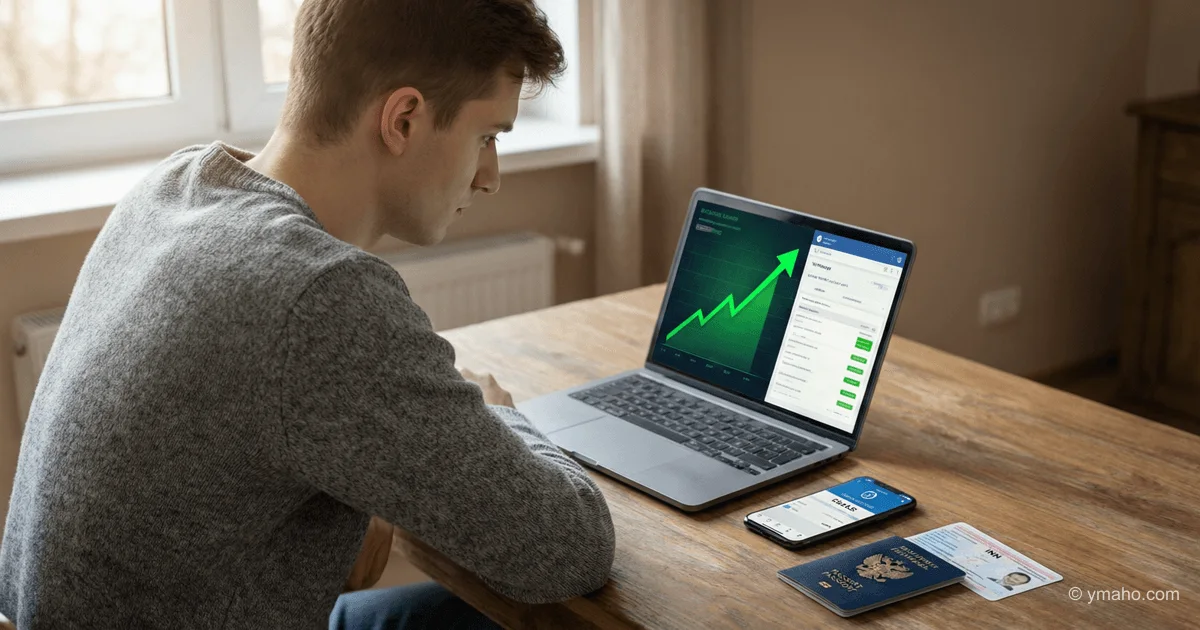
- Submit an application online. Through the broker's website or app. You'll need your passport and taxpayer ID (INN). If you have a verified Gosuslugi account, the form will fill automatically.
- Sign the agreement. Everything is done online — via SMS code or through Gosuslugi. The account is opened within minutes or business days.
- Fund the account. Transfer money from your card or account via the Faster Payments System (SBP). Most brokers have no minimum amount. To get the maximum tax deduction for the year, you need to deposit at least 400,000 USD/EUR. But you can start with 1,000–10,000 USD/EUR.
Step 4. Start with the Right Instruments (No Risk or Complexity)
For your first year of investing, forget about stocks and "speculation." Your goal is to get used to the process and avoid mistakes.
For your first portfolio (amount up to 500,000 USD/EUR):
Buy OFZs (federal loan bonds) with a fixed coupon. These are government debt securities. Yield: 12–14% per annum. Russia's default risk is near zero. Ideal for a first experience.
Recommended issues for 2026: OFZ 26254, 26243, 26248 (with fixed coupon). Why these? The key rate is starting to decline, and prices of long-term OFZs will rise. You'll earn not only coupon income but also from the bond's price appreciation.
Alternative for conservative investors: People's bonds via Finuslugi — no market risk at all, but lower yield.
Portfolio structure at the start (if you have more than 100,000 USD/EUR):
- 50% — long-term OFZs with fixed coupon (main growth driver in 2026)
- 25% — ruble floaters (bonds with floating coupon) — insurance in case rates don't drop
- 25% — foreign currency bonds (in yuan and dollars) — protection against ruble weakening.
If you have 10,000–50,000 USD/EUR: Buy 10 people's bonds (on Finuslugi) — this will be your first simple, understandable experience. Or open an IIS-3 and buy 1–2 OFZ issues.
Step 5. Set Up Regular Contributions (Most Important)
The biggest mistake beginners make is depositing money once and forgetting about it. Investing works over the long haul if you do it regularly.
Set up automatic monthly top-ups to your IIS-3 for a fixed amount. For example, 5,000–10,000 USD/EUR per month. This is called "paycheck investing," and it's the most reliable path to building capital.
Why it works: You buy securities when the market is high and when it's low. Over time, the average purchase price smooths out (dollar-cost averaging strategy).
Step 6. Get Your Tax Deduction (Free Money from the Government)
Since 2026, the process has become simpler: brokers automatically transfer IIS-3 deposit data to the Federal Tax Service (FNS).
What you need to do:
- Wait until the end of the calendar year (in which you funded the account).
- Log into your personal account on the FNS website or the broker's app.
- Find the pre-filled deduction application (it appears automatically) and confirm it.
- The money (up to 60,000–88,000 USD/EUR per year) will be credited to your account within 1–3 months.
Important nuance: The deduction is only given within the amount of personal income tax you paid. If you pay little tax (e.g., you have a "gray" salary), you won't get much back.
Practical Tips and Important Nuances
Tip 1. Forget About "Quick Money"
Telegram channels and social media will promise you 50% annual returns on "reliable schemes." In 99% of cases, these are scammers or financial pyramids. The real market offers 13–18% per annum with reasonable risk.
Tip 2. Don't Buy Stocks in Your First Year
Stocks are volatile. A new investor, at the first 10% drop, will panic and sell at a loss. Start with bonds. After 6–12 months, when you see coupons dripping into your account and bond prices not jumping wildly, you'll get used to the market.
When to move to stocks: After a year of calm bond investing and building a portfolio of at least 500,000 USD/EUR. Start with "dividend" and "growth" Russian companies: Sber, Rosneft, PhosAgro, T-Technologies.
Tip 3. Don't Put All Your Eggs in One Basket
Diversification is the only free lunch in the market. Don't buy only one OFZ issue. Don't buy only stocks from one sector. Ideal diversification for a beginner:
- 50–60% — bonds (OFZs and reliable corporate bonds)
- 20–30% — stocks (large Russian companies)
- 10–20% — defensive assets (gold, silver, foreign currency bonds).
Tip 4. Don't Check Your Portfolio Every Day
If you open the app every morning to see how prices changed, you'll go crazy. Over the long term (5–10 years), the market grows. Over the short term (day–month), it jumps up and down. Ignore it.
Check your portfolio once a month — just to make sure everything is in place. Rebalance (restore original proportions) once a year.
Tip 5. Use the Long-Term Holding Benefit (LTHB)
If you go beyond IIS-3 (e.g., bought stocks in a regular brokerage account) and hold them for more than 3 years, you can avoid paying tax on profits. The limit is 3 million USD/EUR for each year of holding.
Example: You bought stocks for 100,000 USD/EUR, sold them after 4 years for 200,000 USD/EUR. Profit: 100,000 USD/EUR. If you sold earlier, you'd pay 13,000 USD/EUR in tax. With holding over 3 years — tax 0.
Common Mistakes and How to Avoid Them
Mistake 1. "I'll wait for the market to drop and buy cheaper"
This is called "trying to catch the bottom." Even professionals can't do it. While you wait, the market rises, and you lose money on missed gains.
How to avoid: Enter the market now — with the amount you have. For the rest (if you plan to invest more), contribute regularly, not as a lump sum.
Mistake 2. Entire portfolio in one company's stocks
"I bought Sber stock because it's safe." But what if Sber faces a corporate scandal or regulatory issues? The entire portfolio crashes.
How to avoid: Even at the start, diversify. At least 3–5 instruments from different sectors.
Mistake 3. Closing an IIS early
You held the account for 2 years and closed it. Now you must return all tax deductions received (up to 88,000 USD/EUR per year) plus penalties. This can turn "profit" into a loss.
How to avoid: Open an IIS-3 only if you're sure you won't need the money for the next 5 years. If unsure, open a regular brokerage account, even without benefits.
Mistake 4. Investing your "last money"
You have 100,000 USD/EUR in your account. You invest all 100,000 USD/EUR. A month later, your car breaks down — but there's no cash, it's all in stocks. You sell at a loss.
How to avoid: The rule "don't invest your last" is ironclad. First, a financial safety net, then investments.
Mistake 5. Falling for "guaranteed 30% returns"
If someone promises you returns above 15–18% per annum with "zero risk" — it's a scam. Either fraudsters or a high-risk scheme with potential capital loss.
How to avoid: Check the broker's license from the Central Bank of Russia. If you're offered "investments" via a Telegram bot without a license — block it.
Summary: Brief Conclusion and Next Step
Starting to invest from scratch in Russia in 2026 is not only possible but also profitable. The government returns up to 88,000 USD/EUR per year just for setting money aside.
Key decisions in 30 seconds:
| Your Situation | What to Do |
|---|---|
| You have official income and can lock money for 5+ years | Open an IIS-3 — the best terms in 2026 |
| You need access to funds at any time | Open a regular brokerage account (no benefits, but no restrictions) |
| You want to try with a minimal amount and no broker | Buy people's bonds on Finuslugi |
| You have no savings at all | First build a financial safety net — a savings account covering 3–6 months of expenses |
Your next step today:
- Check if you pay personal income tax (do you have a "white" salary or official income). If yes, you're eligible for the IIS-3 deduction.
- Determine your starting amount. This should be money not needed for food, rent, or other mandatory expenses. The amount can be anything — from 1,000 USD/EUR.
- Download the app of any major broker (T-Investments, Sber Investments, VTB My Investments — choose the one whose bank you already use; it's easier).
- Open an IIS-3 online (15 minutes) and fund it with your chosen amount.
- Buy your first security: if the amount is up to 50,000 USD/EUR, start with people's bonds on Finuslugi. If larger, buy OFZs with a fixed coupon (e.g., OFZ 26254).
- Set up monthly contributions — even if it's just 5,000–10,000 USD/EUR. Regularity matters more than size.
In a year, you'll be surprised how much has accumulated. And in 5 years, you'll thank yourself for starting today. Good luck!
— Editorial Team