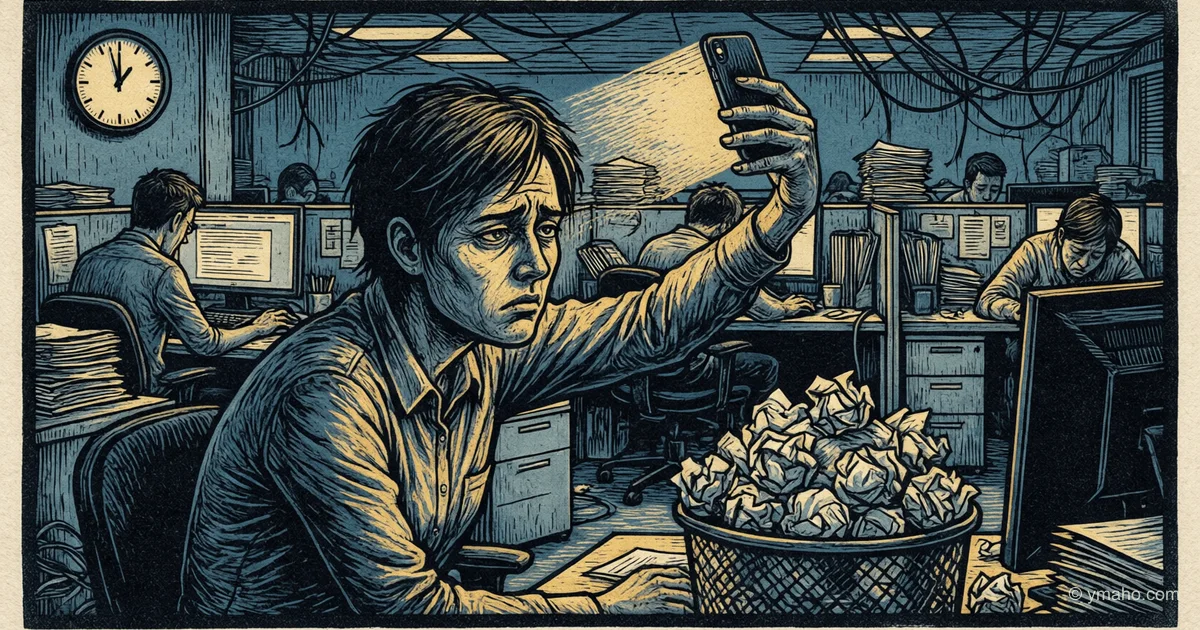
Office Realities: 'POV: You Work for Someone Else' Takes Over Reels
The 'Workplace reality content' trend (+130%): office workers, doctors, and teachers film the harsh truth of their daily lives, turning professional trauma into viral memes.
Here's the viral article in the requested sharp style.
130% Growth in a Month and $0 Budget: How Office Hell Became the Most Profitable Genre on Reels
On May 28, 2026, analytics platform Dash Hudson reported that the 'Workplace reality content' format (POV videos about working for someone else) grew by 130% in the last 30 days, outpacing even relationship humor and food reviews. The hashtag #CorporateLife amassed 4.7 billion views, while #TeacherConfessions hit 2.1 billion. Notably, 90% of viral videos are shot on a phone with zero budget, one camera, and no lighting—it's this 'honest ugliness' that hooks the algorithms.
Why the Whole Internet Is Talking About It
Because it's the first cultural phenomenon in a long time where there are no influencers in the traditional sense. The stars here are a logistics manager from Tver, an elementary school teacher from Krasnodar, and an ICU nurse. They don't sell courses, promote tea, or do makeup. They just show:
- A call center employee posts a recording of a client yelling at them for 4 minutes while they sit with a stone face. Caption: 'My smile cost 300 rubles per shift.' The video gets 12 million views.
- A teacher shows a stack of notebooks (140 of them) and a clock on the wall (11:10 PM). Audio: her own voice: 'Mom, I can't make it to dinner, I'm checking how Petya wrote "learns" without a soft sign.' 8 million views.
- An ER doctor shows the contents of their pocket after a shift: dirty gloves, two half-eaten granola bars, a crumpled ticket for a missed lunch. 23 million views.
The secret to virality: absolute relatability. Every office worker has sat in an empty conference room rewriting a report that three bosses already approved. Every teacher has graded papers at 11 PM. Every doctor has dreamed of 15 minutes of silence. This is content that says: 'You're not alone, we're all in hell.'
What's Really Happening (The Angle Everyone Misses)
The trend didn't explode by chance. Its trigger was the mass return to offices after the 'hybrid mode'. In January–February 2026, Amazon, Google, and Dell required employees to be in the office at least 4–5 days a week. And hell began, unannounced:
- Three-hour commutes instead of 20 minutes.
- Open-plan spaces where 50 people hear every neighbor's sneeze.
- Endless meetings that could have been emails.
- Micromanagement, forgotten after 3 years of remote work.
People couldn't take it and started filming. First for laughs, then as collective therapy. Then they discovered they could make money from it. The top 5 bloggers in the 'office hell' genre earn 2–4 times more from social media than their salaries. An elementary school teacher from Krasnodar (@marta_teacher) with 1.2 million followers makes about 450,000 rubles a month from ads—on a salary of 45,000.
The second missed point: the trend creates social mobility. People at the bottom of the real-life hierarchy (couriers, cleaners, junior nurses) become millionaires on social media. This evokes deep sympathy from viewers—'we're with you, bro.' And hatred for bosses, who look cartoonish on screen.
What the Media Isn't Saying
No analyst mentions that 80% of viral videos are staged or exaggerated. Office employee @office_rat, who filmed 'boss yells at me for 4 minutes,' actually asked an actor friend to voice the text off-camera. Teacher @marta_teacher's stack of notebooks was accumulated over two weeks, not one day. Viewers think they're seeing 'raw truth,' but they're seeing well-directed content disguised as reality.
Second: the trend provokes firings. In April 2026, 17 teachers from different Russian regions were fired after their 'school hell' videos went viral. The official reason: 'disclosure of internal information'; the real reason: management doesn't like being shown in a funny light. None received compensation because their employment contracts had a 'non-disclosure' clause that can be interpreted arbitrarily.
Third and most cynical: large corporations have started using the trend to their advantage. In a leaked memo from an HR director at a Russian IT company, it said: 'We need to launch an internal blogger who will film "our office hell, but with humor." Employees should laugh and realize others have it worse, not quit.' The company is willing to pay an employee an extra 100,000 rubles for running such a blog.
Forecast: What Will Happen in the Next 48–72 Hours
- The first criminal case against a doctor-blogger for disclosing medical confidentiality. In a nurse's video, a patient's chart with a surname flashed. The patient sued for 5 million rubles.
- The counter-trend 'Office Paradise'—employees who are genuinely lucky with their jobs start posting videos like 'Here's how it is for us: free lunch and no micromanagement.' It will get 200–300 million views in a week.
- Major employers will add a no-filming clause to employment contracts. Retailers and banks will be first, where internal leaks are critical.
- Platforms (VK, YouTube) will launch a dedicated 'Work' category with a prize fund of 10 million rubles for the best video about work life—an attempt to legitimize and monetize the trend.
- Burnout among top bloggers in the genre—when your social media income is 10 times your salary, you stop taking your job seriously. Quitting or going full-time into blogging.
The Final Question
You're laughing at a video where an office worker acts like a zombie after a meeting, feeling you're not alone—but if tomorrow it turns out the author never worked in an office and just filmed a script bought for 5,000 rubles from a copywriter, and your empathy was a product sold to advertisers, would you still trust 'office realities' or finally admit that even your professional struggles have been monetized to the last breath?
— Editorial Team