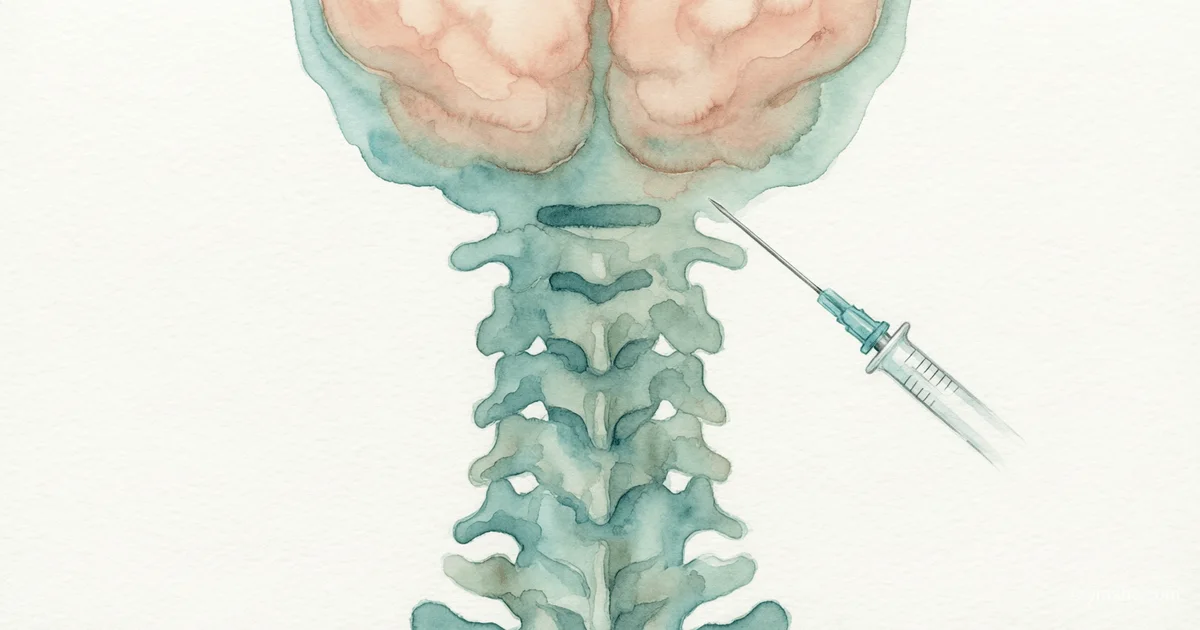
A New Perspective on Alzheimer's: Roche Tests Spinal Therapy
Pharmaceutical company Roche has initiated Phase 1 clinical trials of the drug RO7812653 for early-stage Alzheimer's disease. The innovation lies in direct injection into the cerebrospinal fluid, allowing precise delivery of molecules to the brain.
Insight: Why Roche is quietly burying antibodies and betting on gene weapons against ApoE while everyone watches ARIA
[The Gist]: What's Really Happening
In January 2026, Roche quietly launched Phase I of RO7812653—an antisense oligonucleotide (ASO) administered intrathecally (into the cerebrospinal fluid) for early symptomatic Alzheimer's disease. Headlines read "a new perspective on Alzheimer's." The reality: Roche is publicly admitting the failure of its antibody approach and making a move that will reshape the entire competitive landscape.
Why this matters. Roche has an anti-amyloid beta antibody, gantenerumab. In 2022, it failed two Phase III trials. It didn't work. Then they attached a "Brainshuttle" to it, creating trontinemab, which worked—amyloid cleared, ARIA lower than with lecanemab. Success? Partially. But trontinemab is still an antibody. Antibodies have a fundamental limitation: they don't treat the cause; they clean up the consequence (amyloid). And they don't work in ApoE4 carriers—the highest risk group.
What Roche did. They acquired from Ionis Pharmaceuticals an ASO targeting ApoE—the protein that is the strongest genetic risk factor for Alzheimer's disease. ApoE4 increases risk by 3-12 times. Instead of clearing amyloid, Roche decided to shut down the very mechanism that triggers its aggregation, neuroinflammation, and tau pathology. And they are doing this via intrathecal administration—directly into the CNS, bypassing the blood-brain barrier.
This is not evolution. It's a revolution. And it's happening right now, while everyone debates who has less ARIA—lecanemab or donanemab.
Timeline and Context
Target. RO7812653 (also known as RG6627) is an antisense oligonucleotide that selectively degrades apolipoprotein E (ApoE) mRNA. It targets all ApoE isoforms: E2, E3, and E4. The idea is to reduce ApoE production in the CNS without affecting peripheral tissues (where ApoE is needed for lipid metabolism).
Why ApoE? The scientific rationale is rock-solid:
- ApoE4 is the strongest genetic risk factor for AD
- ApoE protein accelerates amyloid and tau aggregation
- ApoE causes neuroinflammation via microglia
- In mouse models, a 50% reduction in ApoE decreases tau pathology and neurodegeneration
- In humans, rare loss-of-function mutations in ApoE protect against AD and tau pathology
Clinical Dates. Phase I started on January 27, 2026:
- 50 patients with early symptomatic Alzheimer's disease (MCI or mild dementia)
- Single intrathecal injection via lumbar puncture
- 5 dose cohorts versus placebo (3:1 randomization in first cohorts, 3:1 in remaining)
- Primary endpoints: safety, tolerability, suicidality (C-SSRS)
- Secondary endpoints: pharmacokinetics in plasma and CSF, anti-drug antibodies, ApoE protein levels in CSF (target: 50% reduction)
- Expected completion: April 2028
Locations. The first patient in the world was recruited at the National Hospital for Neurology and Neurosurgery in London by Professor Catherine Mummery. Other sites: Amsterdam (Brain Research Center), Glasgow, Southampton.
Who Wins and Who Loses
Winner #1: Ionis Pharmaceuticals. Ionis invented this ASO and licensed it to Roche. Deal terms are undisclosed, but standard Ionis contracts include an upfront payment ($25-50M), milestones ($200-500M), and royalties (low double-digit percentages). If RO7812653 reaches the market, Ionis will reap billions. Ionis already has commercial success with Spinraza (SMA) and Qalsody (ALS). The ApoE ASO could be their fourth blockbuster.
Winner #2: Patients with the ApoE4 genotype. About 25% of Europeans carry at least one E4 allele, and among AD patients, 60-70%. For them, existing antibodies (lecanemab, donanemab) work less effectively and cause more ARIA. An ASO against ApoE could theoretically be equally effective regardless of genotype because it reduces ApoE irrespective of isoform.
Winner #3: Roche—if it works. If Phase I shows safety and Phase II shows cognitive benefit, Roche will have a first-in-class therapy that attacks the cause, not the consequence. The AD therapy market is estimated at $15-20 billion by 2030. Even a 10% share is $1.5-2 billion. Plus, it shows Roche can innovate when it wants to.
Loser #1: Eisai and Biogen with lecanemab (Leqembi). Leqembi is an anti-amyloid antibody. It works, but:
- Requires intravenous infusions every 2 weeks
- Causes ARIA-E in 13% of patients
- Not approved in Europe (EMA rejected it in 2024)
- Costs $26,500 per year
If the ApoE ASO shows a single administration (Phase I uses one injection, but future boosters may be needed) and a better safety profile, Leqembi could become obsolete before recouping its R&D costs (Biogen already wrote off $6 billion on acquiring lecanemab rights).
Loser #2: Eli Lilly with donanemab. Same issues plus ARIA-E in 24%. And donanemab has a limited treatment window: it is stopped once amyloid is cleared, and it's unclear what to do next. The ApoE ASO is not "clear and stop" but "reduce and maintain."
Quiet Winner: Alnylam with ALN-5288 (ASO against tau). Alnylam launched Phase I of its intrathecal ASO against tau in October 2025. Is it a direct competitor? No, because targets differ: Roche hits ApoE (top of the cascade), Alnylam hits tau (closer to the end). If both ASOs work, they could be combined. But if only one works, the market goes to the winner.
What the Media Isn't Saying
Insight #1. Phase I will not provide efficacy data on cognitive function.
Primary endpoints are safety and tolerability. No cognitive scales (ADAS-Cog, CDR-SB) as primary outcomes. Patients will be followed for only 40 weeks. For Alzheimer's, where cognitive decline is measured in years, 40 weeks is nothing.
What this means: even if RO7812653 is completely safe, we won't know if it works for cognition until Phase II, which won't start before 2028-2029. And full Phase I results won't be seen until April 2028.
Insight #2. Risk of CRS and meningitis—the main hidden threat.
Intrathecally administered ASOs carry a known risk: aseptic meningitis and pro-inflammatory response. For nusinersen (Spinraza), post-lumbar puncture headache occurs in 40%, aseptic meningitis in 1-2%. For RO7812653, the same risks apply, plus unknown risks from reducing ApoE in the CNS.
ApoE is involved in lipid and cholesterol transport in the brain. Complete reduction could cause demyelination or impair synaptic plasticity. Preclinical studies in mice showed no issues, but mice are not humans. If serious neurological events (seizures, aseptic meningitis, brain edema) occur in Phase I, Roche will halt development. Then this "new perspective" becomes just another failure.
Insight #3. Why now and not 5 years ago? Answer: gantenerumab's failure and gene therapy's success.
Roche invested a decade in anti-amyloid antibodies. In 2009, they acquired gantenerumab from MorphoSys. In 2022, it failed. They had no Plan B. But in 2023-2024, two things happened:
- Success of Qalsody (tofersen) from Biogen/Ionis—an ASO against SOD1 for ALS, FDA-approved in April 2023. It showed that intrathecal ASOs can be safe and effective.
- Publication of data on protective loss-of-function ApoE mutations in 2024—rare ApoE variants that reduce its function do not cause cognitive issues but protect against AD.
Roche looked at this data and said, "We lost the antibody race, but we can win the ASO race." And they are right. While Eisai and Eli Lilly divide the amyloid-clearing antibody market, Roche is preparing a therapy that makes amyloid irrelevant.
Insight #4. Intrathecal administration—a barrier to widespread use.
Lumbar puncture is not an intravenous infusion. It requires skilled personnel, sterile conditions, and 10-20% of patients develop post-dural puncture headache. In Phase I, patients are hospitalized 24 hours before injection and monitored for 24 hours after.
Even if the ASO is safe, scaling to thousands of patients will be challenging. Unlike antibodies that can be administered in infusion centers, intrathecal injections require specialized neurology departments. This will limit access and increase cost.
Roche knows this. Their bet is that a single administration (or rare boosters) will outweigh the inconvenience of lumbar puncture. But it's a gamble.
Forecast: Next 30 Days and 90 Days
30 Days (June 2026):
- Recruitment of the first cohorts will be completed. By June 2026, the first 10-15 patients should have received the dose. Safety is the main question. If even one case of aseptic meningitis or seizure occurs, Roche's stock could drop 3-5%.
- Roche will publish an update on the trontinemab Phase III. Not to be confused: trontinemab (antibody with shuttle) is a different asset. But Roche uses it as a "proof of concept" for its CNS delivery. If trontinemab shows good safety data in Phase III (expected start in 2026), it will boost confidence in RO7812653.
- Ionis will receive another milestone from Roche (likely $25-50M) for completing the first cohort enrollment. This will be reflected in Ionis's quarterly report in July.
90 Days (August 2026):
- First pharmacodynamic data will be published—ApoE reduction in CSF from the first patients. If reduction reaches 50% or more, it will be a strong positive signal. If reduction is less than 30%, the dose will need to be increased, potentially compromising safety.
- Competitive pressure from Alnylam. ALN-5288 (ASO against tau) is also in Phase I, and they may publish initial data at the CTAD (Clinical Trials on Alzheimer's Disease) conference in October. If their safety data is better, investors may shift focus from ApoE to tau.
- EMA may grant RO7812653 PRIME status (priority medicine). This would accelerate the regulatory pathway. A decision is expected in Q3 2026. If PRIME is granted, it signals EMA believes in the mechanism.
Main risk over 12-18 months: Recruitment failure. Phase I needs 50 patients, but intrathecal injections scare patients and their families. If recruitment drags, Phase I completion will shift from April 2028 to 2029. And each year of delay is a year for Leqembi and donanemab to capture the market. Roche is playing the long game, but long-term strategy comes at a price: short-term losses.
But now, in May 2026, Roche has done what no one expected: they abandoned the amyloid paradigm and went after the genetic root cause. It's either genius or madness. In the Alzheimer's field, the line between them has always been thin.
— Editorial Team