Iran's Supreme Leader Says Gulf States Will No Longer Be a Shield for US Bases
Ayatollah Khamenei, in a written message on the occasion of Hajj, emphasized that the region will no longer allow its territory to be used as cover for American military installations.
Khamenei's Statement on Gulf States: What's Really Behind the 'Shield' Threat
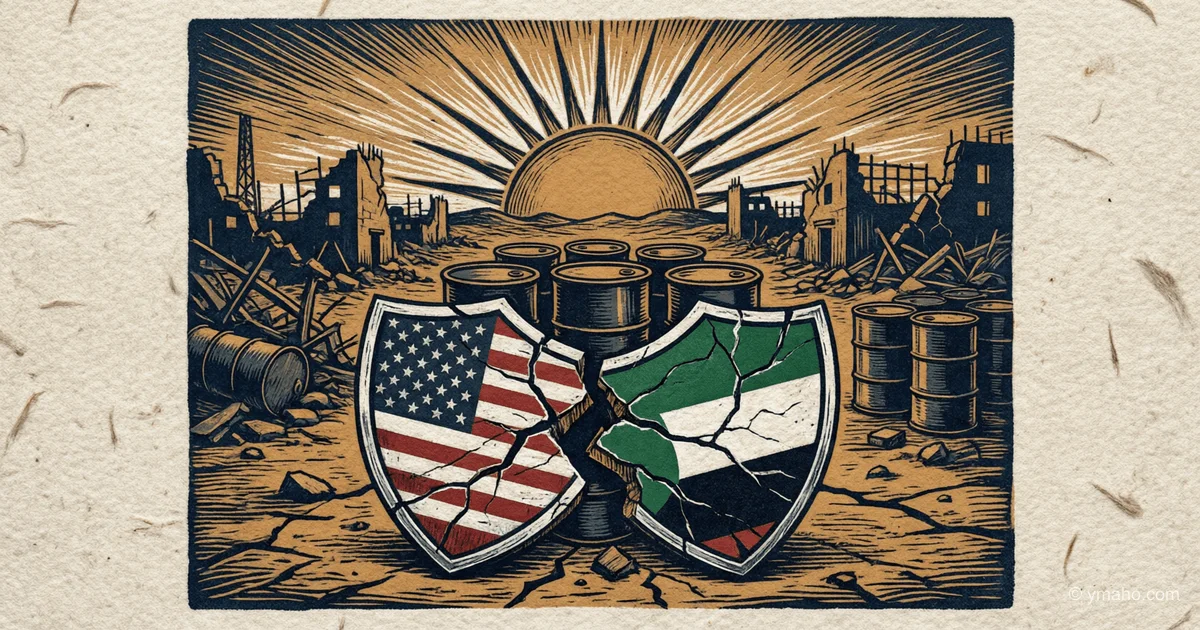
When Iran's Supreme Leader Mojtaba Khamenei declares that Gulf states will 'no longer serve as shields for American bases,' financial markets should hear not so much a military threat as a signal of a structural shift in the regional security architecture. Mainstream media interpret this as another round of rhetoric. But within the industry, we see something else: it is a direct call to action for revising investment models in the Gulf Cooperation Council (GCC) countries, especially in real estate and sovereign wealth funds. Trillions of dollars are at stake.
[The Gist]: What's Really Happening
Khamenei is not just threatening. He is officially moving the conflict to a new level: rejecting the concept of 'depth' (strategic rear). Until now, the Arab monarchies of the Gulf have de facto served as a safe hub for Pentagon logistics. Now Iran declares that any US ally automatically becomes a military target, and Khamenei explicitly says the US will 'no longer have a safe haven' in the region.
For markets, this means the geopolitical risk premium, which was previously 'regional' (only concerning the Strait), is now becoming 'country-specific' (country risk for each monarchy). Oman, Kuwait, Qatar, and the UAE can no longer rely on their sovereignty as protection from collateral damage.
Timeline and Context
The statement during Hajj is not a coincidence but a traditional timing for ideological messages. But the context is critically important:
- The formal truce is not working. Despite diplomatic contacts with Washington, exchanges of strikes continue. Khamenei is giving a 'green light' to proxy forces to attack targets inside US-allied countries.
- Escalation has already occurred. Earlier, since late February, Iran had already struck Saudi Arabia, the UAE, and Kuwait. The current statement legitimizes these actions as 'policy' rather than 'excesses.'
- GCC reaction. Markets have already reacted to the previous strikes: Dubai developers lost 13-17% of their capitalization in one week in March. Now Khamenei says that was just the beginning.
Who Wins and Who Loses
Winners:
- Oman and (temporarily) Qatar. Oman traditionally acts as a neutral mediator and avoids hosting large US offensive bases. Qatar, home to CENTCOM headquarters (Al Udeid), is now under pressure—their 'shield' status makes them a target.
- Insurers (Lloyd's, Swiss Re). Insurance premiums for real estate and infrastructure in Dubai, Abu Dhabi, and Doha will skyrocket. Moody's has already warned: a 20% drop in asset values would hit GCC insurers' capital by 7%. This creates a vicious cycle: insurance gets more expensive → construction stalls → GDP falls.
Losers:
- GCC sovereign wealth funds (PIF, ADIA, QIA). They are caught between a rock and a hard place. On one hand, Western partners (US, EU) demand they distance themselves from Russia and China. On the other, Iran threatens their physical assets at home. According to Caixin, three of the four largest GCC economies (excluding the UAE, which has declared stability) are reviewing multi-trillion-dollar investment portfolios, considering capital repatriation or abandoning sponsorship contracts in the West.
- Dubai real estate funds. Diaspora capital (including Iranian) continues to buy physical real estate as a 'safe haven.' But institutional investors are pulling money out of developer stocks. This divergence signals extreme nervousness among 'smart money.'
What the Media Isn't Saying
Insight #1 — 'Generational change and succession risks.'
Note: the threat comes from Mojtaba Khamenei, not the military. He is preparing to succeed his father (Ali Khamenei) as Supreme Leader. This statement is a signal to the West: even after a change of power in Tehran, the course of pushing the US out of the Gulf will continue, and possibly intensify. Markets are pricing in 'peace dividends' from generational change—that is a mistake. Mojtaba is more hawkish on foreign policy.
Insight #2 — 'US withdrawal = GCC economic collapse.'
The US will not leave Qatar or Bahrain voluntarily. But Khamenei strikes at the weakest point of the allies—tourism and logistics. If investors believe the Emirates and Saudi Arabia are a 'frontline zone' rather than a 'safe hub,' the flow of foreign direct investment (FDI) will collapse. Allianz forecast: closing the Strait of Hormuz for 6 weeks would reduce UAE GDP by 3.3 percentage points. Khamenei's statement increases the likelihood that those 6 weeks will come.
Forecast: Next 30 Days and 90 Days
30 days: Expect renewed missile or drone attacks on targets in the UAE and Kuwait. These will not be strikes on downtown Dubai (that would be suicidal), but strikes on logistics hubs or less protected ADNOC facilities or Ali Al Salem Air Base. The Dubai real estate index (DFMGI Real Estate) could lose another 5-10% from current levels, even despite high oil prices.
90 days: If Khamenei's threats materialize, GCC countries will be forced to declare 'neutrality' while maintaining military contracts with the US. This will lead to the collapse of the united Arab front against Iran. Sovereign wealth funds will begin massively converting dollar reserves into gold and yuan (despite secondary sanctions risks), diversifying away from US assets.
Editorial Forecast
Asset: UAE real estate ETF (e.g., iShares MSCI UAE). Direction — down in the next 72 hours. Khamenei's rhetoric removes the 'safety premium' from Dubai developer valuations. Target decline: 3-5% from current prices. Key level: a break of the March 2026 support (17% drop) is not far off. Confidence level — medium (60%). Main risk: an immediate US-Iran nuclear deal would render Khamenei's threats moot, and GCC markets would surge 10% on 'relief.'
— Editorial Team