US Military Strikes Back at Iranian Drones and Ground Station
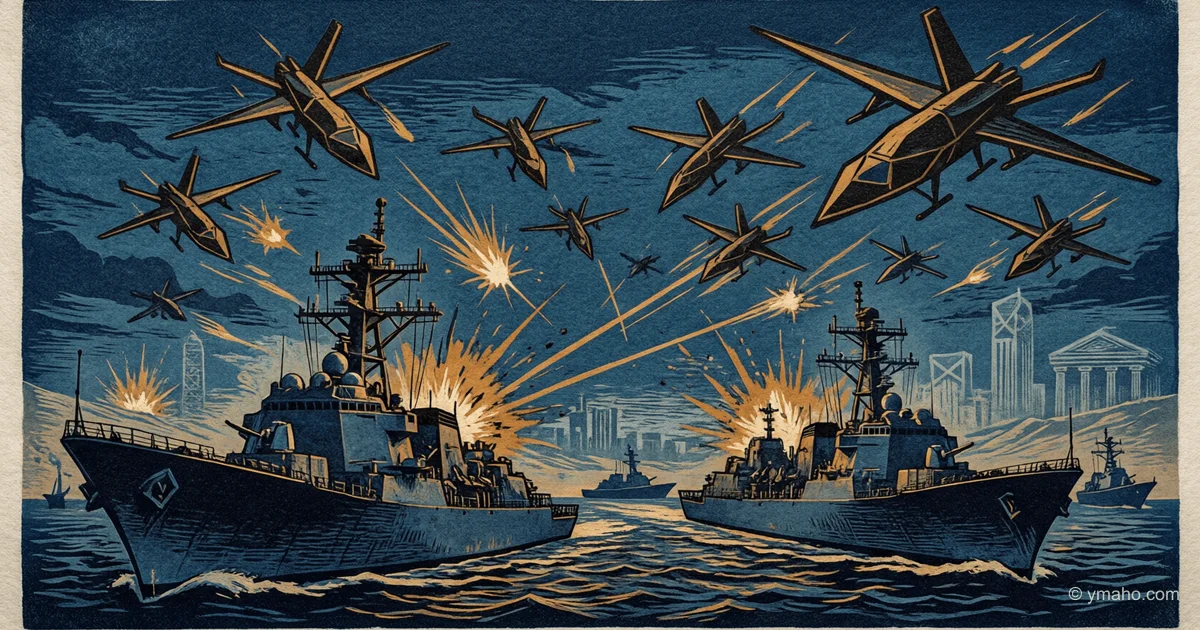
The Pentagon shot down four IRGC drones and attacked a control station in Bandar Abbas after a warning shot incident in the Strait of Hormuz.
US and Iran Retaliatory Strikes: Fragile Ceasefire and a Hidden Bet on the Defense Sector
The Pentagon's announcement that it shot down four Iranian drones and struck a ground control station in Bandar Abbas came as no surprise to those tracking the conflict in real time. What matters more is that both this attack and the subsequent IRGC strike on a US airbase occurred under a formally active ceasefire.
For financial markets, this means a new, highly toxic scenario—war without war. The sides exchange blows but refuse to acknowledge a breach of the April ceasefire. And it is this illusion of "managed escalation" that is more dangerous than any full-scale war, because markets cannot price what officially does not exist.
[The Core]: What's Really Happening
The Pentagon describes its actions as "measured, purely defensive, and aimed at maintaining the ceasefire regime." The target was a ground control station in Bandar Abbas that, according to US intelligence, was preparing to launch a fifth drone. Meanwhile, the Iranian Navy claims it forced a US tanker to turn back after it tried to transit the strait with its radar system off.
However, the essence of what happened lies not in the specific targets but in the new tactics. The US no longer waits for Iranian drones or boats to cause damage. They have shifted to preemptive strikes on control infrastructure—the "blind spot" of the Iranian system. Destroying the drone preparation station in Bandar Abbas undermines Iran's ability to conduct coordinated attacks in the strait without killing Iranian operators (which could be a casus belli for Tehran).
The IRGC, in turn, claimed a retaliatory strike on a US airbase, and Kuwait—home to the major US base Ali Al Salem—confirmed it was repelling missile and drone attacks. Neither Washington nor Tehran officially exits the ceasefire, but both sides are engaged in combat.
Timeline and Context
The conflict, which began on February 28, 2026, with US and Israeli strikes on Iran, had reached a stalemate by early April. The ceasefire brokered by Pakistan on April 8 and later extended indefinitely by Donald Trump did not stop incidents.
- May 25, 2026: The US struck Iranian boats laying mines and missile launchers.
- May 27, 2026: Secretary of State Marco Rubio said there was a good chance for a temporary nuclear deal with Iran. The same day, Trump at a cabinet meeting publicly denied Iranian TV reports of a draft agreement on the Strait of Hormuz, threatening Oman: "These are international waters, and Oman will behave like everyone else, or we'll have to blow them up."
- May 28, 2026, 01:30 local time: Explosions east of Bandar Abbas, air defense systems activated.
- May 28, 2026, around 04:50: The IRGC claims a strike on the US airbase from which, according to them, the attack was launched.
Key point: all this happens amid ongoing negotiations. Iran does not abandon its demands on uranium enrichment, control of the strait, and sanctions relief. The US is unwilling to concede on any point. As a result, diplomacy coexists with military action—a rare and extremely dangerous situation.
Who Wins and Who Loses
Winners:
- Defense contractor stocks. An indirect but direct beneficiary. The conflict has entered a phase of "high-intensity local skirmishes" where air defense systems, electronic warfare, and missile defense play a key role. Lockheed Martin, RTX (formerly Raytheon), and Northrop Grumman secure contracts to replenish expended munitions—interceptor missiles, HARM anti-radiation missiles, precision-guided munitions. The US defense budget for FY2027, currently debated in Congress, will likely receive additional funding.
- Oil volatility traders. Each new exchange of blows adds 3-5% to Brent. Meanwhile, the market has stopped reacting to individual incidents as "black swans" and has begun pricing in the systematic nature of escalation.
Losers:
- Gulf states hosting US bases. Kuwait has already confirmed it was attacked. Qatar, Bahrain, and the UAE realize that the next escalation could turn their territory into a battlefield between the US and Iran. The risk to their sovereign credit ratings and sovereign debt insurance costs rises daily.
- Container shipping operators in the Indian Ocean. Routes around Africa have already become standard for oil tankers. Now the same trend is hitting container shipping, driving up global logistics costs and accelerating inflation in Europe.
What the Media Isn't Saying
Insight #1 — "Kuwait as a New Theater of Operations."
All attention is on the Strait of Hormuz and Bandar Abbas. But the IRGC statement and Kuwait's confirmation hide a key signal: Iranian missiles and drones can reach US assets deep inside allied territory. Ali Al Salem Air Base in Kuwait is the largest US Air Force hub in the region after the withdrawal from Iraq and Syria.
If Iran demonstrates the ability to strike targets in Kuwait, it changes the US force deployment strategy across the Persian Gulf. The consequence will be either a relocation of aircraft to more distant bases (e.g., Oman or aircraft carriers in the Arabian Sea), reducing response time, or a significant buildup of THAAD and Patriot systems around each base. Each such system costs over $1 billion, and these funds are already in Pentagon budget requests for the coming quarters.
Insight #2 — "The Ceasefire No Longer Protects Markets."
The key thesis that markets refuse to accept: the concept of a "ceasefire" has been devalued. If on April 8, 2026, the ceasefire indeed led to lower oil prices and a reduction in risk premium, now the ceasefire is merely a legal fiction. Both the US and Iran launch strikes but call them "defensive" to technically avoid violating the agreement.
For traders, this means the indicator "ceasefire in effect—risks declining" no longer works. Escalation has become a continuous process, not discrete events. Paradoxically, this may keep oil prices above $95 per barrel even without new headline-grabbing incidents—simply because the market has stopped believing in the possibility of de-escalation.
Forecast: Next 30 Days and 90 Days
30 days: Expect continued exchanges of blows at a frequency of 2-3 episodes per week. A new factor will be Kuwait's reaction—if Kuwait City officially requests additional air defense systems from the US, it will signal that the threat is taken seriously. Brent oil will consolidate in the $96-104 range, with short-term spikes of 5-7% after each confirmed strike. Gold (XAU/USD) will hold above $2,450, acting as the only "pure" hedge against escalation.
90 days: By the end of summer, Iran will likely attempt a massive rather than pinpoint attack to test the limits of US tolerance for losses. The target could be not a military base but critical infrastructure—for example, UAE oil terminals. If the US responds in full scale (including strikes on Iranian territory beyond the coastal zone), the ceasefire will officially collapse. In this scenario, Brent will surge to $120-130 per barrel, and stock market volatility will reach March 2020 levels.
Editorial Forecast
Asset: Gold (XAU/USD). Direction—up in the next 48 hours. The exchange of strikes between the US and Iran amid a formally active ceasefire creates a "perfect storm" of uncertainty—markets can price neither peace nor full-scale war. Key levels: resistance at $2,475, support at $2,450 (a break below would require real peace signals). Confidence level—medium (65%). Main risk: a sudden resumption of talks mediated by Qatar with concrete US concessions, which could push gold back to $2,420.
— Editorial Team