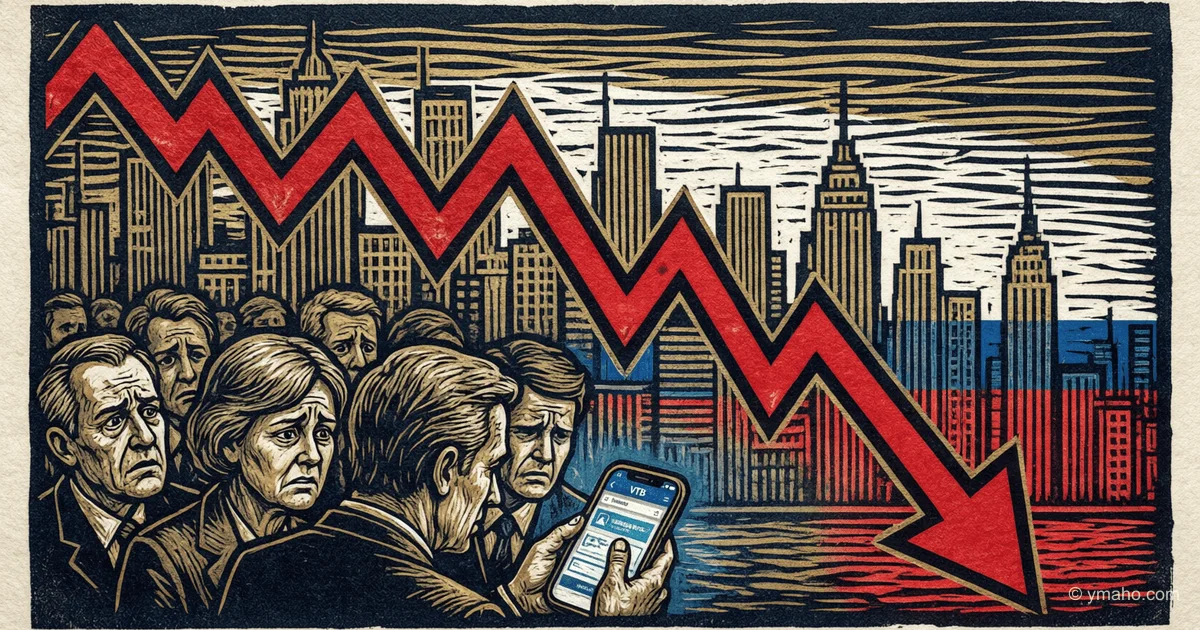
VTB Shares Plunge 8.5% After Dividend News and Additional Share Issue
VTB's Supervisory Board recommended a dividend of 9.71 rubles per share, but also announced an additional share issue worth 49% of current capital. This caused shares to fall over 8.5% on fears of minority shareholder dilution.
Headline: VTB's 8.5% Plunge: Why the Market Punished the Bank for 'Wild Berries'
Author: Independent Financial Analyst (Insider Perspective)
[The Gist]: What's Really Happening
On May 26, 2026, VTB's Supervisory Board made two announcements that turned the bank's shares 180 degrees in one day. In the morning, shares rose 8% on dividend expectations, but by evening they crashed 8.43% to 79.34 rubles. The formal reason: a dividend of 9.71 rubles per share (yield 12.1%) was half of market expectations, and an additional share issue of 49% of capital diluted minority stakes.
But the real story isn't in the numbers. The crux is that VTB broke two key promises made to investors just three months earlier. In February 2026, bank management explicitly stated there would be no additional share issue, and that minority shareholders would be the main beneficiaries of the conversion of preferred shares. The market believed them—and VTB shares rose 35% since the start of the year.
Then on May 26, the bank not only announced an additional share issue, but the largest in its history—up to 6.3 billion shares, or 49% of current capital. This is the seventh additional issue since 2007 and the fourth since 2022. According to Forbes, previous issues diluted the stakes of VTB's first investors by 12.6 times. History repeats itself.
Timeline and Context
February 20, 2026. VTB management meets with minority shareholders and publicly states that the bank will not conduct an additional share issue after converting the state's preferred shares into common stock. Moreover, they emphasize: 'This benefits minority shareholders, who should become the main beneficiaries of this procedure, as their stakes will not be diluted.' The market breathes a sigh of relief. Shares rise.
April 2026. VTB First Deputy Chairman Dmitry Pianov says in an interview that the bank does not plan an additional share issue 'to increase capital adequacy.' But he makes an important caveat that many miss: 'does not plan for capital.' For investment projects—sure.
May 26, 2026 — morning. The Supervisory Board meets. Rumors of dividends push shares up 8% in early trading.
May 26, 2026 — afternoon. Official announcement: dividend of 9.71 rubles per share, totaling 125.5 billion rubles, which is only 25% of IFRS net profit for 2025. A year earlier, the bank paid 50% (nearly 275 billion rubles). The market expected at least 35%.
And then—the knockout blow: an additional share issue of up to 49% of capital at 87 rubles per share. The funds will go toward a partnership with the RWB group—the combined company of Wildberries and Russ.
Reaction is immediate. By market close, shares fall 8.43%. Over two days, VTB's market cap shrinks by 129 billion rubles.
May 27, 2026 — morning. The decline continues: shares hit a low of 75.5 rubles, 20% below the year's peak. Pianov offers explanations: the dividend is a 'compromise' with the Central Bank, the additional issue is for development and is 'not dilutive' but 'value-creating.' The market doesn't buy it.
June 30, 2026. The annual shareholders' meeting will approve (or not) both decisions. The record date for dividends is July 20, 2026.
Who Wins and Who Loses
The losers are obvious: VTB minority shareholders. They face a double blow. First, a 12% dividend instead of the expected 17-25%. Second, a 33% dilution of their stake (if the full 49% of capital is placed). According to KIT Finance estimates, each existing minority shareholder could lose a third of their stake.
But there is also a less obvious loser: retail investors who bought VTB shares in January-February 2026 on promises of 'no additional issues.' Their average entry price is around 88-90 rubles. Now they are down 12-17%, and the 9.71 ruble dividend (yielding 12% from the current price) does not compensate for capital losses.
Winners: The state. After the additional issue, its stake will remain above 50%. But more importantly, the bank will gain access to 80 million Wildberries customers. This is the main 'gold' of the deal, according to Pianov. For comparison, VTB's own client base is 31 million. The merger gives 111 million unique users—the largest ecosystem in Russia after Sber.
Also winning is Wildberries. The company gets ready-made banking infrastructure: retail branches, ATM network, credit and investment products. And for free—using money VTB raises from the market through the additional issue.
And the third winner is the pool of anchor institutional investors ready to buy the additional issue at 87 rubles. The price is above the market at the time of announcement (87 vs. 79-80 rubles)—not a mistake. It's a signal: big players believe in the deal and are willing to pay a premium. Retail investors, who cannot participate in the SPO, are left behind with diluted stakes.
What the Media Isn't Saying
First and foremost: the real reason for the additional issue is not Wildberries, but VTB's 'capital hole' in 2027-2028.
Analysts at KIT Finance and SharesPro founder Denis Astafiev say outright: 'Most likely, the Wildberries partnership is a convenient pretext to justify the scale, while the real goal is to systematically close the capital hole.'
Look at the numbers. As of April 1, 2026, VTB's capital adequacy ratio (N20.0) was 10.7%, with a regulatory minimum of 10%. That's a buffer of only 0.7 percentage points—less than comfortable. If the bank had paid 50% of profit as dividends (like last year), the ratio would have fallen to 10.3%. And with the Central Bank tightening requirements in 2027-2028, the bank needs up to 700 billion rubles in additional capital, according to Andrey Kostin.
The Wildberries partnership requires money (estimated at 273.5 billion rubles—more than half of the additional issue limit). The rest will go to capital. So the deal is not an investment in growth, but a way to simultaneously acquire an asset and meet capital requirements.
Second point often missed: the history of minority dilution at VTB is systemic, not accidental.
Since 2007, when VTB conducted its people's IPO at 13 kopecks per share, there have been seven additional issues. Each time, management explained it as necessary for development. Each time, minority shareholders lost stake. Now, if the full 49% is placed, the minority stake will shrink from the current ~49% (with the state holding just over 50%) to ~33%. That means an investor who bought VTB shares at the IPO has lost more than 12 times their stake over 19 years.
And third insight: the 12% dividend yield is a trap.
Yes, 9.71 rubles per share gives 12.2% at the current price of 79.5 rubles. But the record date is July 20. And the additional issue will take place 'early autumn.' Minority shareholders will receive dividends, then 1-2 months later their stake will be diluted. Effectively, they finance the deal with their own money: get 12% dividends, lose 33% of stake. Net loss.
Forecast: Next 30 Days and 90 Days
30 days: Until the annual shareholders' meeting on June 30, VTB shares will trade in the range of 75-85 rubles. Volatility will remain high. The key factor is whether alternative buyers for the additional issue emerge besides the state and anchor investors. If not, pressure on shares will persist. The dividend gap after the ex-date on July 20 could be 5-7%, but will close quickly if the additional issue hasn't started.
90 days: By September-October, when the SPO takes place, shares may stabilize around 82-88 rubles—close to the placement price of 87 rubles. This is not 'growth,' but mechanical support from the placement organizers. The long-term driver is the success of the Wildberries integration. If synergy yields 30% ROE, as management promises, shares could return to 95-100 rubles by year-end. If not, the next target is 70-72 rubles.
Editorial Forecast
Based on current data, we believe that in the next 24–72 hours, VTB shares will move sideways with an attempted bounce in the range of 78-82 rubles. Key support is 75.5 rubles (May 27 low), resistance is 84 rubles (level before dividend announcement). Confidence level is medium, as discussions on social media and in the press could amplify panic selling among retail investors. The main risk: if any major minority shareholder (e.g., funds) begins publicly criticizing the deal, it could trigger a second wave of decline to 72-73 rubles. This is the editorial opinion, not an investment recommendation.
— Editorial Team