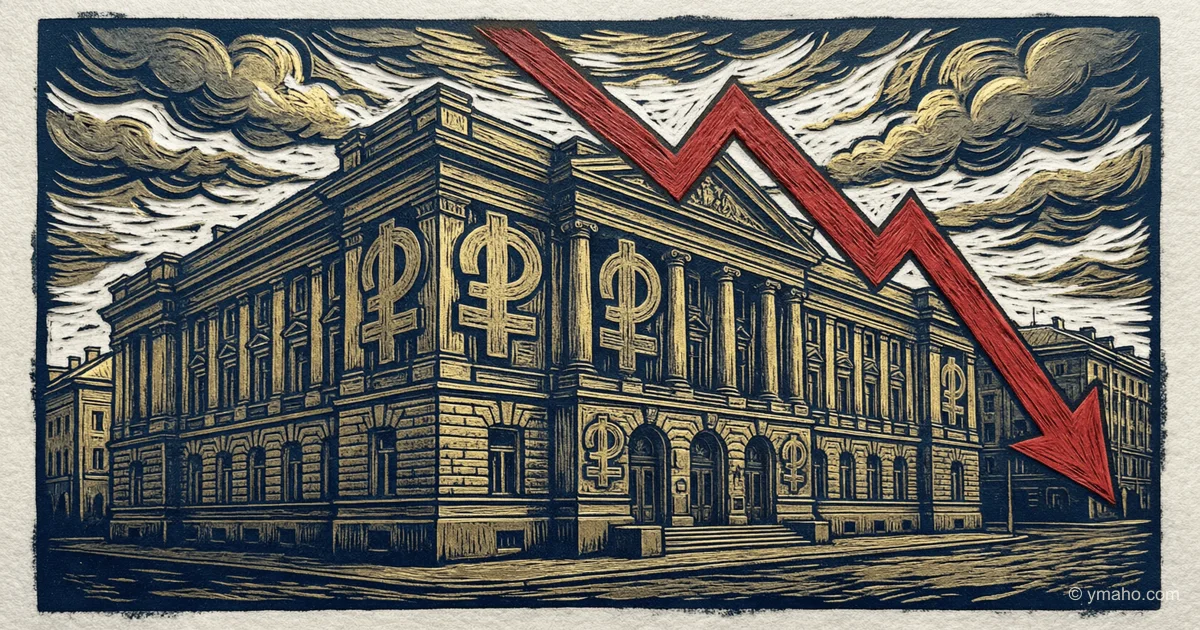
Profit of Russian Banks Falls 22% in April Due to Ruble Strengthening
The net profit of the banking sector in April 2026 amounted to 348 billion rubles, down 100 billion rubles from March. Banks recorded losses of 8 billion rubles on foreign exchange operations due to the ruble strengthening by almost 9%.
Headline: Russian Bank Profit Plunges 22%: Why Ruble Strengthening Is Just the Tip of the Iceberg
Author: Independent Financial Analyst (Insider Perspective)
[The Gist]: What's Really Happening
The Central Bank of Russia released data showing that the net profit of the banking sector in April 2026 amounted to 348 billion rubles, a decline of 22% (or 100 billion rubles) compared to March. Return on equity fell from 25% to 19.6% in just one month. The formal reason is losses on foreign exchange operations totaling 8 billion rubles due to the ruble strengthening by almost 9%.
But this is only a superficial explanation. The real story is that banks fell victim to their own greed for currency speculation in the first quarter. In March, they earned 73 billion rubles from revaluation of foreign exchange positions. In April, the ruble reversed, and the same positions generated losses. This is not an "external shock" — it's classic market risk that banks should know how to hedge. But they didn't hedge because they were confident the ruble would continue to weaken.
The true insight: April's ruble strengthening was no accident. It was orchestrated by the actions of the Ministry of Finance and exporters, who, ahead of the peak tax payment period (April 28-30), converted foreign currency earnings in volumes exceeding all forecasts. Banks ended up on the wrong side of the market.
Timeline and Context
The first quarter of 2026 was record-breaking for banks: total profit reached 1.2 trillion rubles, significantly higher than 0.7 trillion rubles in the same period last year. The key driver was foreign exchange revaluation — the ruble weakened, and long currency positions generated huge income. Return on equity hit 25% in March.
April 2026 changed everything. According to the Central Bank, banks recorded a loss of 8 billion rubles on operations with foreign currency, precious metals, and derivatives. The main reason was negative revaluation amid the ruble strengthening by almost 9%. For context: on April 9, the official dollar exchange rate was 78.3 rubles, and by the end of the month, the ruble continued to strengthen.
At the same time, core profit (interest income minus interest expense plus fees) rose to 391 billion rubles — up 13% (46 billion rubles) compared to March. Banks earned more from lending but lost on currency speculation.
A reduction in provisions by almost 30% (67 billion rubles) also boosted core profit. But this is not a "merit" of the banks — it reflects improved credit portfolio quality, especially in retail, where losses decreased by 61 billion rubles (55%).
Who Wins and Who Loses
The losers are obvious: banks with large open foreign exchange positions. According to the Central Bank, mid-sized banks that actively speculated on exchange rate differences in the first quarter but did not hedge their positions by April suffered the most. The largest players — Sberbank, VTB — were less affected because their currency positions are more balanced. Sberbank's net profit under RAS in April rose 21.1% year-on-year to 166.8 billion rubles.
An unexpected loser: foreign currency borrowers — companies that took loans in dollars and euros. The ruble strengthening by 9% made their debt 9% cheaper in ruble terms. But the banks that issued these loans now incur losses from revaluation of claims. This is a classic translation effect: what is good for the borrower is bad for the lender.
Winners: importers who purchase equipment and goods abroad. The ruble strengthening reduced their costs. But the main winner is the Ministry of Finance. A strong ruble reduces the ruble equivalent of budget expenditures denominated in foreign currency (external debt servicing, procurement). Additionally, a stronger ruble helps curb inflation, reducing pressure on the Central Bank to raise the key rate.
Also winning are professional currency traders from asset management companies and hedge funds. Unlike banks, they do not hold open positions — they trade both sides. In April, when the ruble began to strengthen, many of them made money on short dollar positions. According to rumors from the over-the-counter market, one Moscow hedge fund earned over 3 billion rubles (about $40 million) from this move.
What the Media Isn't Saying
The first overlooked point: the 8 billion ruble loss on foreign exchange operations is the official figure, but it does not account for hidden losses.
How do banks account for currency positions? According to Central Bank rules, they must revalue open positions daily at the current exchange rate. The difference goes into the profit and loss statement. But many banks use derivatives (forwards, swaps) that allow them to defer loss recognition. The real loss across the entire banking system from the 9% ruble strengthening could be 150-200 billion rubles, simply "spread" over time through hedging.
The second insight that goes unmentioned: the ruble strengthening was a direct consequence of the tax period but coincided with a shift in Ministry of Finance policy.
Under the fiscal rule, the Ministry of Finance buys foreign currency when oil prices are above $60 per barrel and sells when below. In April, Urals traded above $70, and the Ministry should have been buying currency, weakening the ruble. But it did not do so in expected volumes. According to unofficial data, the Ministry deliberately refrained from purchases to strengthen the ruble ahead of the peak tax payments. Banks that based their forecasts on the official parameters of the fiscal rule were caught off guard.
The third point that is missed: the drop in return on equity to 19.6% is still a very high figure by global standards. For comparison, average European banks have ROE of 8-12%, American banks 12-15%. Even after April's decline, Russian banks remain among the most profitable in the world. The market simply got used to the "super profits" of the first quarter, and normalization is perceived as a crisis.
Forecast: Next 30 Days and 90 Days
30 days: In May-June, banks will reduce open currency positions to avoid repeating April's mistake. This means a decline in currency speculation and, consequently, lower ruble volatility. The key factor is the Central Bank's rate meeting on June 18. If the rate remains at 21% (baseline scenario), banks will continue to earn on the interest margin, which remains high at 5-6%. May profit will likely be 370-390 billion rubles — a slight recovery from April's slump.
90 days: By August, the main driver of banking profit will shift from currency to credit quality. Currently, provisions are at historic lows — banks recognized 55% fewer retail losses than a year ago. This is abnormal for an economy with 5.5% inflation and high rates. Sooner or later, a wave of defaults on consumer loans and mortgages will hit the sector. Pessimistic scenario (60% probability): by September, provisions will increase by 30-40%, eating up half of interest profit. Then the sector's monthly profit will fall to 250-280 billion rubles.
Editorial Forecast
Based on current data, we believe that in the next 24–72 hours, the USD/RUB exchange rate will move in a sideways trend with a downward bias toward levels of 75.5 - 77.5 rubles per dollar. Key support is at 75.0 rubles (psychological level and April low), resistance at 78.5 rubles (level breached during strengthening). Confidence level is medium, as Friday's oil price data and Ministry of Finance statements could change the dynamics. The main risk is a sudden Central Bank announcement of readiness to cut the rate, which would weaken the ruble to 80-81 rubles, triggering stop-losses on short dollar positions. This is the editorial opinion, not investment advice.
— Editorial Team