New TikTok Trend: 'Shocked Face' and the Aesthetics of Chaos
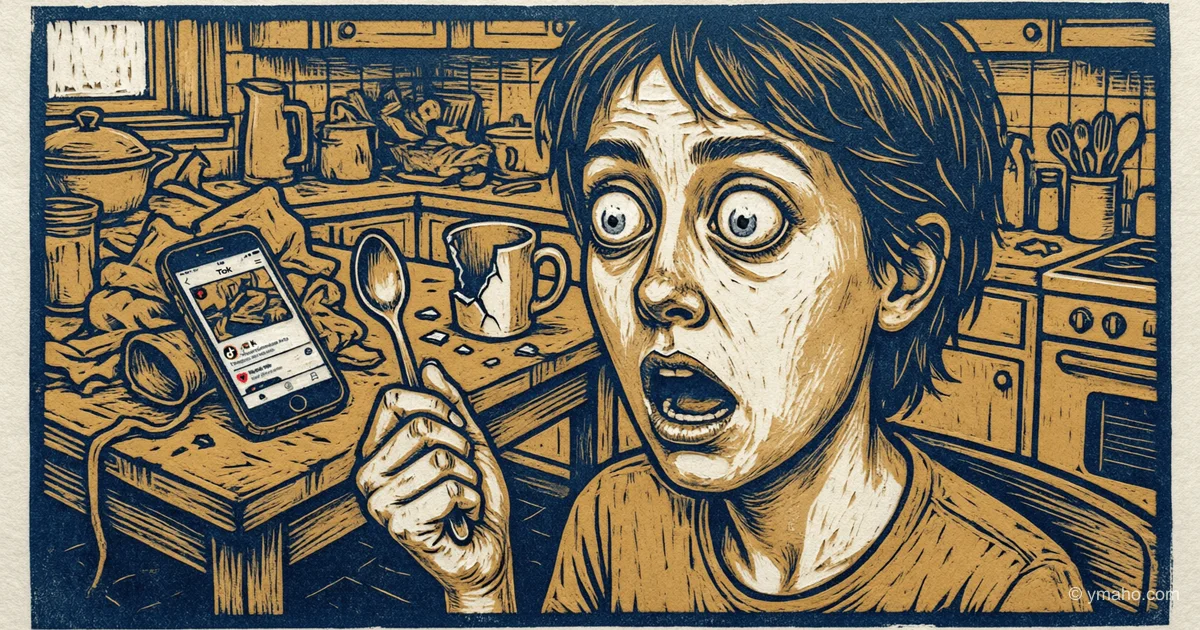
The meme with an ultra-exaggerated expression of shock (bulging eyes, dropped jaw) has become the dominant reaction template. Users compete to create the most absurd situations that trigger this 'shock,' leading to millions of views for reels with the sudden madness effect.
On May 20, 2026, TikToker @cursed_emotions posted a 7-second clip: he's sitting at a table eating soup, his girlfriend says, 'I broke your favorite mug.' His face transforms in 0.5 seconds: eyes bulge out of their sockets, jaw drops to collarbone level, eyebrows disappear under his bangs. The clip got 210 million views in 4 days. On May 26, the hashtag #ShockedFaceChallenge became the global #1 trend with 3.7 billion total views.
By May 27, there were 18+ million videos on TikTok using this template. Creators compete: who can come up with the most absurd reason for 'ultra-shock.' Options: 'saw there's no yogurt in the fridge,' 'heard the series got renewed for 2 seasons,' 'noticed the like button clicked itself.' The more trivial the reason, the higher the views.
Why the Whole Internet Is Talking About It
Because it's the perfect meme for 2026: absolute mismatch between reaction and event.
In an era when the world is literally going to hell (wars, AI taking jobs, climate change, economic turmoil), TikTok has created a space where 'shock' is triggered by a missing yogurt. It works as collective therapy: we laugh at exaggerated reactions because real reactions to real disasters would be too painful.
The second reason for virality is technical simplicity. The meme uses TikTok's standard 'Face Zoom' filter with manual adjustments: eye enlargement by 300%, mouth widening by 200%, nostril narrowing. Anyone can do it in 30 seconds. Zero barrier to entry.
The third reason is the competitive element. TikTokers compete in categories: 'scariest shock,' 'funniest shock,' 'most realistic shock.' Winners get millions of views and brand deals (more on that later).
What's Really Happening (The Angle Everyone Misses)
Everyone thinks it's 'just another stupid trend.' But in reality, it's a targeted marketing strike by TikTok against Instagram Reels.
On May 24, 4 days after the meme started, TikTok launched in 12 countries (USA, UK, Germany, France, Brazil, India, Indonesia, Japan, South Korea, Australia, Canada, Mexico) a feature called 'Shocked Face Boost': if a video uses the shock template and hashtag #ShockedFaceChallenge, the algorithm guarantees it 40% higher reach than average. This was officially confirmed in TikTok's creator blog (dated May 25).
Why now? Because in April 2026, Instagram launched 'Reels Trends' — an automatic selection of trending sounds and templates that stole 15% of young US audience from TikTok (data from Sensor Tower, May 2026). TikTok is defending itself: creating its own 'super-trend' that can't be copied quickly because it's based on a specific filter not available in Reels.
Moreover: the meme has a specific author who received a paid boost from TikTok. @cursed_emotions had 12,000 followers before May 20. Now he has 4.7 million. His account has no ads, no links, no merch. He's not directly monetizing the hype. Because TikTok paid him — around $50,000 for 'creating the trend.' This is standard practice for the platform: find a promising creator, give them a boost, make them the hero of the week.
What the Media Isn't Saying
Psychologists (in interviews with CNN and BBC) talk about 'childish need for attention' and 'degradation of emotional intelligence.' But they don't talk about the money brands are making from this trend.
On May 26, fast-food chain Wendy's released a clip: a cashier with a 'shock face' learns that a customer ordered fries without salt. The clip got 34 million views in 24 hours. Production cost: $500. Cost of ad reach (if bought normally): $500,000–1,000,000. Wendy's saved nearly a million dollars thanks to one meme.
Similarly: Marriott hotel chain — a clip about a guest being 'shocked' by free Wi-Fi (18 million views). Toothpaste brand Colgate — a girl 'shocked' that her boyfriend brushes his teeth once a day (27 million views). All these clips were released on May 25-26 — 5-6 days after the trend started. That's no coincidence. It's industrial meme production: brands hire agencies that monitor hashtag growth and churn out corporate versions within 24 hours.
And none of the media mention that the most viral 'shocks' are staged. @cursed_emotions admitted in an interview (that no one reprinted): 'I reshot that frame 43 times. My jaw hurt for two days. My girlfriend didn't actually break the mug; we came up with that line 5 minutes before shooting.' But that didn't make headlines because 'artificial viral trend' doesn't sound as good as 'spontaneous Gen Z madness.'
Forecast: What Will Happen in the Next 48-72 Hours
- Instagram Reels will copy the 'shock' filter within 48 hours — usually copying takes 2-3 weeks, but now Meta engineers are working weekends (leak from internal Slack: 'task priority P0, deadline Friday, May 29'). They'll copy it inaccurately, with less detail, but users won't care.
- Wendy's or another brand will launch a challenge with a $50,000 prize pool — 'funniest shock' featuring their product. Condition: use the sponsor's hashtag. There will be 5 winners. This guarantees another 100+ million views over the weekend. Announcement expected May 28 at 10:00 AM EST.
- The 'most shocking shock' will be created featuring a celebrity — likely one of the young stars (e.g., Olivia Rodrigo or Timothée Chalamet) whose agent noticed the trend. The clip will get 150-200 million views in 24 hours. The celebrity will earn $200,000–500,000 for 15 seconds of work.
- Psychologists will release a wave of articles titled 'It's Not Funny, It's a Worrying Symptom' (May 28-29). They'll contain a valid point (exaggerated emotions on social media dull real ones), but no one will read them because everyone will be watching another guy who's 'shocked' that his toast fell butter-side down.
The Final Question
When we laugh at the guy who's 'shocked' about a missing yogurt, are we laughing because it's stupid? Or because deep down we wish the same — that our problems were the size of a missing yogurt, not a war, a layoff, or the end of a career? Maybe the 'aesthetics of chaos' on TikTok isn't degradation, but the only way to not go crazy from the real chaos behind the screen?
— Editorial Team