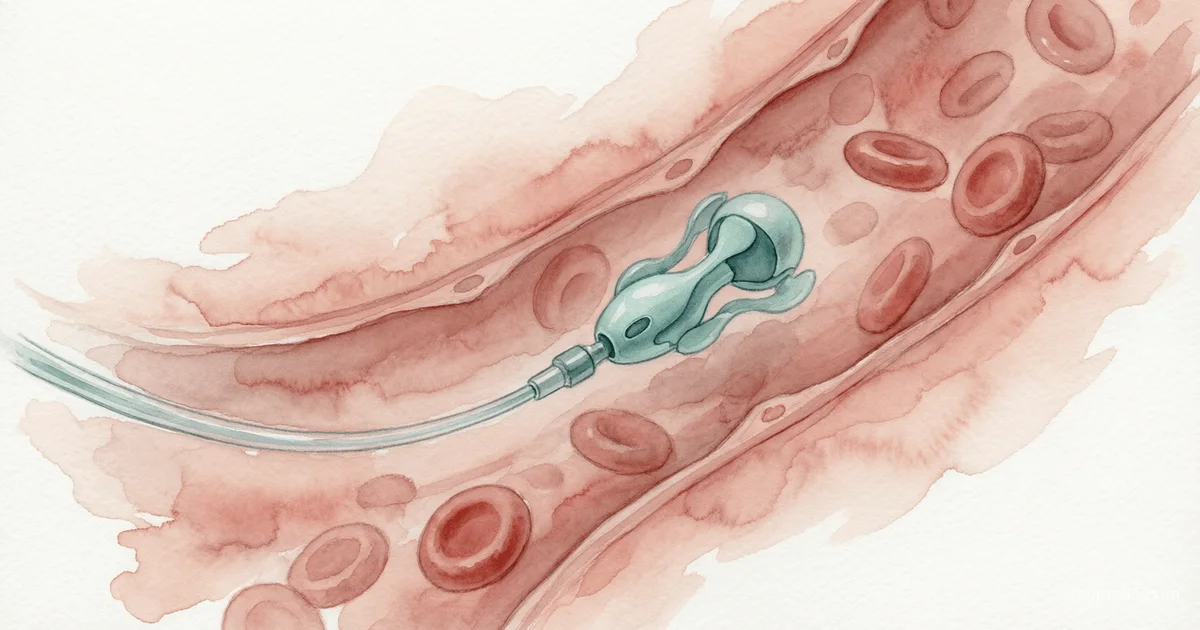
Microscopic Soft Robots Created for Microsurgery Tasks
A research group from Concordia University has introduced AI-assisted microrobots capable of performing complex medical manipulations in hard-to-reach areas, such as neurovascular pathways.
Analytical Summary: Concordia's Microrobots — An Engineering Gem That Will Never See a Patient
Date: May 27, 2026
Source of Event: Concordia University, Smart Materials and Structures, Ramin Sedaghati's group, Alireza Moezi's dissertation.
[Core Issue]: What Is Really Happening
On May 25, 2026, Concordia University's press office released a statement about the development of magnetically controlled soft robots for removing blood clots. It sounds like science fiction come true. But as someone who has seen dozens of similar "breakthroughs," I immediately ask: where are the animals? Where is the pig with an implanted robot in its carotid artery?
The answer: there are none. This is pure in vitro engineering.
Numbers that actually matter:
- Robot size: millimeter-scale (1-3 mm).
- Tracking error reduction: up to 77% compared to standard methods.
- Deformation modeling accuracy: error less than 1.5% in non-uniform magnetic fields.
- Operation in fluid flow: the system maintains accuracy at flow rates up to 2350 ml/min.
Non-obvious insight (what the news doesn't tell you):
Pay attention to the key phrase in the original press release: "These tiny magnetic soft robots are attached to the tips of conventional catheters and surgical wires."
Translating from scientific language: these are NOT autonomous nanorobots that swim freely in the blood. This is a smart tip for a regular catheter (tethered robot). The wire remains. The magnet does not propel the robot into free navigation — it simply bends the tip.
The inside story is why this is downplayed. Because a "robotic tip" doesn't sell press releases. But "microrobots for treating blood clots" does. The gap between engineering truth and marketing packaging here is enormous.
Moreover, the authors themselves admit: this is a proof-of-concept. Not a medical device prototype. Not even preclinical trials. Just "we figured out how to control the bending of a rubber piece with a magnet."
Timeline and Context
The real story of this technology began long before May 25.
- January 22, 2026: Publication of the article in Smart Materials and Structures. First official description of the closed-loop control system.
- January 23, 2026: PhD defense of Alireza Moezi. Dissertation topic: "Magnetoactive Soft Robots for Minimally Invasive Interventions." His work introduces deep learning for magnetic field prediction and reinforcement learning control for the first time.
- May 25, 2026: University issues a press release. The date is not accidental — four months after the defense, when Moezi had already secured a postdoc position at McGill. This is a standard cycle of "reporting to grant funders" (NSERC and FRQNT).
Important context: this is a purely Canadian story, funded by Canadian grants. Not a single medical co-author. No doctors on the list. This is an engineering project trying to find a medical application.
Who Wins and Who Loses
Winners:
- Alireza Moezi: Defended his PhD, got a postdoc at McGill (one of Canada's top medical hubs), became a guest editor for a special issue in the journal Actuators. His academic career has taken off. The press release is an ideal tool to draw attention to his work.
- Concordia University (Engineering Faculty): They now have a high-profile case for attracting students and grants. "We make medical robots" sounds better than "we do vibration analysis of mechanisms."
- NSERC and FRQNT (Canadian grant agencies): They can report to taxpayers: "Your money went to a breakthrough technology." ROI in terms of public relations is excellent.
Losers:
- Interventional radiologists and neurosurgeons: They are promised a "revolution" but are actually given another gadget that will never make it to the operating room. In my years in the industry, I've seen dozens of such "breakthroughs" — from Stereotaxis magnetic navigation to the CorPath robot. None became the standard.
- Investors who fall for the hype: If some venture capital fund invests in a spin-off of this technology at the proof-of-concept stage without animal data, it will be a bad investment. It's 5-7 years to the clinic, if lucky.
What the Media Isn't Saying
- The tethered robot problem: The system only works while the robot is connected to the catheter. This means all the advantages of "magnetic navigation" are negated because the wire still protrudes from the patient. A real breakthrough will happen when the robot can detach and move autonomously. That's not the case here.
- The visualization problem: The system uses high-speed cameras to track the robot's position. This works perfectly in a transparent tube. But as soon as you place the robot in a real vessel with opaque blood, the cameras go blind. In clinical practice, fluoroscopy (X-ray) is needed, which has much lower resolution and frame rate. The authors offer no solution to this problem.
- The magnetic field problem: A permanent magnet on a six-axis robotic arm is used to create the field gradient. This setup weighs tens of kilograms and must move over the patient during surgery. Question: how does this integrate with an angiography system (C-arm) that also requires access to the patient? Integrating two complex systems in one operating room is a non-trivial engineering challenge. The authors are silent about it.
- Competition with NTU: Just one day after Concordia's release, on May 26, 2026, Nanyang Technological University (NTU) announced its own microrobot, 4.4 mm long, capable of performing five functions, including tissue cutting and drug delivery. Note: NTU is already talking about "guiding the robot inside the human body" — meaning they are a step ahead in setting clinical goals. The Canadian project looks more modest in comparison.
Forecast: Next 30 Days and 90 Days
30 days:
No new technical data. There will be a wave of reposts on tech portals (The Robot Report, IEEE Spectrum, possibly). Moezi, as guest editor of the Actuators special issue, will actively promote the topic. Watch his publications — if an article with tests on cadaver models (corpses) comes out soon, that will be a sign of progress.
90 days:
Two scenarios:
- Optimistic: Moezi, in his postdoc position at McGill, gains access to animal models. If a preprint with tests on pigs appears within 3-6 months, the technology moves to the next level. But even then, it's years away from the clinic.
- Realistic: Nothing happens. Moezi continues publishing papers on modeling and control. Sedaghati and Rakheja return to their main projects. The press release remains a "paper breakthrough" that will only be remembered when someone else builds a working prototype.
Analyst's Verdict:
This is beautiful engineering work. The authors solved a complex problem of controlling a soft robot in a non-uniform magnetic field with fluid flow. Their contribution to science — modeling and algorithms — is real and valuable.
But calling this a "breakthrough in treating blood clots" is a marketing stretch. The technology is at TRL 3 (experimental proof of concept in the lab). It's 5-7 years to clinical trials (TRL 7-9), if it ever gets there.
The medical world is full of such stories. Remember the "nanobots" for drug delivery that were written about in 2010? Where are they now? Right, in labs, at the same stage.
Don't believe the headlines. Believe the animal data. There is none yet.
— Editorial Team