JAMA Publishes Analysis of Hantavirus Outbreak on Cruise Ship, Criticizing Global Health System
A detailed report in the Journal of the American Medical Association on the incident aboard the Hondius revealed the fragmentation of the international response and weak coordination in the face of cross-border threats, despite the limited nature of the outbreak itself.
Analytical Brief: The Hondius Hantavirus Outbreak — A 'Shameful Failure' of Global Health That No One Wants to Acknowledge
Date: May 27, 2026
Sources: JAMA, analysis by Lawrence O. Gostin (Georgetown Law), WHO, Nature.
[The Core]: What Is Really Happening
On May 25, 2026, JAMA published not just a report on the outbreak, but a scathing analysis of how the global health system failed when faced with a threat that was limited, predictable, and not new.
The numbers look innocent: 10 cases, 3 deaths on the cruise ship Hondius, the virus being the Andes hantavirus (endemic to Patagonia, the only species capable of limited human-to-human transmission). WHO assessed the risk to the global population as 'low.' It would seem nothing special. But JAMA sounds the alarm not because of the mortality rate (which, by the way, is 35–50% — higher than Ebola), but because of systemic coordination collapse.
Non-obvious insight (what even JAMA doesn't say, but whispers circulate at WHO):
Note the timeline. The first death occurred on April 11, 2026. The body remained on board for 13 days. Formal notification to WHO happened on May 2, by which time 34 passengers and crew members had already dispersed worldwide. But the real insight is why they stayed silent for 3 weeks? Because the ship, flying a Dutch flag, was in waters near a British Overseas Territory (Saint Helena), but passengers came from 23 countries. A legal nightmare of neglect.
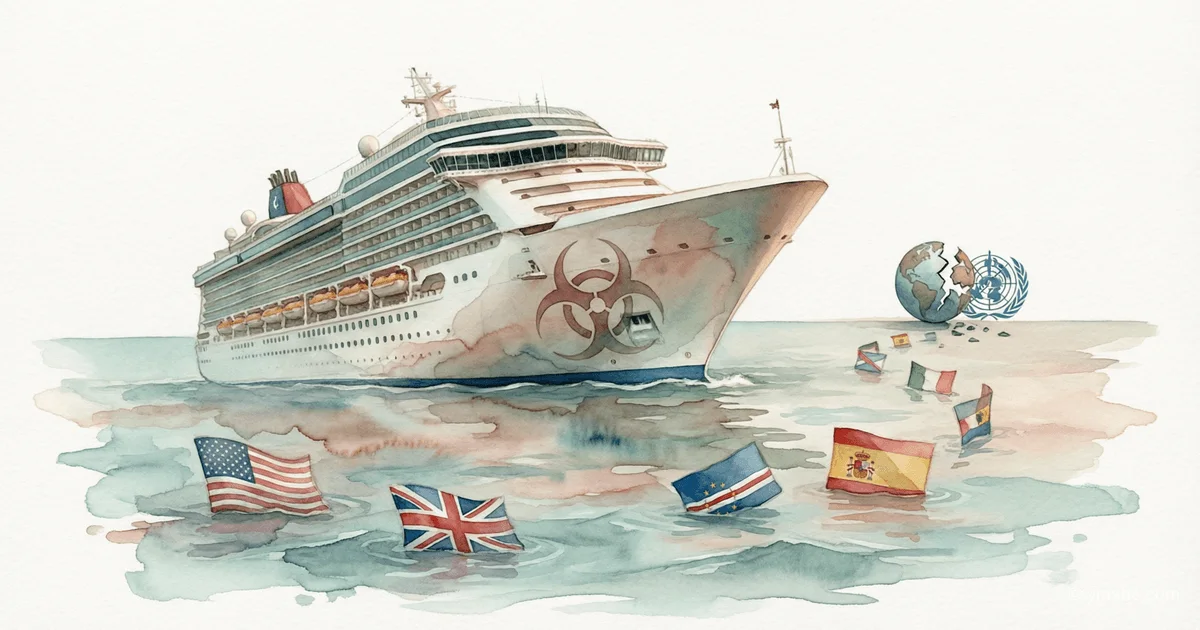
No one wanted to take responsibility. Cabo Verde refused to accept the ship, citing its weak health system. The UK (formally through Saint Helena) was in no hurry. Eventually, Spain agreed to accept the ship in Tenerife only on May 10. During those three weeks, the virus managed to travel to Johannesburg (where the second patient died), Zurich, Germany, the Netherlands, and even Kansas, USA.
Why does this matter? Because after the COVID-19 pandemic in 2024, amendments to the International Health Regulations (IHR) were adopted. They supposedly strengthened coordination. The Hondius case proves: the amendments changed nothing. WHO still lacks the authority to compel countries to act. WHO can coordinate, recommend, but cannot force a country to accept a ship or declare quarantine. This is 'soft law' in a world of hard politics.
Timeline and Context
Here is the actual timeline of events, which you won't find in brief news reports:
- April 1, 2026: Hondius departs from Ushuaia, Argentina, with 149 passengers.
- April 6–11: The first patient (an elderly man) falls ill and dies on board. The body is not buried or properly isolated — it remains in the ship's refrigerator.
- April 22: The ship docks at Saint Helena. The second patient (the deceased's wife) disembarks with symptoms (dismissed as 'stomach upset'). She flies commercial to Johannesburg.
- April 24–26: The woman dies at a clinic in Johannesburg. Only then does panic begin.
- May 2: The UK finally notifies WHO. Three weeks lost. By this time, 34 people have already left the ship and dispersed.
- May 8: The US CDC issues a warning (Health Alert Network). Too late.
- May 10: Spain allows disembarkation in Tenerife.
- May 11: Repatriation of all passengers completed. A 42-day monitoring period begins.
Result: 10 cases, 3 deaths, 9 countries involved, a 42-day monitoring window, but no new cases after May 13. The situation resolved itself, despite the bureaucracy, not because of it.
Who Wins and Who Loses
Winners:
- Global health lawyers and advocates (Lawrence Gostin from Georgetown Law): This JAMA article is their 'gold mine.' They have been shouting about gaps in the IHR for years. Now they have a rock-solid case. Research grants for 'global governance reform' will increase by 200–300%. Gostin has already stated: "Preparedness should not be judged only by whether the world can respond to catastrophic global crises, but also by whether it can manage smaller, containable outbreaks."
- Lawsuits against the cruise industry: Lawyers for passengers are already preparing lawsuits against the ship operator. Why were there no onboard PCR tests? Why was the body not isolated? Why didn't the ship's doctors recognize hantavirus? The cruise market faces a wave of multi-million-dollar lawsuits.
- Countries that refused to accept the ship (Cabo Verde): Cynically, they won. They demonstrated 'sovereignty.' Nothing will happen to them. The IHR does not allow punishing countries for refusing entry. This sets a dangerous precedent: 'if it's difficult, say no.'
Losers:
- WHO's reputation (especially the European Bureau): WHO issued a laudatory press release about 'how the system worked.' But JAMA calls a spade a spade: "fragmented response, lack of operational authority." Director-General Tedros acknowledged a 'serious incident' but avoided real conclusions. The world saw that WHO is an 'ambulance without car keys.'
- The United States (politically): In January 2025, Trump signed an executive order to withdraw the US from WHO and reject the IHR amendments. Now that American tourists from Kansas were at risk, this move looks like a historic mistake. The US withdrawal weakened an already weak system.
- The cruise industry: Shares of Carnival Corp and Royal Caribbean have likely already adjusted, but the long-term reputational damage is huge. The term 'floating petri dish' has returned to the lexicon.
What the Media Isn't Saying
- 'Limited transmission' is a politically correct euphemism. Yes, the Andes virus transmits less easily than COVID-19. But the fatality rate is 38%. For comparison, smallpox was 30%. Imagine if it had mutated. And it could have. Precisely because the ship became an incubator of close contact for 3 weeks. JAMA explicitly writes: "cruise ships compress globalization into a single mobile environment." This is a perfect recipe for a super-strain.
- The 'dead cargo' problem: The first victim's body spent 13 days on board in a refrigerator. In the tropics? No, in the South Atlantic, but still. No one asked: how was it packaged? Were there protocols for handling bodies when a highly dangerous infection is suspected? Answer: no. This shows a complete lack of cruise preparedness for bio-threats.
- The gap between science and policy: Nature published a column stating that "vaccine platforms exist but frameworks to coordinate them do not." That is, mRNA-based vaccines against hantavirus are already in development. But while officials argued over who would allow disembarkation, the vaccine was never used (although it could have been used for ring vaccination of contacts). Because there is no protocol for emergency use of experimental vaccines on cruise ships in international waters.
Forecast: Next 30 Days and 90 Days
30 days:
Expect the release of WHO's official investigation report. It will be diplomatic. But leaks to the medical press (BMJ, Lancet) will be harsh. Also expect the first lawsuits from relatives of the deceased against the cruise company (claims ranging from $5 to $10 million for negligence).
90 days:
Negotiations will begin on a 'Maritime Protocol' to the IHR. Gostin's proposal: create a special mechanism for cruises — mandatory onboard capacity (isolators, PCR labs), uniform disembarkation rules, and 'no refusal without penalty' (fines for refusing entry). The US, having left WHO, will block these negotiations.
What else is critically important to track:
- Major bio-safety drills on cruises: IMO (International Maritime Organization) will issue new recommendations. Shipowners will panic-buy personal protective equipment.
- Virus sequencing data: If it turns out that the virus on the ship mutated toward more efficient transmission (data from labs in the Netherlands or South Africa), this would change the risk assessment from 'low' to 'moderate.' Watch for publications in Eurosurveillance.
Analyst's Verdict:
The Hondius outbreak is not a story about hantavirus. It is a story about how the global health architecture is broken, and no one will fix it because 'it's expensive' and 'it limits sovereignty.' Thank God this time it was a small loss (3 deaths). But imagine if the virus were more contagious? Or if the incubation period were shorter? The world did not learn from the Diamond Princess (2020). And it will not learn from Hondius. The next outbreak will be just as chaotic, perhaps even fatal. Invest in companies making rapid portable PCR tests — that's the only thing that truly saves in such bureaucratic chaos.
— Editorial Team