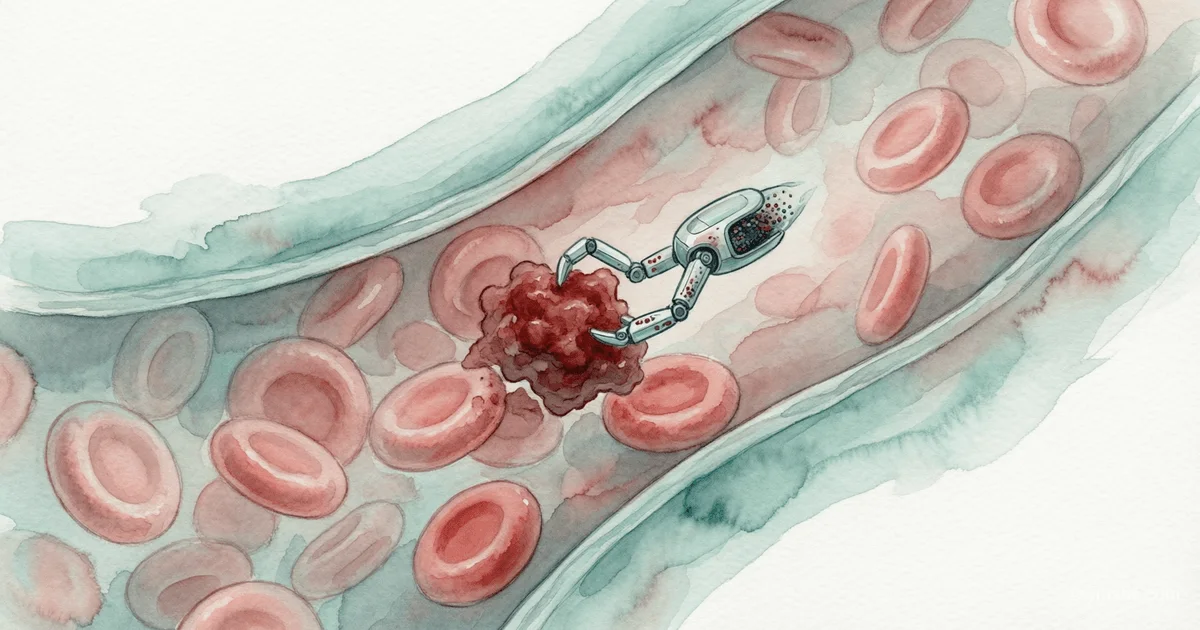
Magnetically Controlled Soft Robots Promise Safer Blood Clot Treatment
Researchers at Concordia University have developed an AI-driven platform based on tiny flexible robots that can be controlled by external magnets, enabling the removal of dangerous blockages in blood vessels with lower risks compared to catheters.
Analytical Summary: Concordia's Magnetic Soft Robots — a Breakthrough Stuck "In Vitro"
Date: May 27, 2026
Event Source: Concordia University (Montreal), journal Smart Materials and Structures, work by Alireza Moezi (PhD 2026), Ramin Sedaghati, Subhash Rakheja.
[Core]: What Is Really Happening
On May 25, 2026, researchers at Concordia University published a prototype platform — tiny (millimeter-sized) soft robots made of biocompatible rubber filled with magnetic particles. The idea is simple to the point of genius: instead of pushing a rigid catheter through the tortuous vessels of the brain (risking wall perforation), you attach this "soft noodle" to a wire and control its bending using an external magnet on a robotic arm.
However, it's important to understand the manipulation of terms. Most news outlets shout: "Magnetically controlled robots treat blood clots!" The reality is harsher. The authors explicitly mention a "proof-of-concept." These are not swimming robots that find clots in the blood on their own. They are robotic tips for standard catheters (tethered robot). The wire remains, but the tip becomes smart and compliant.
Numbers that truly matter for the industry:
- Reduction in tracking error (deviation from trajectory): up to 77% compared to standard technique.
- Accuracy of deformation modeling in a non-uniform magnetic field: error less than 1.5% (in Moezi's dissertation).
- Operation in fluid flow: the system maintained accuracy at flow rates up to 2350 ml/min (physiological realism).
Non-obvious insight (what lead managers keep silent about):
Notice who is NOT among the authors of the press release. No neurosurgeons. No medical doctors. This is 100% engineering work (Department of Mechanical Engineering).
The insight lies in the magnetic field gradient problem. In the lab, the magnet sits on a 6-axis robot. The system "sees" the robot via high-speed cameras and corrects movement in real time (closed-loop). This works perfectly in a transparent tube.
But as soon as you place this inside a skull, surrounded by bones and tissues of varying density, field predictability drops. The magnetic field decays exponentially with distance. The Concordia scientists solved this problem at the algorithm level (Deep Neural Network for predicting the 2D field), but in a real body with hemorrhage or atherosclerotic plaque that changes rheology, their "ideal fluid" will turn into a nightmare for AI. That is precisely why this group has not yet published any in vivo work (on live animals). Only in vitro (in a test tube) and ex vivo (phantoms).
Timeline and Context
The history of this project is a classic path of a lone engineer trying to drag nanotechnology into the operating room.
- January 22, 2026 (publication in Smart Materials and Structures): Official birth of the technology. Moezi and Sedaghati publish the theoretical basis for controlling a soft continuum robot in non-uniform fields.
- January 23, 2026 (PhD defense of Alireza Moezi): A key moment that the media missed. Moezi defends his dissertation "Magnetoactive Soft Robots for Minimally Invasive Interventions." His work introduces for the first time a Deep Reinforcement Learning Fractional-Order Sliding-Mode Controller (a very complex algorithm for dealing with blood turbulence). Industry usually overlooks doctoral dissertations, but here there is a detail: he reduced tracking error by over 40% at high flow rates (1160 ml/min).
- May 25, 2026 (Concordia press release): The university launches a wave of hype. This is a standard cycle: "we received an NSERC grant and FRQNT funds — we need to report to taxpayers."
Who Wins and Who Loses
Winners:
- Engineering faculties and robotics startups: They now have a ready prototype for pitch decks. "Micro-robots for the brain" sounds like a million dollars from venture capital funds. Alireza Moezi (now a postdoc at McGill) wins. His academic career is secured.
- Johnson & Johnson (Cerenovus) and Medtronic: These giants of neurovascular devices just got a free "proof of concept." They won't have to spend their own R&D money on early research. They will monitor patents. If the technology reaches pigs, they will buy the startup for $200-300 million.
Losers:
- Laser atherectomy manufacturers: Technologies that "burn" clots with a laser through a catheter (e.g., Spectranetics/Philips) lose ground in the race for safety. Soft mechanics are potentially less traumatic than thermal effects.
- Traditional interventional radiology: Doctors who have trained for decades on "wire feel" (twisting a rigid J-tip guidewire) may find themselves with an "obsolete skill" if AI and magnets begin to control the instrument more precisely than humans.
What the Media Leaves Out
- The "material fatigue" problem (MSCR Fatigue): The robot is made of elastomer with magnetic particles. To reach the clot, it will have to bend hundreds of times at different angles. The press release says nothing about this. The scientific paper includes a "quasi-static model" but no cyclic tests for a million bends. Imagine a piece of rubber inside the carotid artery cracking or delaminating — embolism from a robot fragment is worse than the clot itself.
- The illusion of "safety": "Lower risk of vessel perforation" is true. But the technology introduces new risks. To create a magnetic field gradient, you need either huge electromagnets (which would sit over the patient's head and break the MRI scanner) or a powerful permanent magnet on a movable arm. And that arm is a piece of metal weighing tens of kilograms, moving over the patient's face during a complex brain surgery. A calibration error in stereo vision — and the magnet will crash into the surgical field. This is not a medical problem; it's an industrial safety problem (heavy equipment safety in the OR) that is kept quiet.
- AI is only for vision here: Yes, Deep Learning is used, but it solves a Computer Vision problem (recognizing the robot's shape from the camera), not decision-making. The robot does not decide "where to go." The operator sets the trajectory. AI only corrects the bending. This is an assistant, not an autonomous surgeon. True autonomous navigation has been implemented so far only on bronchial phantoms; real clinical application is years away.
Forecast: Next 30 Days and 90 Days
30 days:
No clinical news. This is fundamental science. There will be a wave of reprints on medical portals (Medgadget, The Robot Report). Monitor the clinicaltrials.gov database — if Concordia files an application for animal studies (large pigs) soon, it will show serious intent. But I doubt it: NSERC funding typically requires another 6-9 months before "in-vivo trials."
90 days:
Expect the release of a full paper with tests on cadaver models (corpses) or an animal model (pig). Inside info: Moezi moved to McGill (one of the best medical hubs in Canada). He is near the Montreal Neurological Institute. Most likely, they are already secretly testing prototypes on isolated pig heads. If information leaks, shares of small venture-backed neuro-robot companies (e.g., Noah Medical, if they go public) could move 3-5%.
What else is critically important to track:
- WIPO patent application (PCT): If the Concordia team does not file an international patent within the next 60 days (they are currently in the grace period after publication), big pharma will simply copy the idea, replacing the rubber with a cheaper polymer.
- FDA Breakthrough Device Designation: They could theoretically apply for Breakthrough Device status at the FDA by the end of 2026 if they demonstrate work in pigs. Without this status, the path to humans will take 5-7 years (standard 510(k) path for a new device class is a bureaucratic nightmare). With it, 2-3 years.
Analyst Verdict:
This is a beautiful, scientifically sound engineering toy of 2026. It brilliantly solves the physics of controlling a soft body in fluid. But it completely fails to address clinical reality: asepsis (sterilization of a porous soft robot with UV is impossible deep inside a catheter), integration with existing Siemens or GE angiography systems, and, most importantly, what to do if the rubber tip detaches in the basal ganglia?
A 77% reduction in tracking error is a victory for engineers. But for a neurosurgeon, the remaining 1% risk of vessel perforation means a dead patient. The technology will reach operating rooms, but not before 2028-2029, and only after one of the "big three" (Medtronic, J&J, Stryker) buys the patent and replaces the exotic rubber with a proven medical polymer. For now — hold. Too early.
— Editorial Team