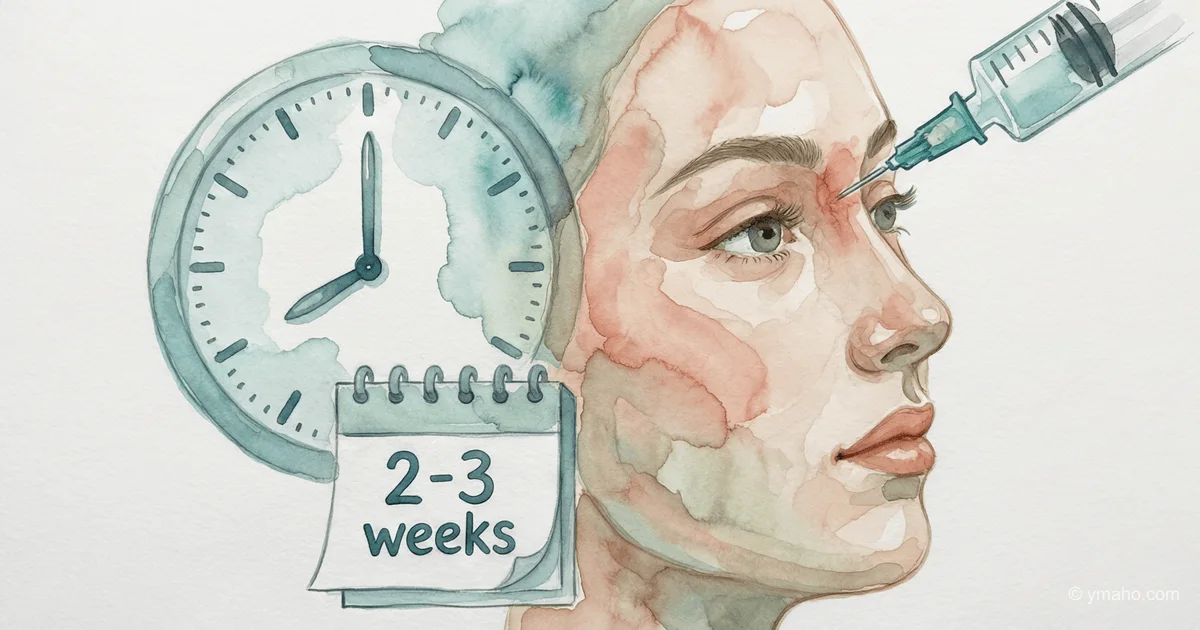
European Regulator Recommends New Neurotoxin for Glabellar Lines
The European Medicines Agency's Committee for Medicinal Products for Human Use has issued a positive opinion for Boey (trenibotulinumtoxin E) for the temporary improvement of moderate to severe vertical glabellar lines.
Analytical Summary: Boey (trenibotulinumtoxin E) — 'Fast Botox' as AbbVie's Trojan Horse for a New Audience
Date: May 27, 2026
Source: EMA CHMP, AbbVie/Allergan Aesthetics, Phase 3 data (M21-500 and M21-508).
[The Core]: What's Really Happening
On May 21, 2026, the European Medicines Agency's Committee for Medicinal Products for Human Use issued a positive opinion for Boey (trenibotulinumtoxin E) for the temporary correction of glabellar lines in adults. The European Commission decision is expected in the coming months. If approved, Boey will become the first and only botulinum neurotoxin serotype E on the European market, where serotype A products have dominated unchallenged for the past two decades.
The numbers behind the recommendation create a completely new clinical paradigm:
- Onset of effect: as early as 8 hours (earliest assessment point) — 9 to 21 times faster than classic Botox, which takes 3–7 days.
- Duration of effect: 2–3 weeks — 4 to 6 times shorter than the 3–4 months of serotype A.
- Safety profile: adverse event rate comparable to placebo (23.2% vs. 21.1% in the placebo group).
- Efficacy in treatment-naïve patients: 65.7% achieved the primary endpoint vs. 1.2% in the placebo group (p < 0.0001).
Non-Obvious Insight (What's Hidden Behind the Headlines):
Note: the drug is recommended for patients whose wrinkles have a 'significant psychological impact.' This is not a marketing gimmick but a legal loophole. In Europe, aesthetic procedures are often not covered by insurance. The wording 'psychological distress' opens the door for partial reimbursement in several countries (Germany, France). AbbVie isn't just selling 'fast Botox' — it's creating a precedent of medical necessity for a short-acting toxin. This changes the entire economics of the segment.
But the real insight goes deeper. The FDA rejected the Boey application in the US in April 2026. The reason — not efficacy, but 'technical aspects of manufacturing' (CMC). That means AbbVie has issues with scaling and stability specifically for the US market. Europe gets the drug 4–6 months earlier than the US — the reverse of the typical drug launch sequence. Watch: if the FDA issues aren't resolved within the next 9 months, Europe will become the global 'sandbox' for Boey, and all post-marketing data (which will be needed) will be collected there.
Timeline and Context
The story of trenibotulinumtoxin E is one of how academic science from 2003 finally reached the market.
- 2003 (Journal of Biological Chemistry): A group of researchers (e.g., work by Foran et al.) described the molecular mechanisms behind the different durations of action of botulinum toxin serotypes. It was known that serotype E cleaves SNAP-25, but its intracellular activity lasts about 0.8 days in rat neurons (vs. >31 days for serotype A). At the time, this was purely academic knowledge.
- 2019–2020 (R&D AbbVie/Allergan): After the AbbVie and Allergan merger (for $63 billion), the new owners of Botox (Botox® Cosmetic — onabotulinumtoxinA) looked for ways to protect their aesthetic flagship from generics. The solution: cannibalize their own market but create a new segment.
- November 2025 (ASDS Annual Meeting, Chicago): Rosalyn George, MD presents Phase 3 data from 309 treatment-naïve patients. The numbers are staggering: 65.7% response at day 7. This is the moment the industry realizes — serotype E works in humans exactly as the 2003 mouse model predicted.
- April 2026 (FDA Complete Response Letter): A blow. The FDA rejects the application due to the manufacturing process. AbbVie shares (ABBV) fall 1–2% on the news but quickly recover — the market knows CMC issues are solvable, unlike efficacy failures.
- May 21, 2026 (CHMP Positive Opinion): Europe says 'yes.' The European Commission decision is expected within the next 2–3 months.
Who Wins and Who Loses
Winners:
- AbbVie (Allergan Aesthetics): The main and obvious winner. They haven't created a competitor to their Botox®, but a product navigator. According to Allergan surveys, many people fear injections because of the duration of effect. Boey is a 'trial.' The patient comes for a quick, short effect (2–3 weeks), sees the result, relaxes — and a month later returns for standard Botox® lasting 3–4 months. Boey is not cannibalization; it's a sales funnel.
- Treatment-Naïve Patients (never-been-injected): The global aesthetic medicine market is growing 10–12% annually, but the main barrier is fear of long-term changes. Boey removes this barrier. 65.7% efficacy in naïve patients is the key number.
- European Aesthetic Clinics: A new SKU (Stock Keeping Unit) with high margins. A short-acting toxin means the patient will return not every 4 months, but every 3 weeks. Visit frequency increases 5–6 times. This is a huge traffic driver.
Losers:
- Competitors with Slow Type A Toxins (Ipsen, Merz, Hugel, Evolus): Their products (Dysport®, Xeomin®, Botulax®, Jeuveau®) are 'heavy artillery' lasting 3–4 months. They lose the segment of 'doubters' and 'testers.' It will hit Jeuveau® (Evolus) particularly hard, which was positioned as 'youth Botox.' Now young people have Boey — even faster and without long-term commitment.
- FDA (US Regulatory Reputation): The US rejection and European approval is a blow to the FDA's reputation as the 'gold standard.' In the eyes of the global industry, Europe becomes more flexible regarding innovative formats.
- Patients Needing Lasting Correction: For them, Boey is a poor choice. Return to baseline by day 21 means injections every 2–3 weeks. That's 4–6 times more expensive annually than standard Botox. No one will use Boey for permanent correction — only for trials or special events (weddings, photo shoots).
What the Media Isn't Saying
- The '8 hours' figure is marketing, not clinical reality for everyone. Yes, first signs are visible at 8 hours. But peak effect is reached at day 7, just like regular Botox. The difference is that regular Botox starts working at day 2–3 and builds up to day 7–10. Boey starts faster, but full results still take a week. The promise of 'results in 8 hours' works for patients who want to look good the morning after a party — but makeup and patches exist for that too.
- The 'triple injection' problem in clinical trials. Phase 3 data (M21-500 and M21-508) included up to three sequential treatments. But the real question: what happens after 10, 20 injections at 3-week intervals? Doesn't immunoresistance develop? Botulinum toxin E is a foreign protein. With frequent administration, the body may start producing neutralizing antibodies. For serotype A, this problem is known but manifests over years. For E, due to the short interval, the risk is higher. Long-term immunogenicity data (over 1 year) simply doesn't exist.
- Side effects: 'Mephisto sign' and blepharoptosis. The CHMP materials list side effects such as eyelid ptosis, brow ptosis, and 'Mephisto sign' (lateral brow lift — the 'devil eyebrow' effect). For serotype A, doctors have learned to minimize these over decades of practice. With a new serotype, new dosage (1400 units per vial), and new kinetics, the learning curve will be steep. Expect an increase in complaints about 'strange facial expressions' and asymmetry in the first 6–12 months after launch. AbbVie plans extensive physician training, but it's never enough.
Forecast: Next 30 Days and 90 Days
30 Days:
The European Commission will officially approve the drug (99% probability after CHMP positive opinion). The price will be announced. Expect the cost of one Boey treatment to be 10–15% lower than standard Botox® — to encourage trial injections. Around €200–250 per procedure (vs. €300–350 for Botox). Shares of Evolus (EOLS) and Hugel may dip 3–5% on competition fears. But not dramatically — the market hasn't fully realized that Boey is an additional option, not a direct replacement.
90 Days:
First commercial experience in Germany and France (first launch countries). Initial case reports of adverse events will appear. Follow aesthetic doctors' social media — they will complain about dosing complexity. AbbVie will release updated reconstitution protocols — a sign that early doctors made mistakes.
What Else to Track:
- FDA Re-submission: AbbVie will file a corrected application in the US. Expect news in August–September 2026. If the FDA rejects again, it's a manufacturing problem, not a regulatory one.
- Data on Forehead Wrinkles (procerus/corrugator): Currently Boey is approved only for glabellar lines. But commercial success will require expanding indications to the forehead and 'crow's feet.' Phase 3 data for these areas will appear in late 2026 – early 2027.
- Combination Boey + Standard Botox: Unofficially, doctors are already thinking about hybrid protocols: Boey for fast onset (8 hours) + standard type A toxin for long-lasting support. If such protocols emerge and prove safe, it will change the entire paradigm of aesthetic toxin therapy.
Analyst Verdict: Boey is not a revolution in science (molecular mechanisms known since 2003), but a revolution in the business model of aesthetic medicine. AbbVie turns injections from a 'serious six-month decision' into a 'quick weekend procedure.' This expands the market 2–3 times by capturing doubters. The FDA manufacturing issues are temporary. Watch the European launch: if the first 10,000 patients don't show a spike in immune reactions, Boey will become the standard entry point for botulinum therapy. If antibody frequency turns out high, the drug will remain a niche product for special cases. My forecast: the first scenario.
— Editorial Team