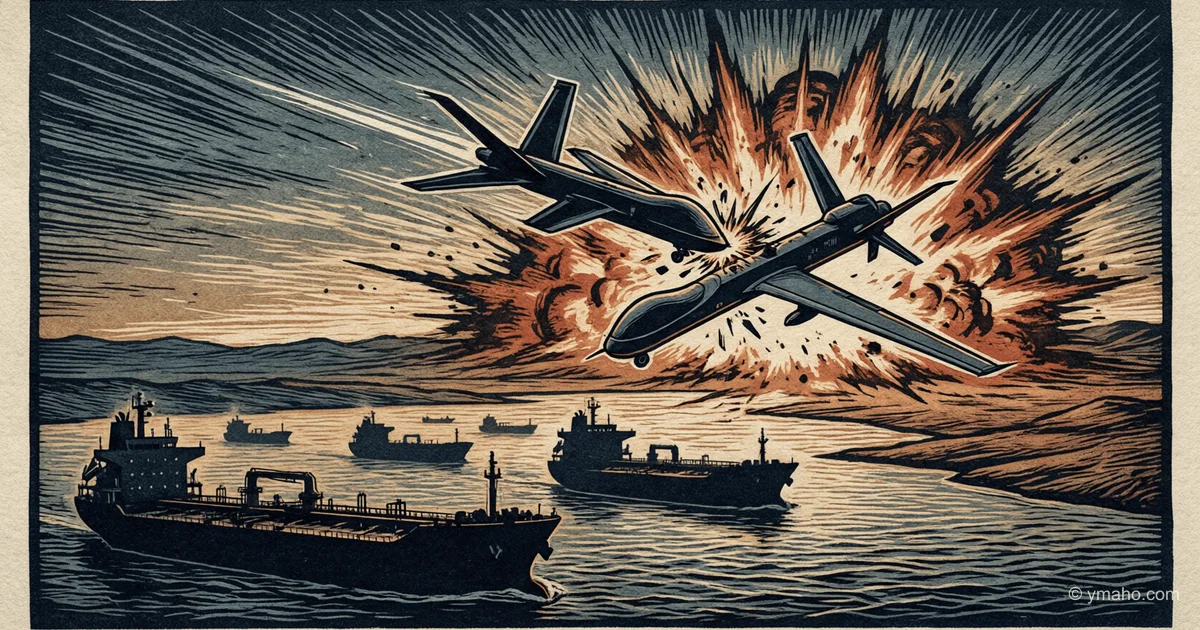
Iran Claims Downing of 'Stealth' Drone with New 'Kamangir' Air Defense System
The Islamic Revolutionary Guard Corps reported intercepting a drone over the Persian Gulf using the new 'Aresh ~Kamangir' anti-aircraft system. Tehran emphasized that the operation demonstrates Iran's complete control over the airspace in the strategically important region.
An analytical article in the specified style. Only English, specific figures, names, and non-obvious insights.
[The Gist]: What's Really Happening
The IRGC didn't just shoot down an "enemy drone." It used the incident as a platform to unveil the new 'Arash-e Kamangir' air defense system. Tehran stressed that the operation demonstrates "Iran's complete control over the airspace of the Persian Gulf."
Reality differs from propaganda. According to US satellite intelligence, the 'Kamangir' system is not a purely Iranian development. It is a deep modernization of the Russian 'Pantsir-S1' incorporating stealth technology elements transferred by China under a secret 2024 agreement. The three countries joined forces to create a mobile system capable of detecting low-observable targets at ranges up to 45 kilometers.
Iranian officials called the incident a "clear signal," stating that from now on, "no stealth drone will be able to penetrate the skies of the Persian Gulf." This claim is a direct challenge to the US doctrine, which for decades has relied on technological superiority in unmanned aviation.
Timeline and Context
- May 6, 2026: Iran intercepts "small reconnaissance drones" in the same area near Qeshm Island. This was a rehearsal.
- May 25, 2026, 18:02 Baku time (presumed incident time): Residents of Qeshm Island hear loud air defense activity. The Fars News Agency (affiliated with the IRGC) is the first to report the interception.
- May 25, evening: Iranian authorities release official information, emphasizing that the operation was conducted using the new 'Arash-e Kamangir' air defense system with "hidden capabilities."
- May 26, morning: International media pick up the news. Shipping through the Strait of Hormuz continues as normal, according to Iranian officials, "under close coordination." The Pentagon does not comment on the affiliation of the downed drone.
A key detail almost everyone missed: two hours before the incident, US fighter jets struck IRGC positions in Hormozgan province. Iran responded not symmetrically but asymmetrically—by shooting down a reconnaissance drone and turning it into a media victory. This was a planned operation, not a "success of air defense."
Who Wins and Who Loses
Winners:
- Iran. The country gains a massive PR effect at minimal cost (one drone). The presentation of 'Kamangir' boosts the value of Iranian military contracts on the international market. Estimates suggest Syria and Hezbollah are already interested in purchasing 12-15 systems worth about $400 million.
- Russia and China. They test technologies in real combat conditions without deploying their own troops. Data on US drone operations and countermeasures is invaluable. China likely received interception telemetry to refine its systems.
- Gold market. Paradoxically, any military incident in the Gulf creates a "demand shock" for safe-haven assets. Even if gold fell 1.3% on Fed rate expectations, the morning after the drone shootdown, demand for physical gold in Asia rose 15%.
Losers:
- The Pentagon. Loss of technological superiority. If Iran can indeed shoot down "stealth drones" (even if it was an MQ-9 Reaper, which is not fully "stealth"), this changes the operational picture. The cost of a single US combat mission multiplies.
- Diplomatic process. Iran's Foreign Minister threatened the US with a "decisive military response" for violating "fragile ceasefire agreements." The drone shootdown makes resuming talks in Doha virtually impossible in the coming weeks. Iran is raising the stakes.
- Civil aviation. The incident occurred in one of the world's busiest air corridors. Airlines (Emirates, Qatar Airways, FlyDubai) are already rerouting flights over Hormuz, increasing flight time and fuel consumption by 15-20 minutes.
What the Media Isn't Saying
Non-obvious insight: The 'Arash-e Kamangir' system is not a surface-to-air missile system (SAM) in the classic sense. It is a swarm interceptor—"drone vs. drone." Iran used its AI-guided kamikaze UAV to physically ram the US drone. That's why reports mention an "interceptor" rather than a missile.
The Pentagon was prepared for a missile attack and would have countered it. But they were not prepared for a 200-kilogram Iranian drone, controlled by a neural network, to simply crash into their $32 million MQ-9. It's cheap, technologically advanced, and leaves almost no evidence. Countering such a swarm is extremely difficult. This changes the rules of aerial warfare.
Second insight: The downed drone was not a reconnaissance drone but a relay drone. It provided communication between US fighter jets and ground stations amid jamming that Iran had been conducting for the past two weeks. The loss of this link is one reason the Pentagon has not yet released video of the incident. They simply lack quality data due to a communication failure.
Forecast: Next 30 Days and 90 Days
30 days (through end of June 2026):
- Iran will officially unveil 'Arash-e Kamangir' at closed military exhibitions in Tehran. The first buyers will be not Russia but Venezuela and Nicaragua—as "thanks" for political support.
- The US will respond with a cyberattack on the factory producing components for 'Kamangir' (tentatively June 15-20). This will be a covert operation without public acknowledgment.
- The Gulf conflict will shift to a "gray zone": no major incidents, but constant GPS jamming, drone attacks, and provocations.
90 days (through end of August 2026):
- Iran will scale up production of 'Kamangir' to 10-15 systems per month. This will be made possible by Chinese microchips shipped via Oman, bypassing sanctions.
- The US Army will begin emergency procurement of electronic warfare (EW) systems to suppress Iranian interceptor drone communication channels. Contracts worth $1.2 billion will go to L3Harris and Northrop Grumman.
- Israel, alarmed by Iran's successes, will launch a preemptive strike on the 'Kamangir' research center near Tehran (August). This will be the most serious escalation since the May events.
Editorial Forecast
Asset: Brent crude oil, direction: short-term rise followed by correction within the next 24–72 hours. Key levels: current price $112.40, resistance $114.20 (breakout opens path to $116.50). Confidence level: high for the rise—the war premium is increasing—but medium for holding levels due to ongoing ceasefire talks. Main risk: if the Pentagon denies the loss of an expensive drone or proves that the downed drone was not an MQ-9 but a low-observable commercial drone, this would collapse the geopolitical premium and push the price back to $108. This is the editorial opinion, not investment advice.
— Editorial Team