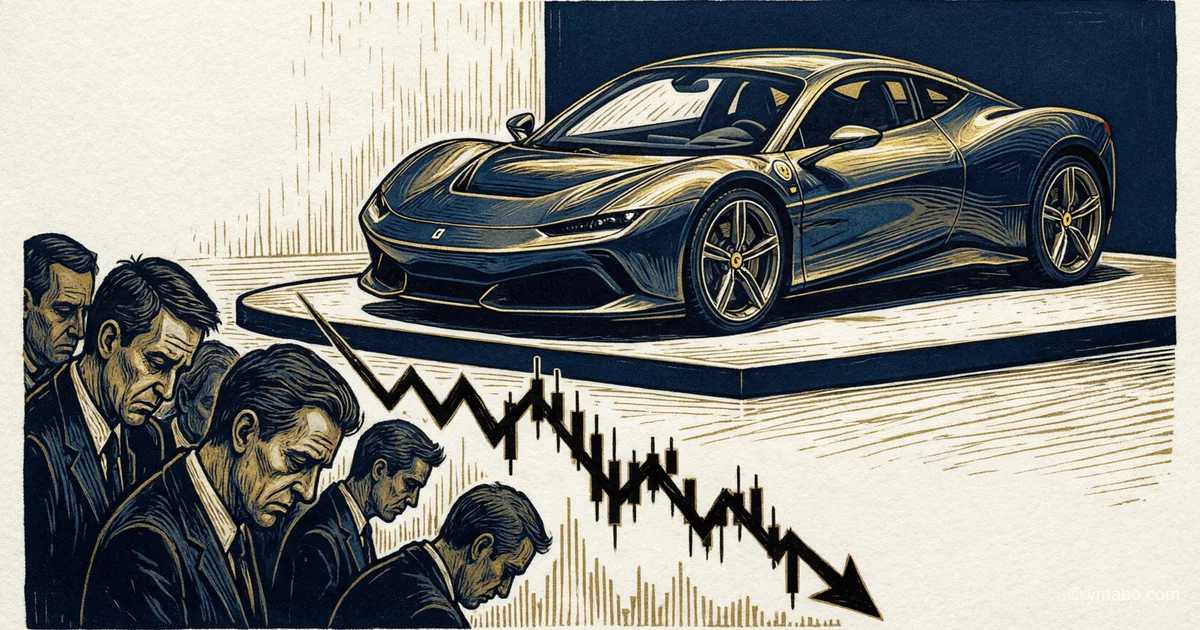
Ferrari Shares Plunge 8.4% After Unveiling of First Electric Vehicle, the Luce
The unveiling of the long-awaited Ferrari Luce electric vehicle disappointed investors, triggering the steepest single-day drop in the stock since October last year. Shares of the Italian automaker were the worst performers among Stoxx Europe 600 components.
Ferrari Luce: How to Kill a Cult in One Evening
An 8.4% drop is not a correction. It's a rout. Ferrari shares crashed to their lowest since October last year, and the issue isn't technical specs. The Luce boasts 1,050 horsepower, a 0-100 km/h sprint in 2.5 seconds, and a range of 530 km. Respectable numbers. But investors and fans ignored the specs. They saw something else: a betrayal of the DNA.
Why did the market react more harshly than to any crisis in recent years? Because Ferrari sells not transportation, but status and aesthetics. And the Luce, it turns out, fits neither.
[The Core]: What's Really Happening
The Luce's main problem isn't the battery—it's the design. For the first time in its history, Ferrari brought in an outside guru: former Apple chief designer Jony Ive and his studio LoveFrom. The result was so alien that even former Ferrari chairman Luca Cordero di Montezemolo, who gave 20 years to the company, said: "I hope they at least remove the prancing horse badge from this car. It's a betrayal of Ferrari's history."
Non-obvious insight: The stock drop isn't just "they didn't like the new model." It's a business model crisis. Ferrari has lived for decades on scarcity and control of the secondary market. The Luce is a five-door hatchback-crossover over five meters long. It's designed to attract new customers from Silicon Valley and China, but it kills "exclusivity" for the old guard. The market fears Ferrari is transforming from a manufacturer of art into a maker of expensive but mass-market electric vehicles.
Timeline and Context
The unveiling took place on the evening of May 25 in Rome. On the morning of May 26, shares crashed. Investors and media were unanimous in their negativity: AIR Capital called the Luce "a cross between a Honda Accord EV and a Tesla Model 3."
Most notable quotes:
- Italian Deputy Prime Minister Matteo Salvini: "It doesn't look like a Ferrari. What would Enzo say?"
- Oddo BHF analyst Anthony Dick: "This is the sharpest market reaction to an automotive design we've ever seen."
A key detail many missed: Ferrari had already scaled back its electrification plans. Even before the Luce unveiling, the company cut its target for "pure" EV sales share by 2030 from 40% to 20%. In other words, the company itself doesn't believe in success. And the second electric model has been postponed until 2028.
Winners and Losers
Loser #1: Ferrari itself. Over the past 12 months, shares had already fallen 31%. This crash erodes investor confidence further. Dealers are telling Evercore ISI analysts about "extremely low demand" for the Luce a month before sales launch. That's a disaster for a model the company was betting on.
Loser #2: Legacy fans. Those who bought Ferrari for the V12 and the iconic silhouette. They feel betrayed. Their reaction is to move to the secondary market for older models, which could crash prices on classics (e.g., the 812 Competizione).
Loser #3: Jony Ive (reputation-wise). The iPhone creator has received such a strong backlash for an automotive design for the first time. His studio LoveFrom tried to be "disruptive," but the market said "disgusting."
Winner: Competitors. Porsche, despite slowing Taycan sales, and even Lamborghini, which canceled its EV plan entirely, look far more sensible in comparison. Investors are fleeing to Mercedes and BMW shares, which aren't trying to break their identity so radically.
What the Media Isn't Saying
Everyone writes about design, but they stay silent about price and positioning.
The Luce starts at €550,000. That makes it the most expensive unlimited-production car in Ferrari's lineup. It costs more than the top-tier SF90 Stradale. And it's a five-seat family hatchback.
The problem is the segment. Wealthy people buy EVs for cities or for the environment (Porsche Taycan, Tesla Plaid). A family crossover for $640,000 is nonsense. For that money, you could buy two Rolls-Royces or three Lamborghini Urus (albeit with ICEs). Ferrari created a product without a target audience: old customers don't like it, new ones (rich Chinese) don't want to switch from a Maybach to a "weird Italian EV."
Forecast: Next 30 Days and 90 Days
30 days (until June 27). The wave of hate will subside, but shares won't recover. Analysts at Evercore ISI and Bernstein will revise ratings. I expect consolidation at levels 5-7% below pre-unveiling prices. If pre-orders in China and the US fall below 2,000 units per year (which is almost certain), the decline will continue to €310-320 per share (from the current ~€330).
90 days (until August 27). The most dangerous aspect is the impact on the brand. If the Luce fails in sales, Ferrari will have to write off platform development costs (billions of euros). Management will likely announce further cuts to EV plans. This will trigger another wave of decline, showing the company doesn't know where to go next. The ceiling will be €300, with a floor testing the February low of €269.
Editorial Forecast
Asset: Ferrari shares (RACE — NYSE / RACE — Milan). Direction: Further moderate decline over the next 24-72 hours by 2-3% following the negative momentum. Key levels: $400 (psychological support on NYSE); if broken, $385. Confidence level: High (75%). Main risk: An unexpected public order from a large institutional investor or a super-limited series that sells out instantly (e.g., the "Assetto Fiorano" version) could reverse sentiment. Watch for official Ferrari statements from Maranello on May 28-29. This is an editorial opinion, not investment advice.
— Editorial Team