European stock indices close in the red on inflation fears
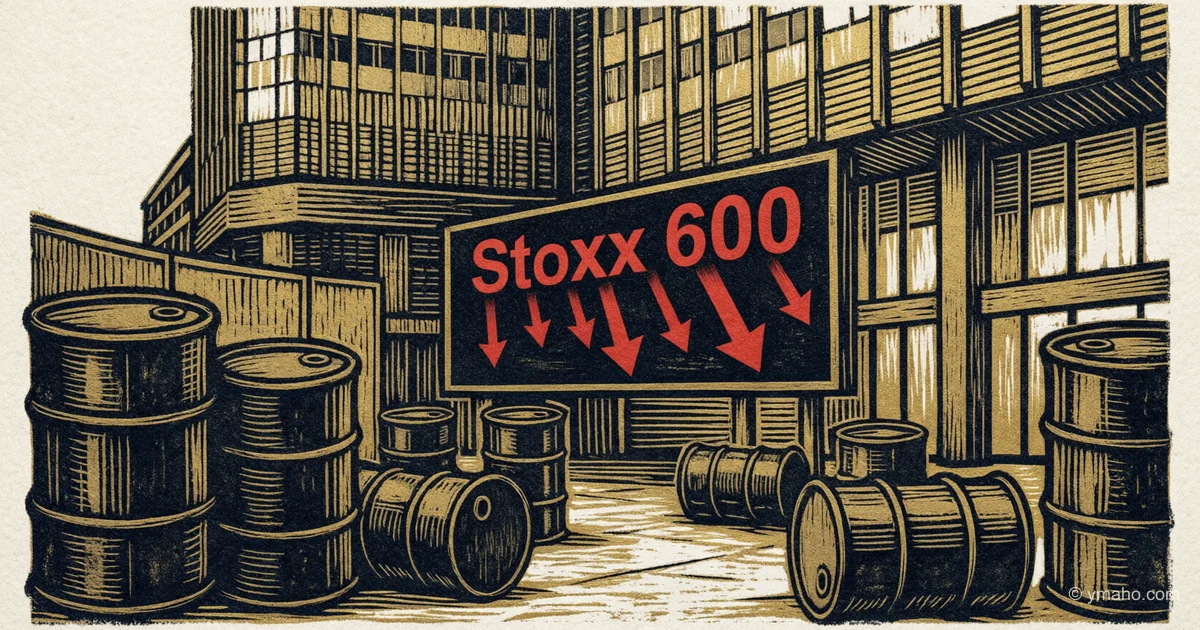
Stoxx Europe 600 fell 0.57% as optimism over a US-Iran deal fades. Investors fear rising oil prices will fuel inflation, prompting central banks to tighten policy. Spain's PPI posted its biggest gain since December 2022.
Europe loses twice: inflation returns, rates rise on a falling market
You've seen the headlines: Stoxx Europe 600 fell 0.57%, Spanish PPI surged to 8.3% — the highest since December 2022. Media outlets write about "inflation fears due to oil." That's true, but only part of the story. Europe's real problem is a structural trap with no easy way out, and it has worsened over the past 48 hours.
[The core]: what's really happening
A non-obvious insight missing from the news: European markets are falling not because of inflation itself, but because the European Central Bank (ECB) is cornered and will be forced to raise rates amid a slowing economy — a classic stagflation scenario that investors had forgotten about since the 1970s.
On May 26, BNP Paribas released a forecast: the ECB will raise rates twice in 2026 by 25 basis points each, bringing the deposit rate from the current 2.0% to 2.50%. The yield on German 10-year bonds (Bunds) will rise to 3.35% by year-end — 30 basis points above current levels. And on May 20, the European Commission cut its EU GDP growth forecast to 1.1% (from 1.4%) and raised its inflation forecast to 3.1% (from 2.1%).
So: inflation is rising, the economy is slowing, and the ECB is preparing to tighten policy. That's the worst cocktail for stocks. And the market is only now starting to realize it.
Timeline and context
May 7 — ECB Executive Board member Isabel Schnabel warns that an energy shock may require policy tightening, as households and companies raise inflation expectations.
May 14 — The European Commission publishes its spring forecast: EU growth cut to 1.1%, inflation to rise to 3.1%.
May 15 — Analysts are divided: half expect two ECB rate hikes by year-end.
May 21 — Optimism over a US-Iran deal pushes oil down, European markets rise.
May 24-25 — The US strikes Iranian boats, talks freeze, oil rises again.
May 26 — Spain's April PPI comes in at 8.3% — that's not a typo. In March it was 3.1%. The increase is solely due to petroleum products and basic chemicals.
May 26, trading — Stoxx 600 falls 0.57% to 628.01 points. DAX -0.8%, CAC 40 -1.0%, FTSE MIB -0.6%, IBEX 35 -0.5%. Exception: UK's FTSE 100 (+0.2%), catching up from Monday's holiday.
Who wins and who loses
Winner #1 — TotalEnergies. The French oil company rose 0.7% in a falling market. Reason: Q1 net profit grew 29% to $5.4 billion, and the company doubled its share buyback to $1.5 billion in Q2. Unlike BP, whose chairman lost his post due to corporate governance violations (BP shares fell 4%), TotalEnergies holds up.
Winner #2 — London mining companies. Antofagasta +3.7%, Glencore +2.9%, Anglo American +2%, Rio Tinto +0.3%. Rising metal prices amid inflation expectations directly benefit miners. The FTSE 100 is in positive territory precisely because of its commodity tilt.
Loser #1 — Luxury goods makers. Hermès -3.3%, Kering -3.1%, LVMH -1.8%, Pernod Ricard -1.9%. Are wealthy buyers becoming sensitive to inflation? No. The problem is China: the luxury industry is critically dependent on Chinese consumers, and China's economy is slowing, plus geopolitical risks weigh on sentiment.
Loser #2 — Ferrari. Shares plunged 8.4% — the biggest daily drop since October 2025. The unveiling of its first electric car, the Luce, disappointed investors. In the context of inflation and high rates, expensive EVs are the last thing buyers want.
Loser #3 — Any holder of long-term bonds. BNP Paribas forecasts Bund yields at 3.35% by year-end. With current yields around 3.0%, that means bond prices will fall 2-3% in the coming months. And if inflation accelerates, losses will be larger.
What the media isn't saying
The main omission: the market still isn't pricing in a third round of ECB rate hikes.
Schnabel said outright on May 7: memories of high inflation in 2021-2022 are fresh, so the shock will transmit faster. Francois Villeroy de Galhau, head of the Bank of France, said on May 26: the regulator will "act without hesitation to contain inflation."
Current market prices imply two hikes by year-end. But if Spain's PPI (8.3%!) is not an anomaly but a harbinger, the ECB may go for three steps. A deposit rate of 2.75% by December 2026 is a scenario that would kill European stocks another 5-7% in Q3.
And the second thing not being discussed: Italy's FTSE MIB at record highs is not a sign of economic strength, but a skew toward energy and defense. On May 6, the index hit a 26-year high, breaking 50,000 points. But the rally was driven by just three companies: Eni (oil), Leonardo (defense), and Enel (utilities). The rest of the market is stagnating. This isn't diversified growth — it's three lifeboats on a sinking ship.
Forecast: next 30 days and 90 days
30 days (until June 27). Key date: ECB meeting on June 4. A 25-basis-point rate hike to 2.25% is expected. Stoxx 600 will fall another 2-3% to 610 points. Bunds (10-year German bonds) will see yields rise to 3.15-3.20%. TotalEnergies and Italian energy stocks will continue to outperform. Luxury goods — LVMH, Hermès — will fall another 5-7% on fears of a China slowdown. Key risk: if the ECB hikes 25 points but gives a dovish signal, the market could bounce 1-2%.
90 days (until August 27). Base case (60% probability): ECB hikes in June and September by 25 points each, deposit rate at 2.50%. Eurozone inflation settles at 2.8-3.0%. Stoxx 600 at 590-600 points (down 5-6% from current). Bunds at 3.30-3.35%. Italy's FTSE MIB corrects 8-10% as investors take profits in Eni and Leonardo.
Alternative scenario (25% probability): Brent oil stays above $100, Spanish PPI rises to 10%, ECB hikes three times (June, September, December). Rate at 2.75%. Stoxx 600 at 560 points. Bunds at 3.50%+.
Editorial forecast
Asset: German 10-year government bonds (Bunds). Direction: rising yields (falling prices) over the next 24-72 hours to 3.12-3.15% (from current ~3.0%). Key levels: yield support at 2.95%, resistance at 3.18%. Confidence level: high (70%). Main risk: if on May 28-29 specific details emerge of renewed US-Iran talks, oil could drop sharply, inflation expectations ease, and Bund yields could retreat to 2.90%, breaking the trend. Watch for news from Oman. This is an editorial opinion, not investment advice.
— Editorial Team