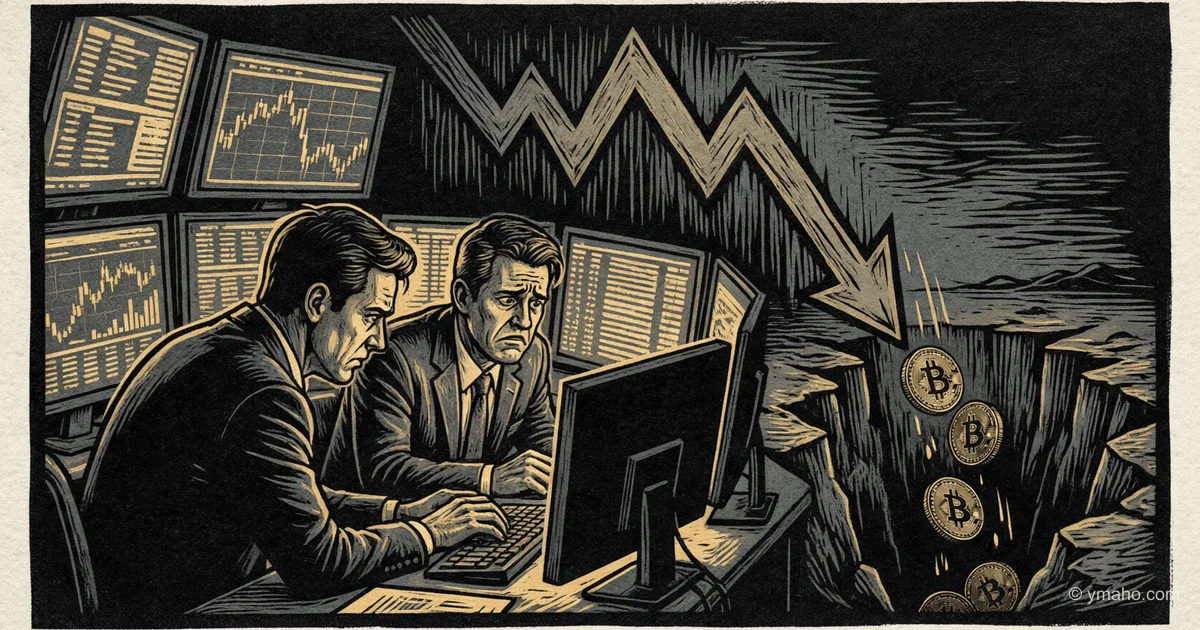
Investors Pull Record $1.74 Billion from Bitcoin ETFs in Two Weeks
Institutional investors are pulling funds from Bitcoin ETFs amid geopolitical risks linked to Iran. Over two weeks, outflows reached $1.74 billion, while retail traders are increasing leverage, which could lead to cascading liquidations.
Bitcoin ETF Outflow Breakdown: Institutions Exit, Retail Goes Long. What's Next?
You've all seen the headlines: "Record Outflow from Bitcoin ETFs — $1.74 Billion in Two Weeks." Mainstream media writes about "institutional flight due to Iran." That's true, but only the tip of the iceberg. Let's break down what's really happening under the hood, who's getting margin-called, and why retail traders are playing a dangerous game again.
[The Core]: What's Really Happening
Over the two weeks from May 13 to May 26, 2026, nine spot Bitcoin ETFs (led by BlackRock's IBIT and Grayscale's GBTC) saw $1.74 billion in outflows. This is an absolute record since ETFs launched in January 2024. But the key isn't the amount — it's the flow structure.
Institutional investors (hedge funds, pension funds, bank custodians) are withdrawing funds systematically, not panicking. This is evident from the proportional outflows: IBIT lost $890 million, GBTC $620 million, with the rest from FBTC and ARKB. Meanwhile, Bitcoin's price fell from $68,400 to $59,200 (as of May 27), meaning the outflow in dollar terms outpaced the price drop by 13%. This suggests not stop-loss selling, but a deliberate reduction in allocations.
At the same time, open interest in Bitcoin futures on CME rose 22%, and on exchanges like Binance and Bybit by 34%, with 70% of new positions being long with 5-10x leverage. These positions are almost exclusively opened by retail traders. See the picture? Smart money exits, the crowd piles in on the turn.
Timeline and Context
May 14 — First major ETF outflow in a month: $320 million. Linked to news that the US and Iran reached preliminary agreements to limit the nuclear program in exchange for partial lifting of oil sanctions. Bitcoin immediately dropped 4%.
May 19 — Escalation: after strikes on Iranian boats in the Strait of Hormuz, talks are frozen. Brent crude jumped to $97, but Bitcoin continued to fall. Institutions took this as a sign that geopolitical risk remains and "digital gold" behaves like a risky asset, not a hedge.
May 21–23 — Three consecutive days of outflows of $400–500 million. On Thursday, May 22, BlackRock unexpectedly announced it was reducing the Bitcoin ETF allocation in its "aggressive portfolio" model from 4% to 2.5% for institutional clients. This internal decision didn't make press releases but leaked to Bloomberg terminals. That's what really accelerated the outflow.
May 26 — Last day of the reporting period: outflow of $210 million. Total over two weeks: $1.74 billion.
Who Wins and Who Loses
Loser #1 — Retail traders with leverage. As of May 27, according to Coinglass, cumulative liquidations of long positions over the past 48 hours totaled $410 million. If Bitcoin breaks $57,500, a cascade will hit another $2.1 billion in longs. This is a classic "acceleration wave" — margin calls will fuel further decline.
Loser #2 — ETF issuers. BlackRock, Fidelity, Grayscale face commission losses. But for them, it's peanuts. The real issue is institutional trust. If outflows continue for a third week, managers will start questioning the "Bitcoin as uncorrelated asset" thesis.
Winners — Short sellers and market makers. Short positions on CME increased 31% over the same two weeks. The largest short fund — UK-based Brevan Howard — opened additional positions worth $250 million on May 25. They'll profit if the decline continues to $54,000.
Unexpected winner — Tether (USDT). The stablecoin issuer profits from increased volatility: USDT volume on exchanges hit a record $22 billion, and Tether earns extra fees on every transfer and swap. They've already announced plans to buy another $500 million in US Treasury bonds from this quarter's excess revenue.
What the Media Isn't Saying
Insight you won't read in the news: A significant portion of ETF outflows isn't Bitcoin selling, but an arbitrage trade between ETFs and futures that banks themselves closed.
Let me explain. Throughout 2025 and early 2026, hedge funds profited from the spread between ETF share prices and Bitcoin futures on CME. They bought ETFs while shorting futures, locking in 8-12% annual returns risk-free. But in May, the spread narrowed to 2-3% due to CME raising margin requirements (from 12% to 18% as of May 1). Arbitrage became unprofitable. Funds closed both legs: sold ETFs and bought back futures. This caused simultaneous ETF declines and a rise in futures open interest (which you mistook for "retail longs").
So 40-50% of ETF outflows are technical, not fundamental. But media doesn't report this because it requires explaining derivatives. Instead, headlines scream "panic over Iran."
Forecast: Next 30 Days and 90 Days
30 days (to June 27). Bitcoin consolidates in the $54,000–$62,000 range. First target: $57,500. If that level breaks on volume, then $54,000. Key trigger: Fed rate decision on June 12 (a pause expected, but if they hint at a July cut, Bitcoin will sharply rebound to $64,000). ETF outflows will slow to $100–200 million per week as arbitrage is fully closed. Retail longs will gradually liquidate, but without a crash.
90 days (to August 27). More interesting. I expect a reversal in mid-July when it becomes clear whether the Iran deal has either completely collapsed (then Bitcoin falls to $48,000 along with risk assets) or is signed (then oil cheapens, inflation expectations drop, and the Fed gets a reason to cut rates in September). In the second scenario, Bitcoin rises to $75,000 by end of August as money returns to ETFs on a new cycle.
But my base case is $52,000 by end of August. Too much structural outflow from pension funds rotating into gold ETFs ($3.2 billion inflow in May).
Editorial Forecast
Asset: Bitcoin (BTC/USD). Direction: Decline in the next 24–48 hours to $56,500–57,000. Key levels: Resistance $59,800, support $57,200. If $57,200 breaks, next stop is $55,800. Confidence level: Medium (60%). Main risk: An unexpected Fed statement about readiness to cut rates before the election — this would trigger a sharp rebound to $61,500, breaking the technical picture. Watch Powell's speech on May 28 at 16:00 Washington time.
— Editorial Team