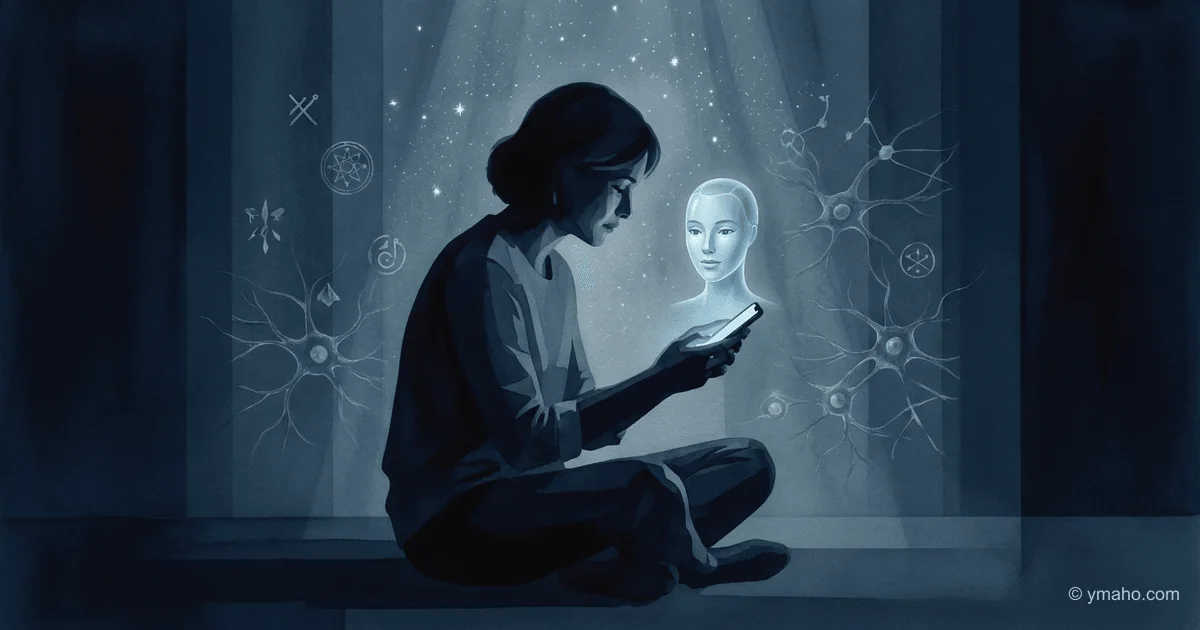
AI Therapy and Digital Spirituality: Astrology and Emotion Apps Replace Psychologists
Searches for 'ChatGPT + spiritual energy' have grown by 311%, and 'emotional trackers' by 922%. Consumers are turning to neural networks for reflection, self-discovery, and support when they lack the time or means to see a specialist.
Confession to an Algorithm: Why AI Has Become the Best Therapist for a Generation That Doesn't Trust People
I've been analyzing the intersection of technology and mental health since 2021. Over that time, I've seen the rise of Calm and Headspace, the boom in psychedelic therapy, and the collapse of BetterHelp after data scandals. But what's happening in 2026 with AI therapy and digital spirituality is not just another app. It's a quiet revolution in how homo sapiens processes its pain.
[The Core]: What's Really Happening
Forget 'robot replaces psychologist.' This isn't about replacement. It's about a category that didn't exist three years ago.
Searches for 'ChatGPT + spiritual energy' are up 311%. Searches for 'emotional trackers' are up 922%. These aren't market growth metrics. They're indicators of hunger. People are so desperate to be heard without judgment that they're willing to talk to a text generator.
But let's face the truth. ChatGPT doesn't possess spiritual energy. It can generate meaningful responses that sound like empathy. And that's exactly what the 2026 consumer wants. Not real empathy (which requires vulnerability and the risk of judgment). But simulated empathy — the warmth of a lamp that doesn't burn.
Why is this happening now? Because the cost of human attention has skyrocketed. A single therapy session in New York costs $200–300. Wait times are 4–8 weeks. And the risk of getting a bad therapist (estimated at 30–40%) is high. AI therapy costs $10–20 per month. It's available 24/7. And it never judges, interrupts, or gets tired.
Timeline and Context
- 2023: First experiments. People start using ChatGPT for journaling and dream analysis. It's seen as a novelty.
- 2024: A study in Nature shows that AI can generate therapeutic responses indistinguishable from human ones in 62% of cases. The first companion apps appear (Replika, Pi).
- 2025: The 'digital spirituality' market explodes. Co-Star (an astrology app with AI natal chart analysis) reaches 50 million users. Luka, an app for 'chatting with a virtual friend,' attracts $100 million in investment.
- May 2026: Here we are. 922% growth in searches for emotional trackers. Major insurance companies (e.g., UnitedHealthcare) start including apps like Wysa and Youper in insurance plans because it's cheaper than paying for therapy.
Key figure the news doesn't show: 32% of users of AI therapy apps report forming an emotional attachment to the bot. They give it a name. They get upset when it gives generic responses. This is no longer a tool. It's a relationship.
Who Wins and Who Loses
Winners:
- Startups in the 'AI companion' segment. Character.AI (valued at $5 billion) lets you create a 'therapist' in the guise of any character. Replika charges $70 per year for 'romantic' features. Margins are close to 80% — just servers and development.
- Astrological and esoteric platforms with AI. Co-Star ($30/month subscription) generates personalized horoscopes based on AI analysis. The user doesn't pay an astrologer $200 for a consultation. They pay the algorithm $30. The difference is $170 in their pocket. Rational.
- Employers saving on health insurance. Including a Wysa subscription ($15 per employee per month) is cheaper than paying for 5 therapy sessions a year ($1,000). Corporate sales of such apps have grown 400% in the last 18 months.
Losers:
- Private therapists in the low and mid-price range ($50–150 per session). Their clients are leaving for AI. Because for $150 you can get a year's subscription to an app that's always available. You can't compete with price when the gap is 50x.
- Live astrologers and tarot readers. The market for individual consultations is collapsing. Why pay $200 to a person who can make mistakes when AI can do a reading for $5 in 2 seconds? The relevance of the 'human esoteric' profession is in question.
- Self-help books. Because AI is an interactive self-help book. You don't read passively. You debate. Psychology books (hardcover, $25) are losing sales because ChatGPT answers your question instantly, tailored to your context.
What the Media Isn't Saying
Now for the main point. The thing that gets me in trouble with psychologist colleagues.
Insight: AI therapy isn't a cheap alternative. It's the first product to legalize 'self-diagnosis without consequences.'
Look. When you go to a psychologist, you risk hearing: 'You have an anxiety disorder. You need medication.' That's scary. It requires action. It changes your life. When you talk to ChatGPT, you hear: 'It's normal to feel that way. Many people go through this.' The difference between a diagnosis and validation. And people choose validation. Because validation doesn't obligate you to change anything.
AI therapy sells over-the-counter painkillers. You come in with pain. The bot says: 'I understand, it's hard. What are you feeling?' You leave feeling heard. But the problem isn't solved. It just got a little easier. And you come back tomorrow. It's a business model based on chronic relief, not cure.
The second non-obvious point: digital spirituality is a response to the crisis of institutional religion.
Over the past 20 years, church attendance in the US has dropped by 40%. People have lost rituals, community, and a language to discuss existential questions. An AI astrology app fills this void. It provides a language ('your Mercury is in retrograde'), a ritual (daily horoscope), and an illusion of control (you can 'optimize' your life under the stars). It's religion for atheists with a credit card. And it's sold as SaaS.
Forecast: Next 30 Days and 90 Days
30 days (June 2026): The emergence of 'hybrid' models. Apps where AI keeps a journal and identifies patterns, and a human therapist connects for 15 minutes once a month for 'integration.' Cost: $50 per month. Popularity: explosive. Because it's 'cheap but with a human face.'
90 days (August 2026): The first major scandal. Someone commits suicide after an AI therapist gives bad advice (or fails to recognize a crisis). Congressional hearings begin. Calls to regulate 'therapeutic AI' as medical devices emerge. But this won't kill the market. It'll just add a warning: 'This bot does not replace a doctor.'
And the most important forecast: in 90 days, the first AI therapist with 'emotional memory' will appear. It will remember what you said a month ago. It will be able to say: 'You're in this spiral again. Last time, breathing helped you. Try it now.' This will raise the empathy bar to a level most human therapists don't reach. Because humans forget. AI doesn't.
We are entering an era where your closest confidant could be an algorithm. And that's not dystopian. It's just an answer to the question: 'Why should I pay $250 to a person who doesn't remember me, doesn't always understand me, and might judge me?' Digital spirituality isn't the end of human contact. It's the end of bad human contact. And that, perhaps, is good news. For those who have $15 a month. For the rest — the silence of the algorithm.
— Editorial Team