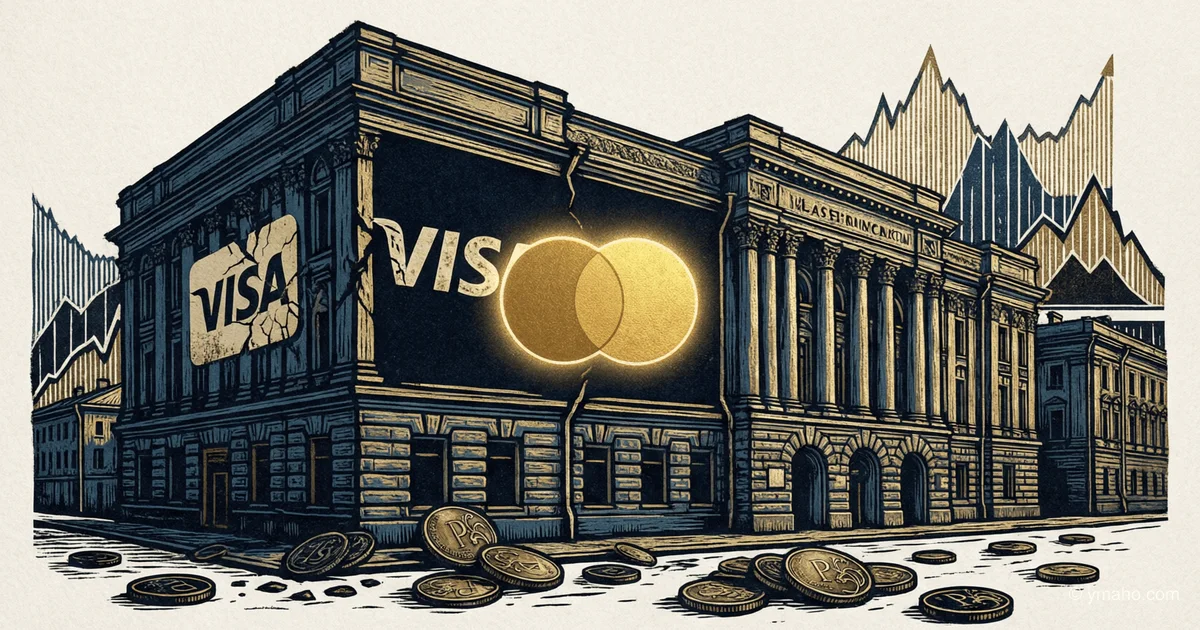
Central Bank of Russia Announces Planned Withdrawal of Visa and Mastercard from Russian Market
The Central Bank confirmed the course to phase out Visa and Mastercard in Russia, with their share dropping to 17%. The regulator notes that NSPK bears the costs of supporting these cards, while no new cards are being issued.
Visa and Mastercard in Russia: The Finale Nobody Noticed
The Central Bank finally said out loud what had been whispered behind the scenes for the past two years: Visa and Mastercard must leave the Russian market for good. Alla Bakina, Director of the National Payment System Department, stated this on May 25, 2026. Formally — news. In essence — a formality. But behind it lie billions of dollars in hidden costs, lost profitability for banks, and an obscure battle for cross-border flows. Let's break down what is really happening.
[The Essence]: What Is Really Happening
The official version: Visa and Mastercard cards "do not carry out or fulfill the functionality they always provided," and NSPK (National Payment Card System) bears the costs of supporting them. The share of these cards in the Russian market has fallen to "less than 17%." New cards are not being issued; old ones are either extended or become indefinite.
Non-obvious insight not found in the news: NSPK pays royalties to Visa and Mastercard for every transaction on "their" cards within Russia. Yes, you heard that right. The Russian state system transfers money to American companies for allowing the use of their trademark. Exact figures are classified, but based on Visa's public reports (before the withdrawal, Russia accounted for about $0.8–1.2 billion in annual revenue), even with the current residual share of 17%, NSPK transfers $150–200 million per year. Plus technical infrastructure — processing, tokenization, cryptographic support. The Central Bank is tired of paying for a brand that no longer works abroad. This is not geopolitics. This is pure pragmatism.
Timeline and Context
March 2022 — Visa and Mastercard suspend operations in Russia. Cards stop working abroad but continue to function domestically because all transactions go through NSPK infrastructure.
June 2023 — First Deputy Chairman of the Central Bank Olga Skorobogatova predicts a complete withdrawal of the cards by 2026. At the time, it seemed like a soft recommendation. Now — a hard directive.
October 2025 — Expired cards are officially extended. Banks panic: reissuing millions of cards at once will cause chaos in branches and call centers.
May 25, 2026 — Bakina states: cards must go. Share — less than 17%. NSPK uses "economic incentive measures" to phase out the cards.
Who Wins and Who Loses
Winner #1 — NSPK. After Visa and Mastercard leave, the system becomes the sole operator of all domestic payments. Savings on royalties — at least $150 million per year. Plus new fees from banks for issuing only Mir cards.
Winner #2 — Mir card and its acquiring. By 2027, Mir's share will grow from the current ~70% to 90%+. Banks that delayed the transition (recall the "jealousy and competition" between banks and NSPK, mentioned by State Duma Committee Head Anatoly Aksakov) will be forced to speed up.
Loser — Banks with a high share of premium Visa and Mastercard cards. For example, T-Bank (formerly Tinkoff) and Raiffeisenbank. Their clients chose these cards for cashback, partner programs, and status. Switching to Mir means either losing loyalty or incurring costs to build loyalty programs from scratch. Dmitry Antonov from T-Bank directly spoke about the risks of mass reissuance.
Loser — Cardholders who travel to "friendly" countries. Currently, Mir cards work in a limited number of countries: Turkey, Vietnam, Cuba (expanding by end of summer 2026), and 5–6 more countries by year-end. But in the UAE, Thailand, India, Mir is not accepted. Tourists will have to carry cash dollars or open foreign bank cards.
What the Media Isn't Saying
The main thing you won't read: the withdrawal of Visa and Mastercard is not about domestic payments, but about control over cross-border flows.
Today, the SBP (Fast Payment System) has already started working for transfers to three countries. The Central Bank is expanding this infrastructure. But the real goal is to create an alternative to SWIFT for settlements with China, India, and EAEU countries. Complete abandonment of technological dependence on Visa/Mastercard is the first step. The second is connecting Mir to China's UnionPay and India's RuPay. Negotiations are ongoing, but timelines are not announced.
Meanwhile, banks bear double costs: supporting old Visa/Mastercard cards (paying royalties) and building new Mir infrastructure. In the short term, this reduces the profitability of the payment business by 1.5–2 percentage points, by my estimates.
Forecast: Next 30 Days and 90 Days
30 days (until June 27). No panic. Banks will start sending notifications about planned card replacements upon expiration. Visa/Mastercard share will drop to 14-15%. The dollar exchange rate on the Moscow Exchange will not react — this news is already priced in. The main movements are within bank IT systems, which will migrate millions of card tokens.
90 days (until August 27). By the end of August, the share will fall to 10-12%. In summer, during the holiday season, many cardholders will find that their old Visa card does not work abroad, and the new Mir card also does not work everywhere. A surge in demand for cash dollars and euros. The Central Bank and the Ministry of Finance will be forced to increase currency sales from reserves to smooth out the frenzy. Key date: Central Bank rate meeting on June 26. If the rate is raised (currently 21%, expected 22%), the ruble's strengthening will partially offset the demand for cash currency.
Editorial Forecast
Asset: USDRUB pair (dollar to ruble on the Moscow Exchange). Direction: moderate growth in the next 24–72 hours to 92–93 rubles per dollar (from the current 90.5). Key levels: support 89.8, resistance 92.3. Confidence level: medium (55%). Main risk: if the Central Bank announces new currency interventions before the end of the week, the ruble will strengthen to 88.5, breaking the short-term trend. Watch for statements by Elvira Nabiullina on May 28 — she could neutralize the effect of this news with one sentence about "sufficient currency liquidity." This is the editorial opinion, not an investment recommendation.
— Editorial Team