Scientists Propose Nanoparticles to Combat Age-Related Immune Aging
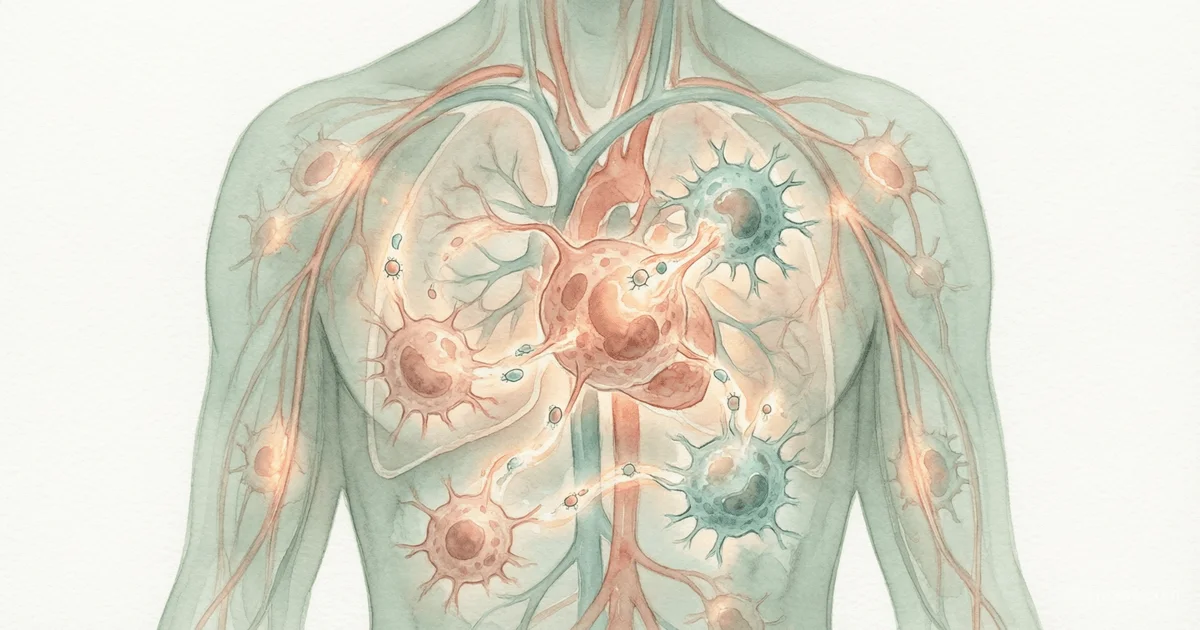
A perspective article in ACS Nano describes a strategy for metabolic reprogramming of immune cells using nanoparticles to reverse immune aging and promote health in old age.
Analytical Summary: Nanoparticles Against Immune Aging — A Prospect That Will Remain a Prospect for Another 5 Years
Date: May 27, 2026
Source: ACS Nano, Perspective article, group of Shashi Gujar (Dalhousie University), Pieter Cullis (UBC).
[The Gist]: What Is Actually Happening
On May 25, 2026, a perspective article was published in ACS Nano, in which a group of Canadian scientists from Dalhousie University and the University of British Columbia proposed a strategy to combat age-related immune aging using nanoparticles.
A crucial detail lost in 99% of news reprints: this is not an experimental study with animal or human data. It is a review perspective article, meaning the authors compiled existing data from immunometabolomics and nanoscience and proposed a conceptual framework for future research.
Key figures to know:
- The primary target is immunosenescence: age-related decline in immune system competence, leading to vulnerability to infections, cancer, and autoimmune diseases.
- The mechanism is metabolic reprogramming of immune cells: restoring the balance between glycolysis and oxidative phosphorylation (OXPHOS), which is disrupted with age.
- The tool is nanoparticles as a platform for delivering metabolic modulators.
Non-obvious insight (what headlines don't say):
Notice the author list. It includes Pieter Cullis — a legend in the world of lipid nanoparticles, the man who pioneered the technology underlying the Pfizer/BioNTech and Moderna mRNA vaccines.
The insight is that Cullis has long stepped back from active R&D and is primarily involved in consulting and venture capital. His involvement in this article is a marker of commercial interest, not pure academia. If Cullis is putting his name on the topic of "nanoparticles against immune aging," it means specific startups and specific money are behind it.
Watch for patent filings from Cullis and his network. Likely within the next 12 months, we will see the creation of a spin-off company attempting to commercialize this concept. For now, it's just a perspective article, but behind it is a well-oiled mechanism for translating academic ideas into business.
Timeline and Context
- May 8, 2026 (publication in ACS Nano): The article appears on the journal's website. This is the key date, though news reached the broader audience only on May 25-27.
- 2020-2025 (accumulation of foundation): Over the past 5 years, hundreds of papers on immunometabolism have been published — from elucidating the role of glycolysis in T-cell activation to demonstrating how aging disrupts the metabolic plasticity of immune cells. The authors systematize this body of work.
- 2023-2024 (successes of nanoparticles in related fields): Studies on nanoparticles with senolytics (killing senescent cells) and nanoparticles for in vivo genome editing are published. The authors claim that the same platforms can be adapted for metabolic reprogramming.
Who Wins and Who Loses
Winners:
- Gujar Group (Dalhousie University): Their academic reputation grows. A perspective article in ACS Nano is an invitation to major conferences (Keystone Symposia, Gerontological Society of America) and a bid for grants from the Canadian Institutes of Health Research (CIHR) and NIH. Expect their research budget to increase by $500,000–$1,000,000 USD in the next 1-2 years.
- Venture capital funds specializing in longevity (Altos Labs, Calico, Longevity Vision Fund): They receive academic justification for investing in the "immune rejuvenation via nanoparticles" direction. This article is a "green light" for due diligence on startups working in this niche.
- Companies already having LNP (lipid nanoparticle) platforms: Moderna, BioNTech, Arbutus Biopharma, Acuitas Therapeutics. They have a ready technological foundation. They only need to "switch" the payload from mRNA for vaccines to metabolic modulators for immune cells. For them, this market is almost a free option.
Losers:
- Skeptics in gerontology: The older generation of aging researchers (e.g., from the Buck Institute) who believe that "immune aging is a consequence, not a cause" face a challenge. If nanoparticles work, their paradigm of "aging begins in stem cells" may be revised.
- Companies betting on "dirty" senolytics (Dasatinib + Quercetin): These combinations, though effective in animals, have issues with selectivity and toxicity. If nanoparticles can metabolically reprogram immune cells without killing them, it could render "crude" senolytics obsolete.
What the Media Isn't Saying
- This is not a therapy. It's not even preclinical. Crucial distinction: a perspective article is not a research article with experimental data. The authors did not create a specific nanoparticle, did not test it on mice, did not measure any biomarker of immune aging in vivo. It is an "expert opinion" with a literature review and proposed directions. Technology Readiness Level (TRL) is 1 (lowest).
- The problem of immune cell delivery. The article optimistically talks about "rapid expansion of nanoparticle science." But the reality is: delivering a nanoparticle to a T-cell or macrophage in vivo is technically challenging. As researchers from Johns Hopkins University showed in another study, T-cells "resist" nanoparticle uptake, and only about 10% of constructs successfully enter the cell and deliver the payload. The perspective authors gloss over this problem.
- What "metabolic reprogramming" means is still unclear. The ACS Nano article proposes to "discuss possibilities." But there are no specific candidate molecules to deliver. Will they be inhibitors of metabolic enzymes? AMPK activators? mTOR inhibitors? Sirtuins? Right now, it's a "black box." Immunometabolism is a young field, and what works in mice may fail in humans.
- Competition from simpler approaches. There is evidence that common interventions such as metformin ($2 USD per month per dose), rapamycin (cheap generic), or even exercise already induce metabolic reprogramming of immune cells. If a cheap pill gives 30% effect and a nanoparticle gives 70% but costs $50,000 USD per course, who needs it? The article does not discuss economics.
Forecast: Next 30 Days and 90 Days
30 Days:
No new experimental data will emerge. There will be a wave of news reprints in media specializing in longevity and anti-aging. Noise levels will rise, but scientific content will not. Monitor the Twitter/X accounts of the authors (Shashi Gujar, Pieter Cullis) — if they start announcing grants or startup creation, that will be a signal.
90 Days:
Expect two types of events:
- Publication of comments/responses in ACS Nano or other journals (Nature Aging, Immunity) from competing groups. There will be disputes over priority: who first proposed this concept? This is standard academic jockeying.
- Grant applications to CIHR (Canada) or NIH (USA) from the Gujar group with specific aims: creation of a lipid-based nanoparticle (LNP) with a payload of a metabolic enzyme inhibitor. If the grant is funded (amount around $500,000–$750,000 USD over 3 years), it will signal that the concept is moving into the laboratory development phase.
What else is critically important to track:
- Cullis startup activity: Pieter Cullis has a history of founding companies. If within the next 6 months a new company is registered with Cullis and Gujar, focusing on "immuno-rejuvenation via nanoparticles," that will be the main indicator that the article was not just an academic exercise but part of a commercial strategy.
- Competing approaches: Follow the work of Vishwa Deep Dixit's group (Yale) on metabolism of aging immune cells and Ronald DePinho's group (MD Anderson) on telomeres and immune aging. If they start publishing nanoparticle studies, the race has begun.
Analyst's Verdict:
This news is a classic example of the science hype cycle, where a perspective article is presented as a breakthrough. In reality, we have a conceptual framework without a single graph of experimental data. The technology is at TRL 1-2.
The next 2-3 years will be spent on fundamental research: selecting a specific molecular target, creating a nanoparticle prototype, testing in mice (first healthy, then with accelerated aging). Clinical trials in humans — no earlier than 2030, if we're lucky.
However, there is a long-term signal: the involvement of Pieter Cullis suggests that commercial entities see potential in this niche. For a venture investor, this is a topic for seed-stage investments — now, while the technology is cheap. But for a patient waiting for a "pill against aging," this is news that hope is far away.
Set a reminder to check the status in December 2026 — if by then at least one preclinical study (in vivo in mice) from this or a competing group has not appeared, the concept has hit its first serious difficulties. For now, we watch, but we don't hold our breath.
— Editorial Team