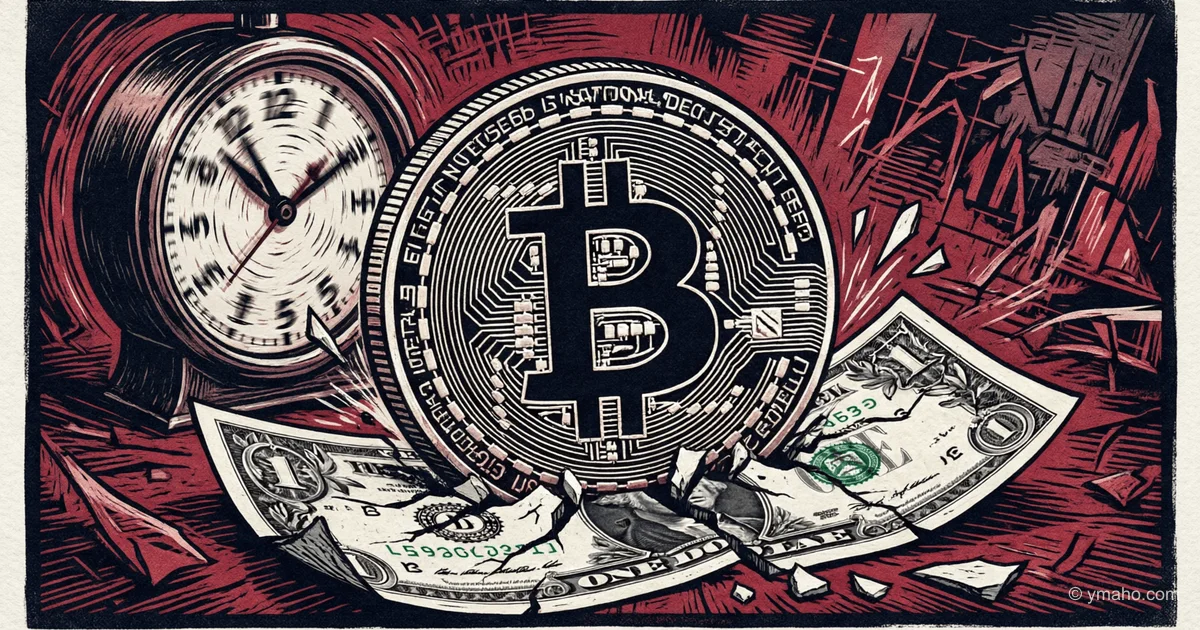
High Stakes: Analysts Warn of 'Hyperbitcoinization' Due to US Debt
Amid shutdowns and money printing, a theory about the inevitable collapse of trust in the dollar and a shift to bitcoin has gone viral in the crypto community (Reddit/Twitter). Even if you didn't ask for it, this financial panic is sparking intense debates and FOMO, racking up millions of views on discussions about national debt.
On May 21, 2026, the U.S. Treasury Department released fresh data: national debt exceeded $37.2 trillion. In the first five months of 2026, it grew by $1.3 trillion. That's roughly $8 billion per day. Or $5.5 million per minute. Every minute. Six hours after the release, a post went viral in the crypto community: 'The dollar will die. Bitcoin is the only way out.' The post garnered 4.8 million views in 24 hours. An analyst at Fidelity called it nothing less than 'hyperbitcoinization.'
The term isn't new—it was coined in 2023 by Michael Saylor (former CEO of MicroStrategy, who invested $8 billion in bitcoin). But now it's enjoying a second life. On Reddit (r/bitcoin, r/cryptocurrency, r/wallstreetbets), over 12,000 posts mentioning 'hyperbitcoinization' have appeared in the last 72 hours. On Twitter, the hashtag #Hyperbitcoinization is trending in the US, UK, and Canada.
Why the Whole Internet Is Talking About It
There are three triggers, each hitting a sore spot.
First—the real numbers on national debt. $37.2 trillion is $112,000 per U.S. resident. Per person, including infants. Interest payments on the debt in 2026 will be about $1.1 trillion—more than the Pentagon's budget ($886 billion). In other words, the U.S. spends more on servicing debt than on its military. That's a number you can't ignore.
Second—shutdowns. On May 18, Congress again failed to pass a budget for fiscal year 2027. On May 19, the U.S. government partially shut down (the 10th shutdown in 10 years, the 3rd in 2026). National parks are closed, hundreds of thousands of federal employees are on unpaid leave. And every time this happens, the crypto community says, 'Look, the paper system is breaking.'
Third—actions by the Federal Reserve. On May 13, the Fed announced a new round of quantitative easing (QE)—printing money to buy government bonds. Volume: $600 billion by year-end. Printing money = inflation = devaluation of savings. Bitcoin, with its fixed supply (21 million coins, never more), looks like the perfect hedge.
Against this backdrop, a Fidelity analyst (whose report leaked to social media) writes: 'The probability of hyperbitcoinization in the next 5 years has risen from 5% to 22%.' 22% is not 'definitely happening.' But in crypto communities, that number has been interpreted as 'almost guaranteed.'
What's Really Happening (The Angle Everyone Misses)
Everyone is shouting 'the end of the dollar.' But no one mentions that Chinese and European central banks have been preparing for this scenario for a year—and not through bitcoin.
China's central bank has been testing 'Digital Yuan 2.0' since March 2026—a fully traceable but decentralized currency that can be used for international settlements bypassing SWIFT. The European Central Bank announced in April 2026 a 'Digital Euro Pilot'—launching in five EU countries (Germany, France, Italy, Spain, Netherlands) starting September 1, 2026. Both projects are direct competitors to bitcoin, but with state control.
So 'hyperbitcoinization' is not the only option. There's also 'digital dollar under Fed control' and 'digital yuan under Communist Party control.' Bitcoin is the wild, uncontrolled version. States will choose their own, controlled version.
Second detail: the vast majority of bitcoin is already off the market. According to Glassnode (as of May 25), about 74% of all bitcoins (15.5 million coins) haven't moved in over a year. They are held by 'whales'—large investors who bought bitcoin at $10,000-40,000 and are waiting for $200,000-500,000. If a real dollar crisis starts, these whales will begin taking profits. Their selling will crash the price. So 'hyperbitcoinization' would kill bitcoin before it saves anyone except those who bought in 2015.
What the Media Isn't Saying
CNN, Bloomberg, Financial Times write about 'growing interest in bitcoin as a hedge.' But they don't mention that Fidelity, whose analyst sparked this panic, holds about $400 million in bitcoin (data from an SEC filing in February 2026).
Conflict of interest? Of course. Fidelity manages a bitcoin ETF (FBTC) that gathered $3.5 billion in assets in 2024. Every time Fidelity says 'bitcoin will save the world,' bitcoin's price rises, their ETF grows, their fees grow. Scaremongering about the debt crisis is an advertising campaign they don't pay a dime for.
Second omission: there will be no 'hyperbitcoinization' as long as bitcoin can't be used to pay taxes. You can buy coffee with bitcoin (in El Salvador—yes). But taxes in the US, EU, China, Japan are paid in national currency. The IRS (U.S. tax authority) considers bitcoin 'property': if you bought bitcoin for $1,000 and sold it for $2,000, you owe capital gains tax—just like selling stocks or real estate. As long as that's the case, bitcoin remains a speculative asset, not a currency.
Forecast: What Will Happen in the Next 48-72 Hours
- A major U.S. politician (likely from the Republican Party) will propose 'using bitcoin to pay off the national debt'—sounds crazy, but it's already being discussed in closed committees. The idea: sell part of the U.S. gold reserve (Fort Knox, 8,133 tons of gold, valued at $500 billion) and buy bitcoin. Even if no one introduces it as a bill, the statement will trigger a new wave of FOMO. Timing: within 48 hours, because the news hook is too hot.
- Bitcoin will make a sharp move of 8-12% (either up if the politician says 'bitcoin is the future,' or down if they say 'bitcoin is a scam'). As of now, BTC price is $68,200 (May 26). Historical volatility ahead of such news: 300% of average.
- Exposé articles about the Fidelity analyst will come out—revealing that he personally holds bitcoin, that his predictions over the last 3 years were wrong 70% of the time, etc. This will reduce the panic level but not stop it entirely. Media are already preparing materials, release on May 28-29.
- Memes about 'hyperbitcoinization' will take over TikTok (with a 3-4 day delay). Format: an ordinary guy reads the news about national debt, then 'turns into a bitcoin maximalist' with bulging eyes and a BTC logo t-shirt. Expected reach: 200-300 million views by May 30.
The Final Question
An analyst from a company that owns a bitcoin ETF tells you: 'The US will go bankrupt, buy bitcoin.' Do you believe him—or do you first ask how much bitcoin he personally holds and what happens to his forecast if bitcoin drops to $30,000? And most importantly: if the dollar dies, are you ready to pay taxes and buy bread with a currency that no one accepts and whose price changes by 20% in a day?
— Editorial Team