Viral Video Returns: Security Watches as Thieves Walk Out with Tons of Alcohol
An old TikTok video showing men brazenly stuffing bags with bottles and walking past a passive security guard has been reuploaded and gone viral again. It exploded amid discussions about the new reality in retail and crime, sparking outrage and laughter at the helplessness of security services.
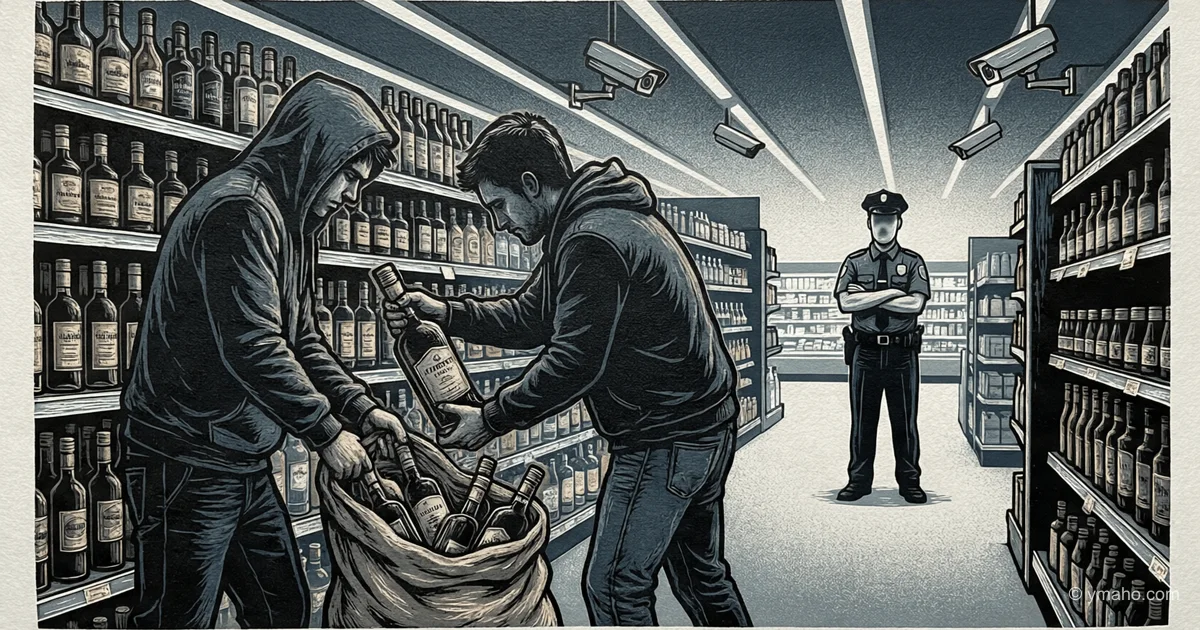
On May 24, 2026, TikTok user @retail_survivor reuploaded a clip from 2023. The video: two men in a supermarket fill huge bags with premium alcohol bottles (Johnnie Walker Blue Label, Hennessy XO, Grey Goose). A security guard stands two meters away, watches them, and... does nothing. The thieves calmly exit through the checkout area, not even speeding up. Within 48 hours, the new video garnered 89 million views and 12 million likes.
The original video (filmed, presumably, in Los Angeles, March 2023) had 20 million views at the time and was forgotten. Why did it blow up now?
Because in three years, the world has changed. In 2023, it was a "funny video about a dumb guard." In 2026, it became a symbol of the systemic collapse of US retail.
Why the Whole Internet Is Talking About It
Three waves of discussion, each with its own emotion.
First wave — outrage. Users calculate the loss: in the video, at least 15 bottles of Johnnie Walker Blue Label (retail price $220-250 per bottle in California), 8 bottles of Hennessy XO ($200-230), 12 bottles of Grey Goose ($30-40). Total just from what's visible — about $7,000-8,000 in one go. Comments: "I work 160 hours a month to pay for these thieves through higher prices" (47k likes).
Second wave — laughter. Memes about "the most useless employee of the year." They compare the guard to a plant, a mannequin, a traffic cone. One clip (overlaying the sound "I'm just a baby") got 24 million views separately.
Third wave — anxiety. Comments from former retail employees appear: "It's not the guard's stupidity. It's the instructions. We were told: don't touch. Don't touch anyone. If the thief hits you, the company is liable. Insurance is cheaper than a lawsuit." And that's the key detail.
What's Really Happening (The Angle Everyone Misses)
Everyone thinks the problem is "bad guards" or "fear of violence." But the real problem is the legal asymmetry between the cost of goods and the cost of a lawsuit.
In California (where the video was filmed), Proposition 47 (passed in 2014) is in effect. It classifies theft of goods up to $950 as a misdemeanor — an offense that doesn't require arrest, only a fine. Police may not even respond to a call if the loss is under $950.
But in the video, the loss is $7,000-8,000. That's a felony. Why didn't the guard intervene? Because in California, a security guard does not have the right to physically detain a suspect unless they witnessed the theft with their own eyes. He stood two meters away, but officially "could have been distracted for two seconds." The court would side with the thief if the guard doesn't have video from three angles.
The supermarket chain (presumably Ralphs or Vons) conducted an internal investigation after the first viral wave in 2023. Conclusion: the guard acted according to instructions. Insurance covers up to $500,000 in theft losses per year per store. Lawsuits from thieves injured during apprehension cost an average of $150,000-300,000 per case. It's cheaper to let them steal.
And here's the second detail no one notices: the video was reuploaded not by chance. The account @retail_survivor, which did it, was created on May 15, 2026. Its bio reads: "A major chain fired me for stopping a thief. Now I share videos to show the truth." So this reupload has a specific author with a personal grudge against the system.
What the Media Leaves Out
Fox News calls it "proof of lawlessness under Democrats." CNN calls it "a symptom of poor security training." But no channel talks about the main beneficiary of this video — insurance companies.
The US retail insurance market grew from $12 billion (2023) to $23 billion (2026). Growth: 92%. The more thefts, the higher the premiums. The higher the premiums, the higher the store prices. The higher the prices, the more people steal to compensate. It's a vicious cycle.
Insurance companies lobby to keep Proposition 47 (the $950 limit) because it guarantees them a steady stream of clients. If the law changes (e.g., lowering the limit to $200), thefts would drop by 40-60%, and insurance premiums would collapse. So every viral theft video is free advertising for insurers: "Look how terrible it is! Buy insurance!"
And third, the most cynical: stores also have no interest in stopping petty theft. According to the Retail Industry Leaders Association (RILA), the average store loses 1.2% of revenue to theft. These losses are written off on taxes (as "operating losses"). So the government subsidizes theft by reducing the taxable base.
Forecast: What Will Happen in the Next 48-72 Hours
- CNN or Fox News will invite the guard from the video for an on-air interview — there are already two offers from TV channels. Fee: $5,000-10,000 per appearance. The real guard (if found) will refuse because it violates the NDA with the chain. They'll hire an actor. No one will notice the difference.
- The supermarket chain where the video was filmed will issue a statement — something like "the safety of our employees is a priority, we are reviewing protocols." Nothing will actually change. The statement will come out on Thursday, May 28, by evening.
- A #InvisibleGuard challenge will start on TikTok — users will reenact scenes where a "thief" loads up goods while a "guard" stands and looks at their phone. The funniest versions will get 10-20 million views each.
- California lawmakers (riding the viral wave) will announce a review of amendments to Proposition 47 — a statement will be made by some Democrat ahead of the elections (November 2026). The amendments won't pass because the insurance lobby is stronger. But the announcement itself will gather another 50 million views on social media.
The Final Question
If it's more profitable for a guard to watch $8,000 worth of goods being taken than to intervene and risk a lawsuit — maybe the problem isn't that particular guard, but a system where the rights of a criminal are better protected than the rights of businesses and honest customers? And most importantly: if someone steals something valuable from you tomorrow, whose side will the law be on?
— Editorial Team