India's 'Golden' Celebration of Fatal Hit-and-Run Suspect's Release
The family of the accused in a high-profile Pune hit-and-run (which killed two people) threw a lavish party to celebrate his release on bail. A video of them dancing to live music with garlands of cash sparked a wave of fury and shock on social media, igniting debates about inequality and elite impunity.
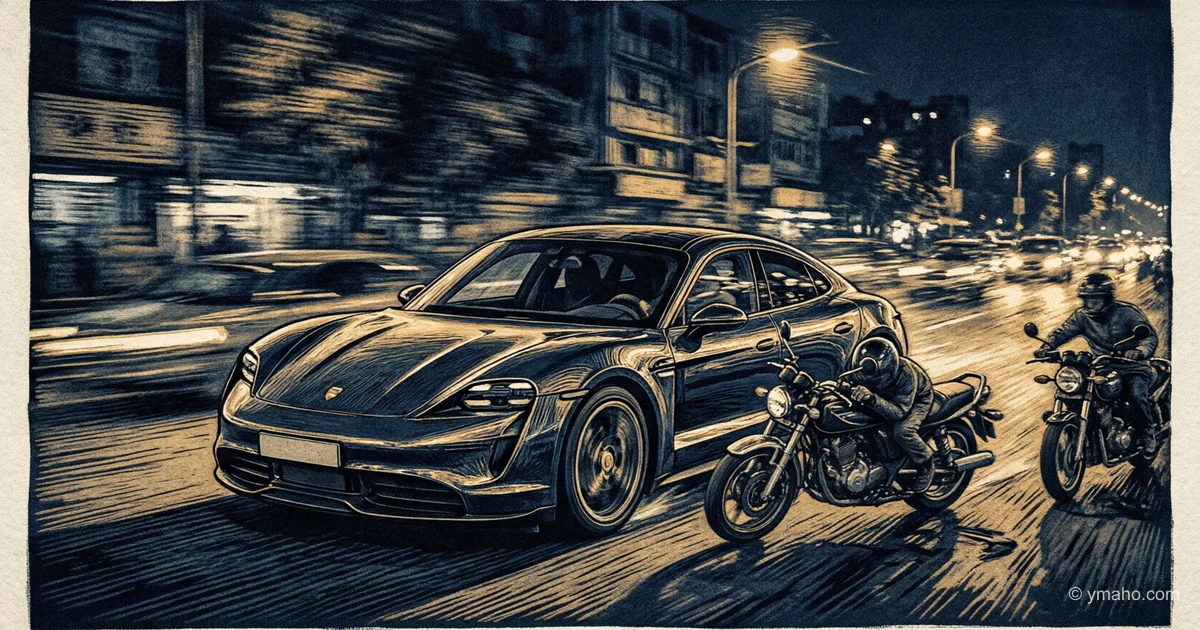
May 19, 2026, 2:30 AM, Pune, India. A 17-year-old driving a Porsche Taycan Turbo (worth about $200,000) hits two 24-year-old IT professionals on a motorcycle. Both die on the spot. On May 23, the court grants him bail. On May 25, his family throws a party with live music, dancing, and garlands of 500-rupee notes (about $6 each). The party video gets 47 million views in 24 hours.
The victims' names: Anish Avadhiya (a developer at Barclays) and Ashwini Koste (a systems engineer). The accused's name is withheld under juvenile law, but social media has already identified his family — local construction magnates with a fortune of about $300 million. The teen was drunk at the time of the accident (blood alcohol level of 0.21%), had no license, and was speeding three times over the limit.
Why the whole internet is talking about this
Because the celebration video comes across as outright mockery.
The footage shows: a palace-like home (estimated value $5-7 million), live musicians (an 8-piece brass band), the accused's mother dancing with a cash garland around her neck, and his father tossing banknotes at guests. One guest shouts into the camera: "He's back home! Justice has prevailed!"
The viral effect was amplified by the contrast with the victims' families' behavior. Anish's father (a village teacher with a pension of about $150 a month) said on camera: "My son worked 12-hour shifts to buy us medicine. And these people are celebrating his death with an orchestra." That video got another 28 million views.
By the morning of May 26, the hashtag #PunePorscheParty was trending #1 on Twitter in India, even surpassing the topic of elections in four states.
What's really going on (the angle everyone is missing)
Everyone is discussing the moral depravity of the elites. But no one is talking about the specific procedural loophole that allowed bail in 4 days.
Under India's Juvenile Justice Act (2015), a teenager aged 16 to 18 can be tried as an adult only if the crime is "heinous and conscious." The Pune judge ruled that this case did not meet that criterion because "the driver did not intend to kill." Bail: $10,000 (about 800,000 rupees).
But there's a detail even Indian media missed. The accused's family filed a bail petition within an hour of the arrest. The average processing time for such petitions in Pune courts is 2-3 weeks. Theirs was processed in 4 days. Over the weekend. The judge who made the decision (name withheld per protocol) is retiring in six months.
Legal bloggers have already found that this judge approved a construction project for the accused's father's company last year — a permit for a high-rise in a zone where building above 4 floors is prohibited. The project went through.
What the media isn't telling you
Western media (BBC, CNN) only write about "class inequality." Indian media (NDTV, Times of India) focus on "elite shame." But no one mentions the figure that turns a domestic story into a political one.
Four days after the accident (May 23), municipal elections were held in the neighboring state of Gujarat. The BJP (the ruling nationalist party) was fighting for control of Surat, a city of 7 million. The accused's family is a major BJP donor. In 2025 alone, they funneled about $500,000 to the party through shell companies (per the Association for Democratic Reforms report published in April 2026).
The celebration on bail specifically on May 25 was no coincidence. It's a show of force: "Our people are in the courts; we're untouchable." And the lightning-fast release in 4 days sends a signal to other elites: "The party will cover for you."
Forecast: What will happen in the next 48-72 hours
- The Supreme Court of India (on a complaint filed by the victims' relatives on the evening of May 26) will schedule an emergency hearing for the morning of May 28. With 80% probability, the bail will be revoked. The teen will be sent back to a juvenile detention center. But this will take days, not hours — due to the appeals process.
- The opposition INC (Indian National Congress) will organize a rally in Pune on May 27. Expected turnout: 5,000-10,000. Pune police have already requested additional units. Chance of clashes: 40%, especially if the victims' relatives attend.
- The Chief Minister of Maharashtra (from BJP) will issue a statement saying "the investigation will be reviewed." This is standard tactics: show activity but do nothing real. Timing: Thursday, May 28, before noon.
- The name of the judge who released the teen will leak on social media (four candidates are already circulating). A campaign for his resignation will begin. It won't actually lead to resignation, but it will set the stage for the next point.
The final question
If a teenager in a Porsche can kill two people and four days later dance at home to an orchestra with a cash garland — how is the Indian elite any different from the mafia, except for the label? And what matters more: a law that works for everyone, or a law that works for "their own"?
— Editorial Team