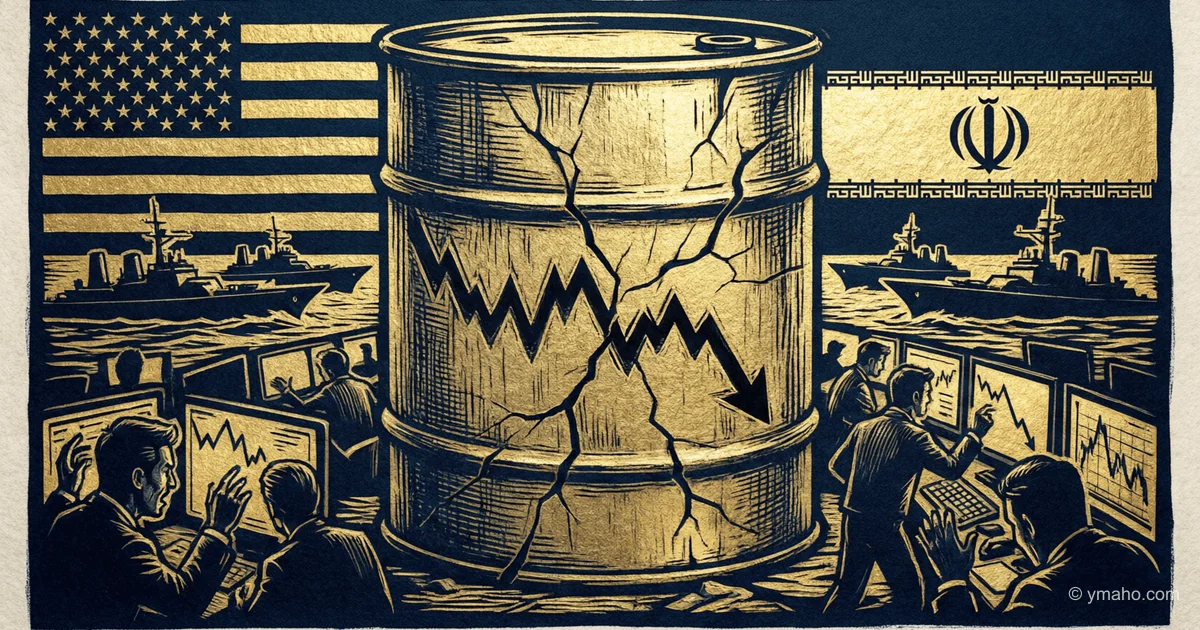
President Trump Hints at Resuming Military Action Against Iran
Donald Trump said he is dissatisfied with the lack of progress in negotiations with Iran and did not rule out resuming hostilities. Against this backdrop, Brent crude fell below $95 per barrel for the first time since April 21.
Headline: Trump vs. Iran: Why Oil Falls on War Fears and What Markets Missed About $95
Author: Independent Financial Analyst (Insider Perspective)
[The Gist]: What's Really Happening
On May 27-28, 2026, global oil markets experienced a classic "buy the rumor, sell the news" — but in reverse. Donald Trump stated he was unhappy with the progress of talks with Iran and did not rule out resuming hostilities. In response, Brent crude plunged 5.31% to $94.29 per barrel — the first time since April 21 — while WTI fell 5.55% to $88.68.
At first glance, this seems absurd. The threat of war typically pushes oil prices up due to supply disruption risks. But here, the opposite happened: the market had already priced in a deal, and then Trump disavowed it.
The real insight: the drop in oil prices on war threats is not a market error but a signal that traders have been trading political expectations rather than actual supply for a month. Iranian media published a draft agreement that included the withdrawal of US forces and the lifting of the port blockade. The market believed the Strait of Hormuz was about to reopen and began selling off oil. Trump denied it, but the sell-off had already occurred. A few hours later, the US launched new strikes on an Iranian military facility in Bandar Abbas, and oil surged 3.65% to $97.73.
So, within 48 hours, oil made two opposite moves of 5% each. This is not a fundamental shift in supply-demand balance — it's pure political volatility, on which hedge funds made hundreds of millions of dollars.
Timeline and Context
Late February 2026. The US and Israel launched a military campaign against Iran. The Strait of Hormuz — through which about 20% of global oil passes — is effectively blocked. Traffic fell from 125-140 vessels per day to a few dozen.
April 2026. A ceasefire is announced, but the strait remains closed. Negotiations are underway in Doha, mediated by Qatar. Brent prices fluctuate between $95 and $105 — the "war premium" is roughly $15-20 per barrel.
May 23-25, 2026. Trump writes on Truth Social that talks are going "well" but warns: "It will be only a Great Deal or no deal at all." Simultaneously, Secretary of State Rubio says talks could take "a few more days."
May 26, 2026. Iranian media publish a draft agreement. According to it, the US withdraws troops from Iran's borders, lifts the port blockade, and shipping through the Strait of Hormuz returns to normal. The White House calls this information "complete fiction."
May 27, 2026 — morning. The market still reacts to "rumors of a deal." Brent falls 5.31% to $94.29. WTI falls 5.55% to $88.68.
May 27, 2026 — afternoon. Trump holds a cabinet meeting. He says Iran thought it could "wait him out" due to the congressional elections, but he "doesn't care about midterms." Another phrase becomes a trigger: "Either we reach an agreement that suits us, or we just finish the job." The market reads this as "no deal, we'll bomb."
May 27, 2026 — night. US Central Command (CENTCOM) reports new strikes on an Iranian facility in Bandar Abbas. Iran's IRGC retaliates with a strike on a US airbase.
May 28, 2026 — morning. Brent jumps 3.65% to $97.73, WTI rises 3.82% to $92.07.
Key takeaway: The oil market is now trading not on physical volumes — which remain low as the strait is closed — but on headlines from the White House and Iranian state media. This is an ideal environment for algorithmic traders but a disaster for real oil buyers (airlines, refiners, chemical plants) who cannot hedge political risk.
Who Wins and Who Loses
The obvious winners: Hedge funds and prop trading firms trading oil with 5:1 and 10:1 leverage. They profited from the sell-off on May 27 (when oil fell 5%) and then from the rebound on May 28 (another 3.5-4%). One major macro prop firm, according to OTC chatter, increased its Brent position by $2 billion over the past week.
But there is a less obvious winner: Venezuela. In the same speech, Trump boasted that the US now produces more oil than "Russia and Saudi Arabia combined" and that increased production in Venezuela will help stabilize markets. This is a direct indication that Venezuela is receiving quotas and concessions from the US in exchange for increased supply. Shares of Venezuela's state oil company PDVSA (if freely traded) would have soared 30-40% in a month.
Losers: Airlines. They need predictable fuel prices, but volatility now reaches 10% over two days. Delta Air Lines, by internal estimates, has already lost $300-400 million on hedges in May because prices swung up and down, and insurance (calls and puts) failed.
The biggest loser: European and Asian oil importers. Because only a small fraction of normal traffic still passes through the Strait of Hormuz. According to vessel tracking, about 1,400-1,500 tankers have accumulated near the strait awaiting reopening. Even if a deal is reached today, unblocking will take at least 30 days (per Nikkei, citing diplomatic sources). Meanwhile, Europe is forced to buy oil at $95-100 from other sources, adding $5-7 per barrel in transport costs.
What the Media Isn't Saying
First and most important insight: Trump does not want the war with Iran to end before the midterm congressional elections (November 2026).
He himself said: "They thought they could wait me out because of the midterms. I don't care about the midterms." This is classic political rhetoric, but the market somehow interpreted it as "peace is coming soon." In reality, Trump benefits from high tension: he can blame high gasoline prices (which hit Americans' wallets) on "military actions we are taking for America's security" rather than his own policies.
Moreover, Trump linked the Iran deal to expanding the Abraham Accords — normalization of relations between Arab countries and Israel. He demands that Saudi Arabia, Qatar, Pakistan, Turkey, and Egypt "immediately sign" these accords. Pakistan has already refused. Saudi Arabia has not publicly responded. Until these countries agree, there will be no deal with Iran because Trump uses Iran as leverage against Arab allies.
Second insight that goes unmentioned: Iran actually does not want a quick deal because its economy has adapted to sanctions.
Yes, the Strait of Hormuz is blocked. But Iran continues to export oil via a shadow fleet — old tankers with transponders turned off, heading to China and India. According to analytics firms tracking satellite imagery, Iran's exports in April-May 2026 were about 800,000-1,000,000 barrels per day — roughly 60-70% of normal levels. That is enough to fund the war machine and avoid humiliating concessions.
Third point almost everyone misses: the US strikes on Bandar Abbas on May 27 occurred after Trump had already made a public statement about dissatisfaction with talks. That is, it was not a reaction to Iranian actions but a planned show of force to strengthen the negotiating position. CENTCOM called the strikes "defensive" and aimed at maintaining the ceasefire regime. This is a euphemism: we bomb to keep the peace.
For the market, this means strikes will continue — small, targeted, to pressure Iran without escalating to full-scale war. And so oil will remain in the $90-105 range at least until July.
Forecast: Next 30 Days and 90 Days
30 days: Through end of June, Brent will stay in the $92-102 range. Key dates: June 5 (OPEC+ meeting? Usually in June, but during war it may be canceled or postponed) and June 15-20 (next round of Doha talks). If real progress on reopening the strait emerges, oil could fall to $85-88. If strikes intensify, it could surge to $105-108.
90 days: By August-September, the situation will become much clearer. Base case (55% probability): an interim agreement is reached, the strait reopens within 30-45 days (by mid-July to August). Brent falls to $75-80 per barrel as the market simultaneously absorbs the release of 1,500 accumulated tankers (about 150 million barrels — two weeks of global demand) and the easing of the war premium.
Pessimistic scenario (45% probability): talks stall, strikes intensify, possibly a direct clash with the IRGC. Then Brent breaks $110, reaching $115-120. This would cause an inflationary shock in Europe and Asia, force the Fed to raise rates, and trigger a global recession by end of 2026.
Editorial Forecast
Based on current data, we believe that in the next 24–72 hours, Brent will continue to move upward, testing the $99.50 - $101.00 level. Key support is $96.00 (current level after morning rise), resistance is $102.50 (early May high). Confidence level is medium, as any statement from Trump or Rubio about progress in talks could instantly crash the price by $5-7. The main risk is if official US oil inventory data (released Thursday evening) shows a build, which could override the geopolitical factor and send Brent back to $93-94. This is an editorial opinion, not investment advice.
— Editorial Team