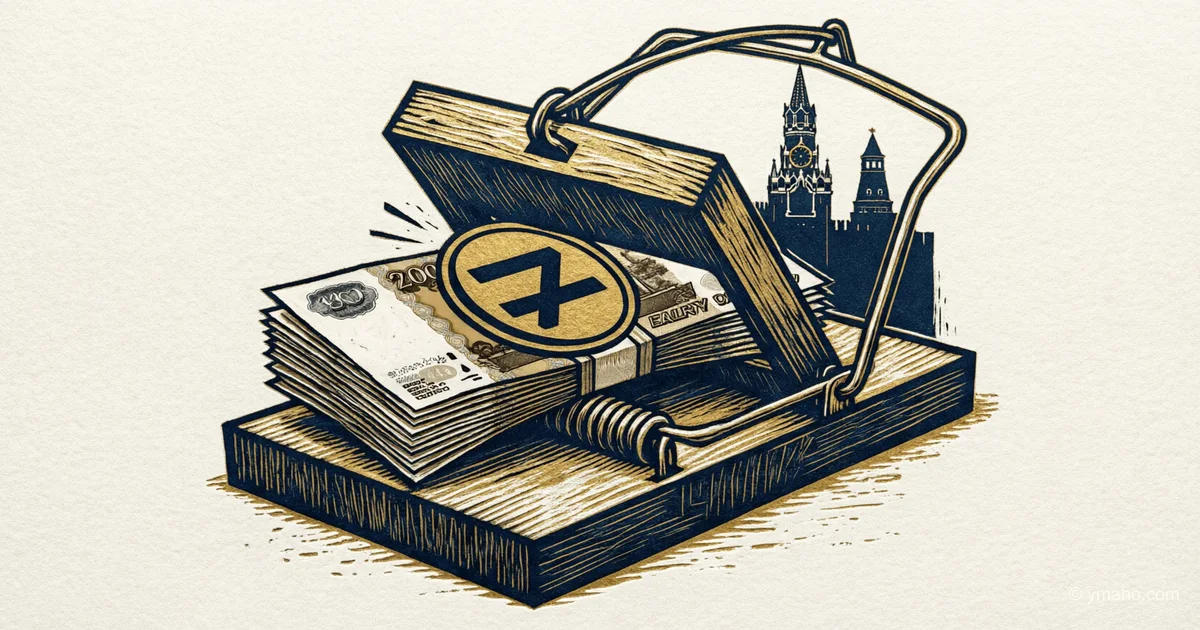
Finance Minister Siluanov Warns of Rising Government Spending Amid Uncertainty
Russian Finance Minister stated that due to increased global uncertainty, budget parameters will change and government spending will continue to rise. This could fuel inflation expectations and hinder the Central Bank's key rate cut.
Headline: Finance Minister Siluanov Admits: Budget Trap Has Snapped Shut, and the Central Bank Rate Will Remain High
Author: Independent Financial Analyst (Insider Perspective)
[The Gist]: What's Really Happening
Finance Minister Anton Siluanov gave an interview to Kommersant on May 26, 2026, in which he acknowledged what had been whispered behind closed doors for months: budget parameters will change, spending will continue to rise, and reserves are not infinite. The formal reasons are changing macroeconomic conditions and the Middle East conflict.
But the real essence is not that. Siluanov effectively admitted that Russia's fiscal policy has entered a turbulent zone with no easy way out. Since 2019, federal budget spending has risen from 16.6% to 20.0% of GDP, and in nominal terms, more than 2.3 times. Meanwhile, the deficit for January-April 2026 reached 5.8 trillion rubles (about $81.8 billion), 1.6 times higher than the planned annual deficit of 3.8 trillion rubles.
The true insight: Siluanov's statement is not a forecast but a capitulation to reality. The Ministry of Finance can no longer keep the budget within previously approved parameters because military spending and social obligations (the two "absolute priorities," in his words) are growing faster than the economy. And the economy, according to the Ministry of Economic Development's forecasts, will grow only 0.4% in 2026 instead of 1.2%.
Timeline and Context
2025. Budget spending reached 20% of GDP—an all-time high for peacetime (if this can be called peacetime). The deficit was covered by the National Welfare Fund (NWF) and borrowing.
January-April 2026. Spending amounted to 17.6 trillion rubles ($248.2 billion), revenue to 11.7 trillion rubles ($165 billion). That is, every third ruble spent by the state was not backed by tax revenue. The deficit of 5.8 trillion rubles already exceeded the liquid balance of the NWF (3.63 trillion rubles, or $51.2 billion) by more than 60%.
May 26, 2026. Siluanov gives an interview to Kommersant. Key points:
- Budget parameters will change due to shifting macroeconomic conditions.
- Spending is growing at an accelerated pace, reserves are not infinite.
- Social welfare and defense are absolute priorities; everything else is in question.
- There will be no spring amendments to the budget law, but flexibility is needed now.
Forecast for end of 2026. Analysts at Gazprombank believe that to meet the deficit target (3.8 trillion rubles), the Ministry of Finance would need to achieve a monthly surplus of 200 billion rubles until the end of the year. This is unrealistic. The actual deficit for the year will be 5-5.5 trillion rubles ($70.5-77.6 billion).
Who Wins and Who Loses
The losers are obvious: holders of ruble-denominated bonds (OFZs). Rising government spending in a stagnating economy means one thing: the Ministry of Finance will enter the market with new borrowing. Already, OFZ yields are in the 15-17% range, and additional supply could push them above 18-20%. This is a direct blow to bond prices, which will fall another 5-10% in the coming months.
The less obvious loser: private business, especially small and medium enterprises. Economist Dmitry Polevoy from Renaissance Capital warns: the Ministry of Finance will either have to cut spending (impossible given the current geopolitical situation) or find new sources of revenue. That means new taxes. A windfall tax, an increase in VAT or excise duties. Many private companies no longer have a safety margin, and any additional tax burden will finish them off.
Winners: defense contractors and the social sector. Siluanov directly stated that these two spending items will remain untouchable. Defense enterprises will continue to receive government orders, and pensioners and public sector workers will get indexation.
Also winning are gold importers (both physical and ETFs). Because a growing budget deficit and the prospect of monetization through the Central Bank (read: printing press) is a classic driver for gold. Siluanov's statements signal that inflation will remain high and real rates negative. Gold thrives in such an environment.
What the Media Isn't Saying
The first and most important insight: Siluanov let slip that the NWF is effectively empty for budget needs.
He said: "Reserves are not infinite. Fortunately, we have always been careful with the budget." Translating from diplomatic to plain Russian: the liquid part of the NWF is 3.63 trillion rubles. The deficit for four months is 5.8 trillion. So even if you take the entire NWF down to the last kopeck, it won't be enough to cover the hole for January-April. And there are still eight months ahead. The next tranche of NWF withdrawals is a matter of "when," not "if."
But there is good news (for those who understand): the NWF still has an illiquid part—infrastructure bonds, deposits at VEB, etc. But these cannot be sold quickly. The Ministry of Finance has essentially admitted that the "safety cushion" is gone.
The second point that goes unmentioned: rising government spending makes a key rate cut impossible in 2026.
Central Bank Governor Elvira Nabiullina has been fighting inflation for months, which as of May 25, 2026, stood at 5.48% annually. The key rate is 21%. If the Ministry of Finance increases spending (and it will, because it cannot avoid it), this will add inflationary pressure. Demand will rise, supply cannot keep up. The Central Bank will either have to raise the rate (unlikely but possible) or keep it at the current level throughout 2026 and possibly the first half of 2027.
The market had already priced in a rate cut to 18-19% by the end of 2026. Siluanov's statement kills that narrative. OFZs with fixed coupons (especially long-dated ones) are a trap for those hoping for lower yields.
The third insight, unspoken but obvious to professionals: the Ministry of Finance and the Central Bank are starting to pull in different directions.
Siluanov talks about increasing spending. Nabiullina talks about tight monetary policy. This is a classic conflict between fiscal and monetary authorities. The Ministry of Finance needs money at any cost—it will borrow, spend, and increase the deficit. The Central Bank will tighten the screws to curb inflation. In this situation, the ruble becomes a hostage: the central bank won't let it fall (to avoid fueling inflation) but won't let it strengthen either (because a strong ruble reduces budget revenues from exports). The result is artificial stability in a narrow corridor of 75-80 rubles per dollar, which the Central Bank will support with interventions, gradually burning through the remaining NWF.
Forecast: Next 30 Days and 90 Days
30 days: By the end of June, the Ministry of Finance will present updated budget parameters. We expect an official increase in the planned deficit from 3.8 trillion to 5-5.5 trillion rubles. OFZs will react with a 3-5% drop, yields on long-dated issues (10+ years) could exceed 19% annually. The ruble will stay in the 76-79 per dollar range—the Central Bank won't let it fall below 80, but won't allow strengthening either.
90 days: By August-September, it will become clear whether the Ministry of Finance will resort to unpopular measures—tax increases. The most likely scenario (60%): a one-time windfall tax on large exporters that reaped superprofits from the ruble's weakening in 2024-2025. The amount could be 500-800 billion rubles. A more radical option (30%): raising VAT from 20% to 22% or increasing excise duties. This would hit consumption and finally kill hopes for a Central Bank rate cut in 2026.
Editorial Forecast
Based on current data, we believe that in the next 24–72 hours, gold (XAU/USD) will continue to rise toward $2,450–$2,470 per troy ounce. Key support is $2,410, resistance is $2,480 (the all-time high from April 2026). Confidence level is high, as Siluanov's statement is already priced in, but potential for further growth remains amid expectations of new data on the US and Russian budget deficits. The main risk is an unexpected Fed rate hike, which would strengthen the dollar and push gold down to $2,380. This is the editorial opinion, not an investment recommendation.
— Editorial Team