Iran Fires Warning Shots at Vessels in the Strait of Hormuz
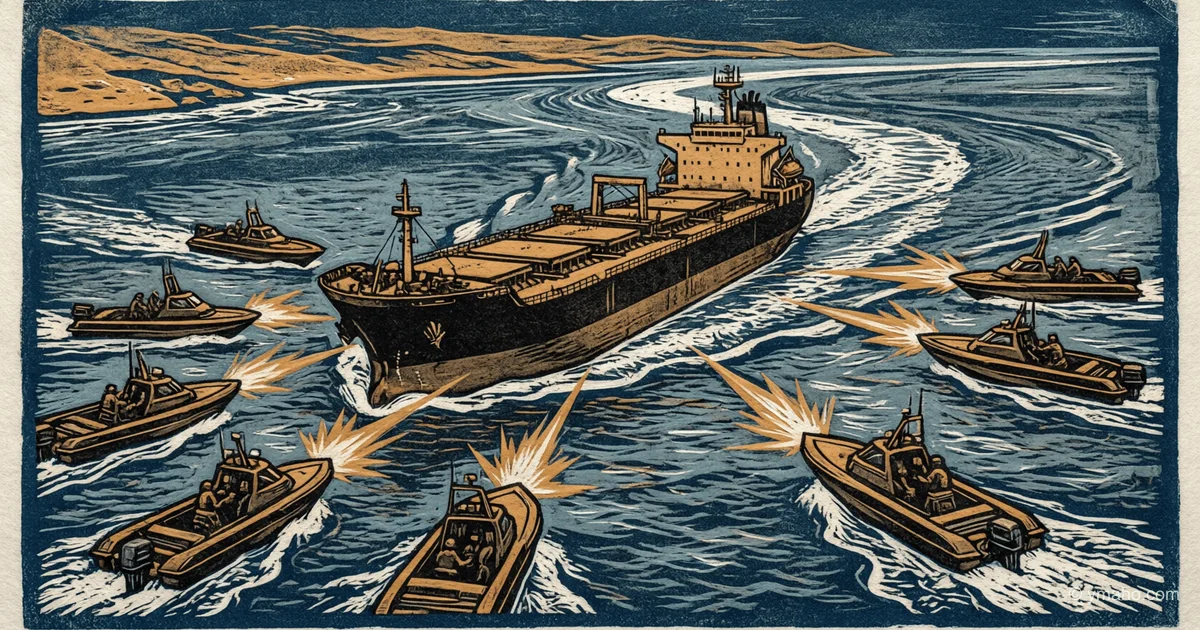
The Islamic Revolutionary Guard Corps opened fire on four vessels attempting to transit the strait without coordination, forcing them to turn back.
Iran's warning shots in the Strait of Hormuz: a 'neither peace nor war' scenario and the hidden trigger of an insurance collapse
The announcement by Iranian state TV about warning shots fired at four vessels on the night of May 28 is not news of military escalation. It is news that the illusion of normalized shipping has shattered against reality.
While global media focus on the word 'shots,' financial markets have already priced in this incident with a sharp spike in oil prices. But the real story is not about ballistics. It is about the fact that the Strait of Hormuz is already commercially dead, and the warning shots are merely an external symptom. Those who understand this are profiting from the insurance collapse.
[The Core]: What Is Really Happening
The IRGC claims it opened fire on vessels attempting to transit the strait without coordination. The Pentagon, in turn, says it shot down four Iranian drones and attacked a ground control station in Bandar Abbas.
On the surface, this is another round of tit-for-tat strikes. But the deeper truth is: the market mispriced the 'probability of peace'.
Days before the incident, Iranian media hyped a story about a 'framework agreement' with the US to reopen the strait. Brent crude plunged on this news from $96.3 to $92.96 per barrel. President Trump called it a 'fabrication.' Now that the shots have confirmed Trump was right, traders who sold oil on fake news are forced to urgently buy back positions.
But the main hidden driver is not geopolitics—it's underwriting.
Timeline and Context
On February 28, 2026, the US and Israel launched an operation against Iran. Iran almost immediately blocked the Strait of Hormuz.
In three months, the strait went from 'closed' to 'dead' in a commercial sense. Vessel traffic collapsed by 93%. But the key turning point occurred not on the battlefield, but in London's insurance offices.
Since March 5, 2026, seven key P&I clubs (shipowner liability insurers) have withdrawn war risk coverage for operations in the Persian Gulf. War risk insurance premiums have soared from the usual 0.2-0.25% to 1-3%, and in extreme quotes to 7.5-10% of the vessel's value.
Numbers that will make you pause. A tanker worth $138 million. Normal war risk insurance: roughly $345,000. Today: up to $14 million. A 40-fold increase.
When insurance costs 10% of a vessel's value for a single voyage, shipping stops on its own. No missiles are needed for that.
Who Wins and Who Loses
Winners:
- Traders who bought oil volatility options (VOL). The May 28 incident is being priced in with a 3.6-3.8% rise in Brent. But the real profit is for those who entered credit default swaps on shipping companies.
- Alternative logistics routes. While the strait is blocked, the margin for tanker operators going around Africa (Cape of Good Hope) has surged 740% in daily freight rates—from $50,000 to $420,000.
- Short positions on European and Asian airlines. Each week of the strait blockade adds 2-3% to jet fuel costs, crushing carrier margins.
Losers:
- Shipowners with floating freight rates. They cannot pass on insurance costs to shippers amid falling demand.
- Global oil traders holding physical oil in floating storage off the coast of Oman. Each day of waiting costs tens of thousands of dollars in insurance. On May 27, 2026, one major trader (unnamed) was forced to sell a cargo at an 8% discount to Brent simply because the 7-day limit on its insurance policy expired.
What the Media Isn't Saying
Insight #1 — 'Insurance won't return even after a ceasefire.'
Military conflicts end. But the Lloyd's and P&I club insurance market does not recover instantly. When seven major clubs simultaneously withdrew coverage, they broke the reinsurance mechanism. Even if Trump and Khamenei sign peace tomorrow, reinsurers (giants like Munich Re and Swiss Re) will demand 12-18 months of stable incident statistics before returning to the region.
What does this mean for the market? Freight rates will remain 3-5 times higher than pre-war levels at least until 2027. Current oil prices do not include this 'future insurance premium.' The arbitrage between Brent and WTI will widen, as US oil (not passing through Hormuz) gains a competitive advantage of $8-12 per barrel.
Insight #2 — 'Oman finds itself at the epicenter of a financial tsunami.'
Trump threatened Oman—a US ally—that they would 'have to blow them up' if they tried to manage the strait jointly with Iran. But few realize that Oman is a key hub for undersea internet cables between Asia and Europe. 95% of SWIFT financial transactions between Dubai and Mumbai go through Omani infrastructure. If Trump strikes Oman, it's not a missile war. It's a shutdown of the Middle East's financial hub. The UAE dirham against the dollar would collapse 15-20% within hours, triggering a liquidity crisis in all Dubai real estate funds.
Forecast: Next 30 Days and 90 Days
30 days: Expect 2-3 'warning shot incidents' per week. This will become the new normal. Each such incident will add $2-3 to Brent, creating an 'escalation ladder' effect. By June 28, Brent will trade in the $98-105 range, but with wild intraday volatility of 5-7%. Shipping companies will begin mass reflagging their fleets under neutral countries (Panama, Liberia) to somehow bypass OFAC sanctions lists.
90 days: By late August, the hurricane season in the Gulf of Mexico will compound the Hormuz blockade. This is a classic 'double supply shock.' Oil will surge to $115-120, and the Fed will be forced not just to 'pause' but to urgently raise rates right in September. The indicator I watch: the spread between 3-month LIBOR and OIS. If it exceeds 50 basis points, it signals that credit markets are stopping financing shipping against future cargoes—the beginning of a logistics collapse.
Editorial Forecast
Asset: Brent Crude (July futures). Direction — up in the next 48 hours. The May 28 incident broke the downtrend caused by fake news of a truce. Key levels: resistance at $98.50; support at $95.80 (a break below would invalidate the scenario). Confidence level — high (75%). Main risk: an urgent resumption of talks mediated by Qatar could push prices back to $92, but given Trump's threats against Oman, the probability of this in the next 72 hours is near zero.
— Editorial Team