Nature: Breakthrough in Combating Immune Aging with Nanoparticles
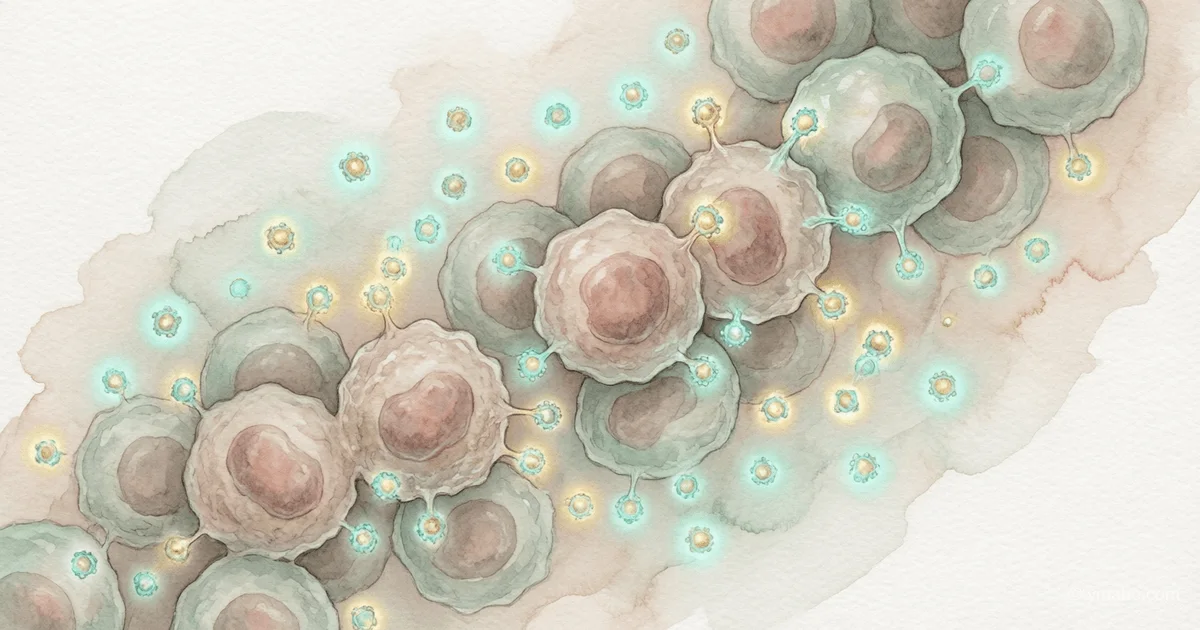
The journal ACS Nano has published a promising study by scientists targeting age-related immune system aging. The researchers propose using nanoparticles for metabolic reprogramming of immune cells to rejuvenate immunity and promote healthy longevity.
Insight: How Cullis and Gujar are preparing a revolution in immunometabolism while the longevity market looks at senolytics in the wrong direction
[The Gist]: What is really happening
On May 8, 2026, a perspective article by the group of Shashi Gujar and Pieter Cullis from Dalhousie University was published in ACS Nano. Headlines scream: "nanoparticles against immune aging." But if you are inside the industry, you see something much more fundamental happening.
Why this matters. The anti-aging field has been obsessed with senolytics for the past five years—drugs that kill senescent cells. Unity Biotechnology, Mayflower, Senolytic Therapeutics—all are hunting the same target: p16-positive senescent cells. But there is a problem: senolytics work, but temporarily. After 3-6 months, senescent cells return because their source—dysfunctional immunity—has not been addressed.
Gujar and Cullis propose not to kill senescent cells, but to reprogram the metabolism of immune cells so they stop aging. This is a shift from "garbage collection" to "factory repair."
The key insight everyone is missing: The article is based on the work of Pieter Cullis—the man who invented the ionizable lipid nanoparticles (LNPs) used in the mRNA vaccines from Pfizer/BioNTech and Moderna against COVID-19. Cullis is not just a co-author. He is the one who knows how to deliver any RNA to any cell. If Gujar brings the biology of immunometabolism, Cullis brings the technology that is already FDA-approved and scaled to billions of doses.
Timeline and Context
Biological platform. Immune aging (immunosenescence) is the age-related deterioration of immune system function. It manifests through three mechanisms:
- Myeloid skewing — the bone marrow starts producing more myeloid cells and fewer lymphoid cells, reducing T and B cell diversity
- Inflammaging — chronic low-grade inflammation due to accumulation of SASP factors
- Metabolic dysregulation — aging immune cells exhibit persistently elevated glycolysis while oxidative phosphorylation (OXPHOS) is suppressed
What Gujar and Cullis propose is metabolic reprogramming using nanoparticles. Instead of introducing new genes (like CRISPR) or killing cells (like senolytics), they want to "switch" the metabolic pathways of immune cells from pathological to healthy.
Why now, not 5 years ago? Because only in the last 2-3 years has the field of "immunometabolomics" been fully established. It is now known that specific metabolic pathways (glycolysis, OXPHOS, fatty acid oxidation) regulate immune cell activation, differentiation, and survival. And it is the imbalance of these pathways that triggers senescence.
Who Wins and Who Loses
Winner #1: Pieter Cullis and his portfolio. Cullis is a co-founder of Acuitas Therapeutics, the company that developed the LNP for the Pfizer/BioNTech vaccine. In 2023, Acuitas sued Pfizer for royalties (settled privately). Now Cullis is in a new venture. If the Gujar/Cullis nanoparticles move to the clinic, Cullis will have a second blockbuster on the same LNP platform. Estimate: licensing fees could reach hundreds of millions of dollars.
Winner #2: Shashi Gujar and Dalhousie University. For Gujar, a professor of pathology and microbiology at Dalhousie, this is an opportunity to move from academia to commercialization. The university has likely already filed a patent on the technology. If a startup is created (expected in 2026-2027), Dalhousie will get equity.
Winner #3: Klothea Bio (indirectly). In February 2026, Klothea Bio launched a Phase I mRNA therapy of alpha-Klotho packaged in LNPs. Their goal is to increase levels of the Klotho protein, which declines with age. But the philosophy is the same: metabolic reprogramming via nanoparticles. The Gujar/Cullis article validates the approach itself, increasing investor interest in the entire field.
Loser #1: Unity Biotechnology (UBX). Unity is a pioneer of senolytics; their drug UBX0101 failed Phase II for knee osteoarthritis in 2020, and shares fell 90%. They are now developing UBX1325 for eye diseases. But the market increasingly understands: killing senescent cells is not enough; you need to fix immunity. Unity has no platform for immunometabolic reprogramming. Their scientific approach is becoming obsolete before our eyes.
Loser #2: Mayflower (a Calico subsidiary). Calico (Alphabet) has invested billions in anti-aging, including Mayflower, which develops senolytics. But neither Calico nor Mayflower has published convincing data on immunometabolism. They may try to buy the technology, but Gujar/Cullis likely already have a term sheet from someone else.
Silent winner: BioNTech. BioNTech has an mRNA platform and experience with LNPs. If immunometabolic reprogramming shows efficacy, BioNTech could easily enter this market by adapting its technology. They already have aging projects (e.g., John Ramen's project), so this will not be a surprise for them.
What the Media Isn't Saying
Insight #1. This is a perspective article, not an experimental study.
The researchers themselves call it a "perspective," not original research. That is, they did not conduct experiments on mice or humans. They proposed a concept and gathered evidence from the literature on why it should work.
In the world of scientific publications, this is equivalent to "we think this is a good idea, and here's why." It is not "we did it and got results." The difference is enormous. Media that present this as a "breakthrough" are misleading the public.
What this means in practice: from this article to the first dose in humans is at least 5-7 years. Needed:
- Preclinical studies in mice (2-3 years)
- Optimize nanoparticles for the specific metabolic target (1-2 years)
- File an IND with the FDA (1 year)
- Conduct Phase I in healthy volunteers (1-2 years)
Do not expect therapy before 2033.
Insight #2. They do not name a specific molecule or target.
The article contains no nanoparticle structure, no lipid composition, no specific metabolic inhibitor or activator. It is a platform, not a drug.
Compare with the work on iron oxide nanoparticles (KGM-PEG-SPIONs) for bone marrow rejuvenation published in January 2026 in Biomaterials. That had a specific formulation: Fe3O4 nanoparticles conjugated with konjac glucomannan and PEG. That can be reproduced. Gujar and Cullis offer only an abstract concept.
This means readers expecting a "pill for immune aging" within a year will be disappointed. There is not even a candidate for preclinical testing yet.
Insight #3. The market for such an approach is unclear because immunosenescence lacks a biomarker.
How will you know that immunity has been "rejuvenated"? Measure IL-6 levels? T-cell count? Response to vaccination? The FDA will require a surrogate endpoint for approval. Currently, no such endpoint exists.
Compare with senolytics: there are biomarkers for senescent cells (p16, p21, SASP factors). For immunometabolic reprogramming, there is no approved way to measure a patient's "immune age."
Klothea Bio solves this problem simply: they measure the level of Klotho protein in the blood. That is a direct biomarker. But Gujar and Cullis have no such equivalent. Without a biomarker, clinical trials will be very difficult and expensive.
Forecast: Next 30 Days and 90 Days
30 days (June 2026):
- Expect news about a patent application. Dalhousie University has likely already filed a provisional patent on the technology. An official announcement may appear in June. Without a patent, commercialization is impossible.
- Gujar and Cullis will begin negotiations with venture capital funds. The longevity field is hot: in 2025, investments in anti-aging startups reached $5.2 billion. But investors will ask: "Where are the mouse data?" Without them, the valuation will be low ($5-10 million). With mouse data, $50-100 million.
- Reaction from Unity Biotechnology and other senolytic companies. Their stocks may drop slightly (2-5%) if the market perceives the article as a signal that senolytics are a dead end. But the drop will be short-term.
90 days (August 2026):
- Publication of experimental data on bioRxiv. This is the most important thing to track. Gujar and Cullis likely already have unpublished mouse data that were not included in the perspective due to journal length constraints. They will post them on a preprint server (bioRxiv or medRxiv) within 3-6 months. If the data show immune rejuvenation in old mice (e.g., restored vaccine response or a 50%+ reduction in IL-6), that will be a real breakthrough. If not, the article will remain theoretical.
- Creation of a spin-off company. Likely name: ImmunoRejuvenation Therapeutics or something similar. Cullis will be technical co-founder (LNP platform), Gujar as CSO (biology). Office in Halifax (Dalhousie) or Vancouver (Cullis). First seed round: $3-5 million from Canadian VCs (iGan Partners, Amplitude Ventures) or family offices.
- Klothea Bio will publish first data from its Phase I (expected in August-September). If their Klotho mRNA shows safety and increased protein levels, it will be a positive signal for the entire field of nanoparticles in longevity.
Main risk on the 12-18 month horizon: Competition from Chinese groups. The article on palladium nanoparticles from Beijing CDC, published in Advanced Science in April 2026, already showed mitochondrial rejuvenation and lifespan extension in C. elegans. The Chinese are moving faster and with specific formulations (PdP NPs). If they move to mice and then to the clinic before Gujar/Cullis, the Canadian group will miss the train.
But now, in May 2026, the main thing is not specific results, but a paradigm shift. Gujar and Cullis told the industry: "You are all looking in the wrong direction. The problem is not old cells; the problem is the metabolism of the immune system." And when that is said by the man who invented the LNP for mRNA vaccines, the industry listens.
— Editorial Team