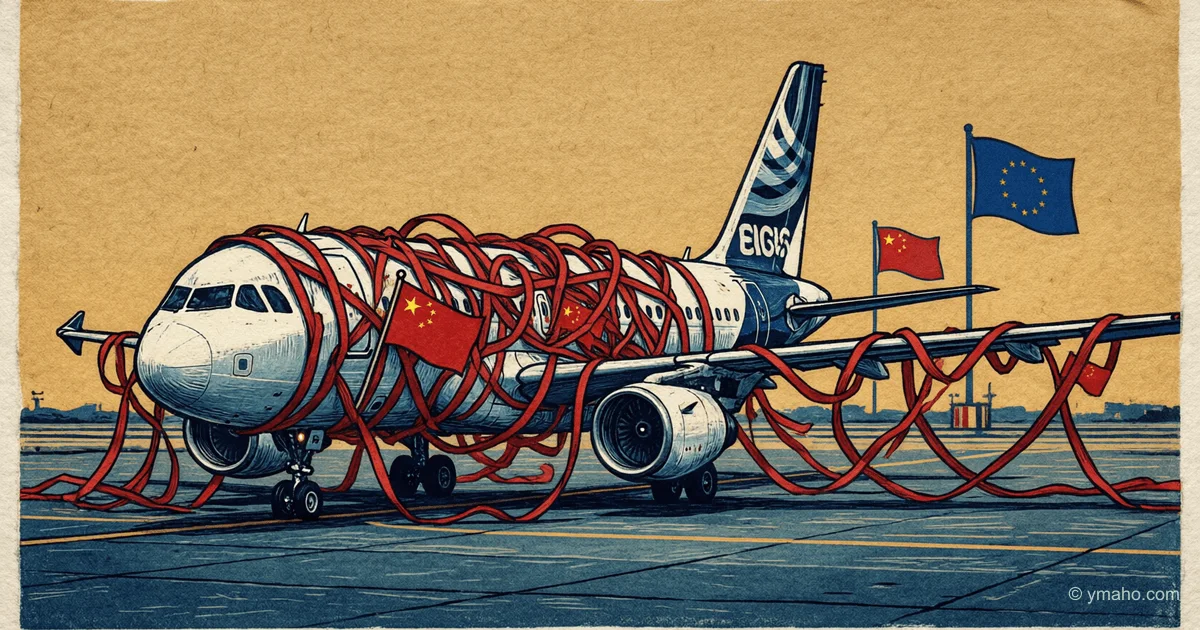
China Delays Airbus Certification in Response to European Regulators' Actions
Beijing has slowed approval of the European aircraft manufacturer's orders due to delays in certifying China's C919 in the EU, sharply reducing aircraft deliveries to China.
Airbus Certification Delay in China: Aerospace Becomes the Main Battleground of the Trade War
The official narrative is "China delays Airbus deliveries due to delays in C919 certification in the EU." But those working inside the aviation industry and global supply chains see a far more alarming picture: aerospace has become a hostage in the trade war between China and the West, with stakes measured not in millions but in tens of billions of dollars and thousands of jobs on both sides of the ocean.
China is not just "losing patience." It is flexing its muscles, using its status as the world's second-largest aviation market as leverage against Brussels. This is not a delay—it is a deliberate strategy that has already caused serious damage to Airbus and could reshape the global balance of power in aerospace for decades to come.
[The Core]: What Is Really Happening
For several months now, the Civil Aviation Administration of China (CAAC) has been deliberately delaying the issuance of final approvals needed to put new Airbus aircraft into commercial service in China. The official reason is an "administrative issue," as Airbus CEO Guillaume Faury delicately put it. Unofficially, Beijing is pressuring the European Union Aviation Safety Agency (EASA) to speed up certification of China's narrow-body COMAC C919.
Scale of the problem: In the first quarter of 2026, Airbus delivered just 114 commercial aircraft to customers—the lowest figure since 2009. In the first five months of the year, China received only 16 aircraft, compared to 47 in the same period in 2025. Nearly 20 finished aircraft are stuck on the ground in France due to the lack of Chinese approval. Airbus CFO Thomas Toepfer estimated the accumulated inventory surplus at €5 billion—that is how much sits on the company's balance sheet in undelivered products.
Timeline and Context
January 2026: EASA intensified C919 certification, starting test flights in Shanghai. EASA Executive Director Florian Guillermet warned the process could take three to six years—significantly longer than for Boeing or Airbus.
April 2026: Faury publicly acknowledged an "administrative problem" in China blocking deliveries of 20 aircraft and promised to resolve it by the end of June. Airbus's first-quarter report showed a 26% drop in net profit (to €586 million) and free cash flow falling to minus €2.48 billion.
May 2026: Bloomberg and Reuters published information about China's deliberate delivery delay. The situation became public, and the geopolitical subtext could no longer be ignored.
It is important to understand the historical context: China used this same tactic in 2023, freezing Boeing 737 MAX deliveries due to a diplomatic dispute with the US. Unblocking only occurred after a personal meeting between the two countries' leaders. Now, Airbus is the "hostage," and the point of contention is European certification of a Chinese competitor.
Who Wins and Who Loses
Airbus loses (direct losses):
- €5 billion frozen in inventory;
- Loss of market share in a key market—China is expected to take 9,570 new aircraft over the next 20 years, and the aviation services market in China will grow from $24.8 billion in 2025 to $63.8 billion by 2044;
- Risk that Chinese airlines will start revising their order portfolios in favor of COMAC.
European airlines and lessors lose: Each week of delay means they do not receive contracted aircraft, forcing them to extend leases on older fleets (which is expensive) or cancel flights.
Boeing loses (indirectly): The company is still recovering from the 737 MAX crisis. A trade war between China and Europe could push Beijing to lift restrictions on Boeing as a "divide and conquer" tactic—but that is just a hypothesis. For now, the US manufacturer also cannot fully return to the Chinese market.
COMAC wins (strategically): Even if the C919 does not get EASA certification tomorrow, the very ability to delay Airbus deliveries is a show of strength. While bureaucratic delays continue, the C919 is accumulating flight hours on domestic routes—by the end of 2025, China's three largest airlines (China Eastern, Air China, China Southern) were already operating 31 aircraft. Every day of operation provides data for EASA and a "safety" argument.
What the Media Isn't Saying
Insight #1 — "The real certification timeline for the C919 is not 3 years, but never"
When EASA talks about "three to six years," technical specialists understand this is a diplomatic way of saying no. It is not that the C919 is bad. The issue is that certification under EASA standards requires independent verification of every component. The C919 uses LEAP-1C engines (a joint venture of CFM International—American/French), avionics from Honeywell (US), and landing gear from Liebherr (Germany/Switzerland). Essentially, COMAC is an integrator of Western technology under a Chinese shell.
EASA cannot certify an aircraft whose key systems are subject to sanctions risks. If the US imposes export restrictions on engines tomorrow, the C919 would be grounded. An EASA certificate implies a guarantee of spare parts supply for decades. No one in Europe will give such a guarantee until the issue of dual technology control is resolved.
Insight #2 — "China is preparing a retaliatory strike on after-sales service"
The most profitable part of the aviation business is not selling aircraft but maintaining them (MRO—Maintenance, Repair, Overhaul). Airbus forecast: China's aviation services market will grow to $63.8 billion by 2044. Currently, 80% of this market is controlled by Western companies (Airbus Services, Boeing Global Services, GE, Rolls-Royce, Pratt & Whitney).
By delaying new aircraft deliveries, China is forcing Europeans to make concessions not only on certification but also on MRO technology transfer. In closed negotiations, the CAAC is already demanding that European service centers in China come under the control of Chinese joint ventures with COMAC holding at least a 51% stake. These are billion-dollar contracts that headlines ignore.
Insight #3 — "Airbus has already found a workaround, but it is dangerous"
Faury stated that the "administrative problem has been resolved" and deliveries will resume in the second quarter. But how? According to unofficial sources, Airbus agreed to an unprecedented step: granting the CAAC full access to the digital twins of each delivered aircraft—models that allow China to independently predict maintenance without European engineers. This is an intellectual property leak that will likely end up in court.
Forecast: Next 30 Days and 90 Days
30 days: Faury predicts normalization by the end of June. I bet on a partial unblocking—10-12 of the 20 frozen aircraft will be delivered, but without an official announcement lifting all restrictions. China will keep a "trump card" for further bargaining. Airbus shares (ticker AIR.PA) could rebound 3-5% on news of resumed deliveries, but the long-term trend will remain downward.
90 days: If by September EASA does not announce specific timelines for C919 certification, China will impose "quiet sanctions"—formally not blocking deliveries but dragging out each approval for weeks. This will create chronic uncertainty for Airbus, and the company will start moving production capacity from Europe (Toulouse, Hamburg) to... China (Tianjin). Strategically, this is exactly what Beijing wants: to force Airbus to manufacture on Chinese soil, keeping technical control and jobs in China.
Editorial Forecast
Asset: Airbus SE shares (AIR.PA). Direction: slight decline over the next 48-72 hours. The market has already priced in some normalization of deliveries, but full restoration of investor confidence will require clear signals from the CAAC, which will not come. Target: consolidation in the range of €140-150 (current price around €145 after falling from March's €165). Confidence level: medium (60%). Main risk: if EASA unexpectedly announces completion of the third stage of C919 certification (moving to the final fourth stage), Airbus shares could jump 5-7% on hopes that the "siege is lifted"—but this is unlikely in the coming days, given that as recently as April EASA spoke of years of work.
— Editorial Team