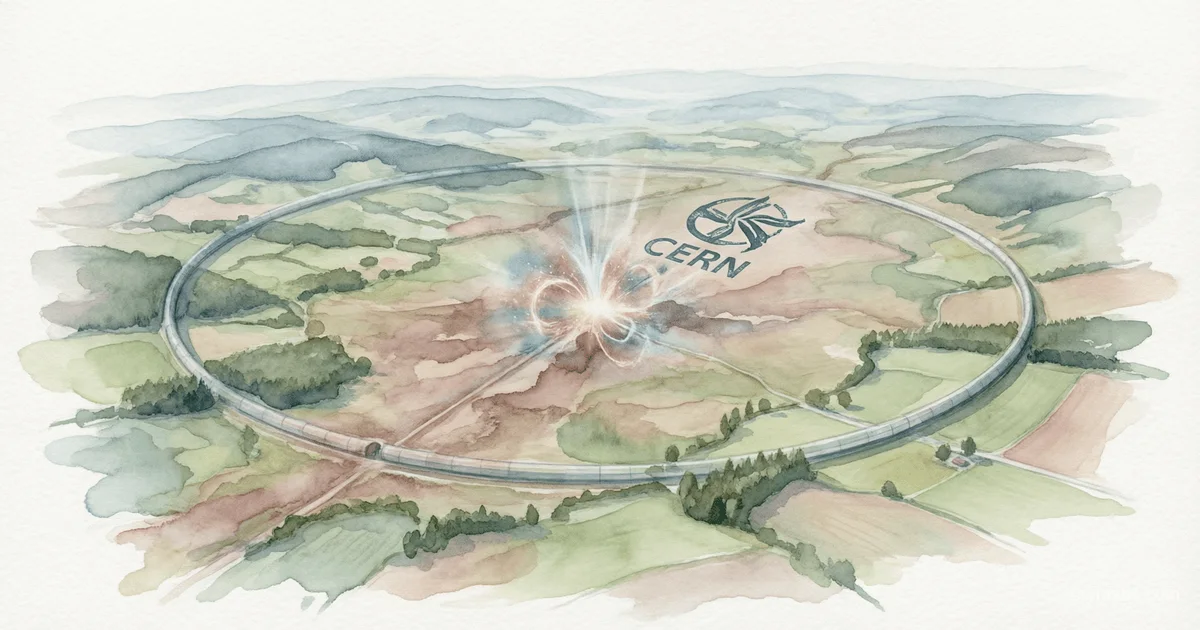
CERN Officially Approves Plan for 91-km Future Circular Collider
The European Organization for Nuclear Research has announced the selection of a 91-km collider as the successor to the Large Hadron Collider. The project, costing around $19 billion, aims to study the Higgs boson in detail and search for new physics.
Insight: How CERN won the race for the future of physics thanks to China's pause, but still faces a $4 billion shortfall
[The Gist]: What's really happening
On May 22, 2026, CERN officially announced that the 91-km Future Circular Collider (FCC) has been chosen as the official successor to the Large Hadron Collider. At first glance, it's a routine decision by the European physics community. In reality, it's the result of a geopolitical fluke that CERN exploited with surgical precision.
Why this matters. For the past five years, the world of high-energy physics has been in a duopoly: Europe with its FCC (91 km, $19 billion) and China with its CEPC (100 km, estimated $5-7 billion). Two competing projects, two contenders for the title of 'world's first Higgs boson factory.' And at the end of 2025, something unexpected happened: China paused its CEPC.
CERN Director-General Fabiola Gianotti then said what is usually not said publicly: 'The pause of the CEPC is an opportunity for CERN.' In CERN's diplomatic language, that's the equivalent of a victory dance. And now, in May 2026, with the European Strategy for Particle Physics updated, the FCC has become the sole player in the field.
But the problem is that the political window opened, but the wallets haven't fully followed.
The project costs 15 billion Swiss francs (about $19 billion) for just the first phase — FCC-ee, an electron-positron collider set to start in the mid-2040s. Half of that amount is to come from CERN member states. The European Union has promised to consider €3 billion in 2027. Private donors pledged €860 million (about $930 million) in December 2025. But even after that, a shortfall of roughly 4 billion Swiss francs remains.
That's what the headlines aren't saying: CERN won the race, but it doesn't have the money for the home stretch.
Timeline and Context
Technical architecture. The FCC is not one collider but two in the same tunnel:
- FCC-ee (electron-positron, 2040s) — operates at energies up to 0.365 TeV. Its goal is to produce and study Higgs bosons with unprecedented precision. Electron-positron collisions provide a 'clean' signal, unlike proton collisions which produce a lot of debris.
- FCC-hh (proton-proton, 2070s) — after the FCC-ee program ends, the equipment will be dismantled and a new accelerator installed, colliding protons at energies up to 100 TeV. That's 7 times more powerful than the current LHC. But this is a project for your grandchildren.
Why such a long horizon? The 91-km tunnel, at an average depth of 200 meters under Switzerland and France, will require excavating 9 million cubic meters of rock. Just digging it will take 5-7 years. Then come magnet installation, superconducting radio-frequency cavities, detectors. The schedule is tight: construction will start in 2030 if the CERN Council makes a final decision in 2028.
Key dates:
- 2020 — The European Strategy for Particle Physics names a 'Higgs factory' as the top priority after the LHC
- 2025 — Feasibility study completed with 1,500 experts
- December 2025 — China pauses the CEPC, excludes it from the next five-year plan
- May 22, 2026 — CERN officially approves the FCC as the next collider
- May 18 – October 2, 2026 — Public consultations in Switzerland
- June 2 – October 1, 2026 — Public debates in France (CNDP)
- 2028 — Final CERN Council decision on construction start
- 2030 — Tunnel construction begins
- 2045-2048 — First FCC-ee commissioning
Who Wins and Who Loses
Winner #1: CERN as an institution. In 2026, this organization turns 72. It survived the Cold War, technological paradigm shifts, and the discovery of the Higgs boson. But after 2040, when the LHC shuts down, CERN would have no raison d'être. The FCC gives it another 50 years of life. Moreover, they're repeating a model that worked in the 1980s: first they built LEP (a 27-km electron-positron collider), then placed the LHC in the same tunnel. Now, scaling up to 91 km.
Winner #2: Mark Thomson (new CERN Director-General). Thomson took office in early 2026, succeeding Fabiola Gianotti. And he immediately got the biggest project in CERN's history on his desk. If he steers the FCC through funding and construction, he'll go down in history alongside Rolf-Dieter Heuer (LHC). If not, his name will be associated with failure.
Winner #3: Private donors who have already pledged €860 million. Among them are names from the Forbes list — tech billionaires who want to touch 'fundamental physics.' For them, it's philanthropy, tax breaks, and a place in history. But there's a catch: their money is only 5% of the required amount. It won't save the project if states refuse to pay.
Loser: The Chinese Academy of Sciences and the CEPC. China spent years developing the CEPC technical design, published final technical reports in 2025, and received positive reviews from international experts. And in December 2025, the project was paused. The official reason is 'priority reassessment.' Unofficially, the price tag is higher than Beijing is willing to pay in the current economic climate. Wang Yifang, director of the Institute of High Energy Physics of the Chinese Academy of Sciences, said at the time: 'We will submit a new application in 2030; but if Europe launches the FCC before that, we will consider joining the FCC instead of building our own.' That's a diplomatic admission of defeat.
Loser #2: Germany — CERN's largest annual contributor. Germany supports the FCC in principle but rejected the proposed funding mechanism through the EU budget. Berlin doesn't want European money (to which Germany is already the largest net donor) going to a project that primarily benefits CERN and Switzerland. This is a classic European wallet battle that will only intensify.
Quiet loser: Physics in the US. The Americans have no equivalent of the FCC. Their next big project is the Electron-Ion Collider at Brookhaven (construction started, launch in the 2030s), but that's a completely different scientific goal. And although the strategic plan of American physicists envisions a $1-3 billion contribution to the FCC, Congress hasn't allocated a cent yet. If the US stays on the sidelines, its best young physicists will go to Europe — a repeat of the 1950s brain drain, but in reverse.
What the Media Isn't Saying
Insight #1. The May 2026 decision is not a 'green light' but a 'yellow light.'
Headlines scream: 'CERN approves construction!' Reality: The CERN Council (representatives from 23 member states) only included the FCC in the updated European Strategy for Particle Physics. That's a political signal, not a legal obligation to start construction. The final decision won't come before 2028.
What does this mean? Germany, France, and the UK have three years to negotiate. They can demand cost reductions (a 'stripped-down version' with two detectors instead of four is being discussed, saving about 15% — over $2 billion). They can insist on redistributing contributions. And they can simply delay the decision until 2030, hoping the economic situation improves.
Insight #2. The 2026 public consultations could kill the project locally.
On May 18, 2026, a four-month public consultation process began in Switzerland under independent guarantors. On June 2, a similar process starts in France under the National Commission for Public Debate (CNDP).
Sounds like a bureaucratic formality? No. In the 1990s, during LHC construction, there were serious protests from locals — noise, vibration, concerns about groundwater. Now the tunnel will pass under Lake Geneva and the Alpine foothills. Opponent groups have already formed, claiming construction will disrupt Geneva's water supply and damage farmland in French Savoy.
If the CNDP issues a negative opinion, the French government could veto the project. And without France (one of the two host countries), the FCC is impossible.
Insight #3. The FCC's physics program doesn't justify $19 billion in the face of other challenges.
This is the most uncomfortable question that physicists don't like to discuss publicly. What new will the FCC bring?
- Refining Higgs boson properties to 1% precision instead of the current 10-20%
- Searching for supersymmetry (SUSY) at energies inaccessible to the LHC
- Investigating dark matter through direct or indirect signatures
But none of these questions guarantee a 'breakthrough.' The FCC might simply show that the Standard Model works even at 100 TeV — with no new particles. That would be scientifically significant (ruling out SUSY up to a certain mass), but it wouldn't change our understanding of the universe the way the Higgs discovery did.
So the question arises: is $19 billion the right allocation of resources? That money could build dozens of space telescopes, fund breakthroughs in fusion (ITER already costs €20 billion), or launch a mission to Europa (Jupiter's moon) with an under-ice probe. But these alternatives are never discussed at CERN — because CERN exists only for high-energy physics.
Forecast: Next 30 Days and 90 Days
30 days (June 2026):
- June 22-26 — CERN Council session. This is a key event. At this session, member states will present their preliminary positions on funding. Germany will likely confirm its support in principle, but with caveats on the contribution mechanism. France (the host country) must officially announce the launch of a national project assessment — this will happen against the backdrop of the CNDP public debates that started on June 2.
- Expect the publication of a detailed financial plan. CERN must show how it intends to close the 4 billion Swiss franc gap. Main sources: Japan (silent so far), the US ($1-3 billion — but Congress hasn't allocated), the United Arab Emirates (unexpected interest, contacts at the ambassador level). If no written commitments from at least one non-European country appear by the end of June, investors in CERN bonds (yes, they issue eurobonds) may start to get nervous.
90 days (August 2026):
- Completion of public consultations in France (October 1). The CNDP will publish its opinion in the first half of October. Likely scenario: 'favorable opinion with 20-30 environmental conditions.' That's not a veto, but not a carte blanche either. CERN will have to spend an additional €200-300 million on groundwater protection and noise reduction measures (night work banned, 24/7 vibration monitoring).
- China will make an unofficial statement about the CEPC. Expect a comment from Wang Yifang at the International Conference on High Energy Physics in August. Most likely, he will say that 'China continues to study the possibility of building the CEPC, but the priority is cooperation with international partners.' That's a diplomatic way of saying: 'We're not building, but we want to participate in the FCC so our scientists don't fall behind.' If that happens, CERN gets a powerful political card to convince skeptics in Germany.
- Negotiations with the European Commission on €3 billion will begin. The EU budget for 2028-2034 is already being discussed. The FCC will compete with defense projects (post-2022, EU priorities have shifted), climate initiatives, and digital transition. Chances of getting the full €3 billion: 40%. Chances of getting €1.5 billion: 80%. A reduced EU budget is a direct path to a 'stripped-down' FCC with two detectors.
Main risk in the next 12-24 months: A global recession in 2026-2027 (some economists already predict a downturn in the Eurozone in the second half of 2026). If the economy worsens, Germany and France may freeze their contributions to CERN. Unlike the US, where science is funded by Congress (often regardless of the economic situation), in Europe CERN's budgets directly depend on the finance ministries of member states. In 2010, during the eurozone crisis, CERN had to freeze salaries and delay LHC upgrades by two years. With the $19 billion FCC, such a delay would mean pushing the launch from 2045 to 2048 at least.
But CERN has been through worse. It survived the cancellation of the Superconducting Super Collider in the US in 1993 (a 22-km tunnel had already been dug in Texas; the project was scrapped). It survived the Cold War, the 2008 financial crisis, and the pandemic. Now it has what it needs most for success — political will and the absence of a competitor. All that's left is to find $19 billion. Details.
— Editorial Team