EMA Approves World's First Drug for Idiopathic Pulmonary Fibrosis
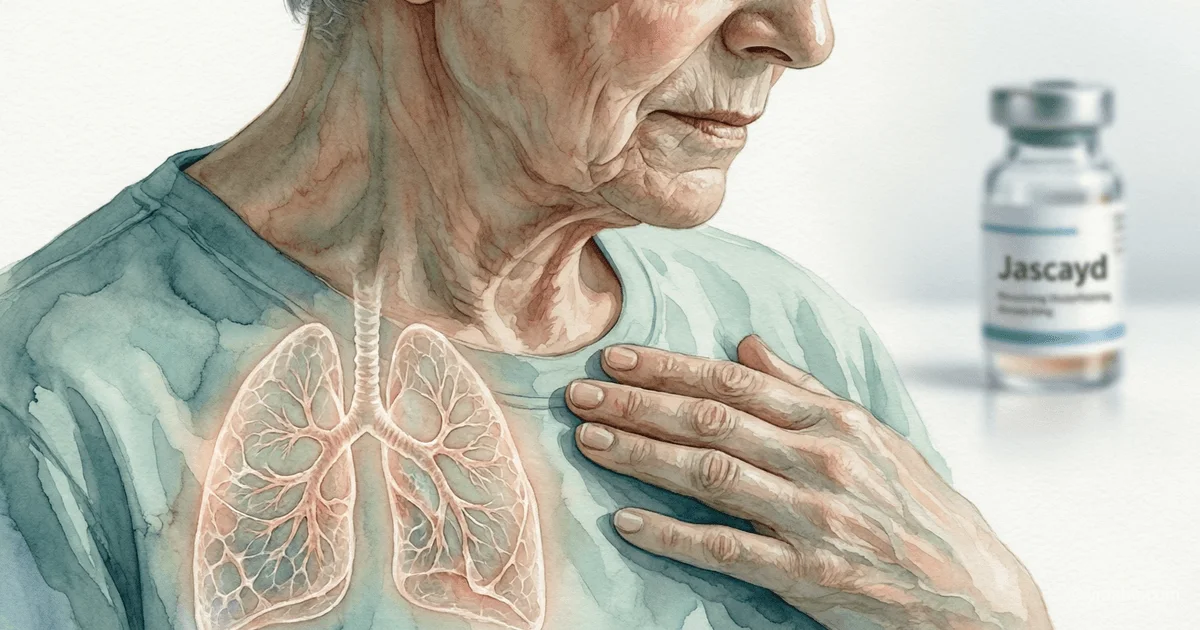
The European regulator EMA has recommended Jascayd (nerandomilast) for the treatment of idiopathic or progressive pulmonary fibrosis—diseases characterized by irreversible scarring of lung tissue. This is the first drug approved for this severe condition with limited treatment options.
Inside Scoop: How Boehringer Ingelheim Is Rewriting the Rules in Pulmonology While Everyone Was Watching GLP-1
The Gist: What's Really Happening
On May 22, 2026, the EMA issued a recommendation for Jascayd (nerandomilast) for the treatment of idiopathic (IPF) and progressive pulmonary fibrosis (PPF). At first glance, it's just another approval. In reality, it's a tectonic shift.
Why this matters. The IPF market has been a duopoly for the past decade: Ofev (nintedanib) from Boehringer Ingelheim and Esbriet (pirfenidone) from Roche. Both drugs have poor tolerability—diarrhea, nausea, phototoxicity. And they don't cure; they only slow the decline in lung function (forced vital capacity, FVC) by about 50-70 mL per year.
Nerandomilast provides 68.8 mL benefit over placebo over 52 weeks (114.7 mL vs. 183.5 mL decline in FVC). That's better than existing drugs, but that's not the real headline.
The real breakthrough. The drug works through a fundamentally new mechanism—selective inhibition of phosphodiesterase 4B (PDE4B). It's the first representative of a new class in this niche in a decade. And it has a "hidden" feature: mortality. In the pooled analysis of FIBRONEER (n>2300), 18 mg nerandomilast reduced the risk of death by 43% in the overall population and by 59% in patients without background therapy.
Think about it: none of the current antifibrotics have shown such a convincing survival signal in phase III. For IPF, where median survival after diagnosis is 3-5 years, this changes the standard of care.
Timeline and Context
Let's set the record straight. Boehringer Ingelheim is a German pharma giant (a family-owned company, by the way) that already owns Ofev (nintedanib). So they are about to get a second blockbuster in the same narrow niche, with higher efficacy and a better tolerability profile (diarrhea in 41% on 18 mg, but discontinuation <4%).
Timeline of key events:
- May 2025 — FIBRONEER-IPF presented at ATS and published in NEJM
- September 2025 — Mortality data shown at ERS: 59% in monotherapy
- February 2026 — NICE (UK) begins assessment, expected final decision September 2026
- May 22, 2026 — CHMP (EMA) issues positive opinion
- Around Q4 2025 – Q1 2026 — FDA decision expected (priority review, breakthrough therapy)
What actually happened? BI leveraged its Ofev infrastructure (same target audience, same pulmonologists) and simply "cannibalized" its own market. Brilliant: instead of letting another player take market share, they created their own successor.
Winners and Losers
Winner #1: Boehringer Ingelheim. The IPF market size in 2025 is approximately $4.37 billion, projected to reach $6.16 billion by 2030. Jascayd could capture 50-70% of this share, as physicians switch patients from Ofev to it, and new patients go straight to Jascayd. BI gets a "perpetual" patent cycle: Ofev dies, Jascayd is born.
Winner #2: Patients with PPF (progressive pulmonary fibrosis). This is even bigger than IPF. Until now, there were no approved drugs for PPF (fibrosis in systemic sclerosis, rheumatoid arthritis, etc.) in Europe. Only off-label use. Jascayd is the first approved drug worldwide for PPF.
Loser: Roche with Esbriet (pirfenidone). Roche has no replacement. Their drug already had a smaller market share due to worse tolerability. Now they are completely out of the race.
Loser: Pirfenidone generics. In 2026, pirfenidone is already losing value. But doctors will still prescribe Jascayd over a generic of an older, less effective drug.
Quiet loser: Patients who can't access Jascayd due to cost. The new drug will cost at least $100,000 per year (by analogy with Ofev). Insurers will require step therapy—first Ofev, then Jascayd. That means years of life lost on a less effective drug.
What the Media Isn't Saying
Insight #1. Secondary endpoints were not met.
This is what BI isn't advertising. The FIBRONEER protocol included secondary endpoints—time to first acute respiratory hospitalization or death. They were not met. So formally, the drug hasn't proven it reduces hospitalizations. Only a post-hoc analysis (pooled analysis of two phase III trials) showed a reduction in all-cause mortality, but this wasn't prospectively confirmed. Did regulators overlook this? Yes. But doctors will debate it for another year.
Insight #2. Monotherapy vs. combination therapy.
The strongest mortality signal is nerandomilast monotherapy without background antifibrotic (HR 0.41, 59% reduction). In combination with nintedanib, the effect is weaker (HR 0.59). This hints that the two drugs may interfere with each other. The mechanism is not yet understood. But if confirmed, the "add to Ofev" standard will collapse. Ofev will remain only for patients who fail Jascayd monotherapy.
Insight #3. Gastrointestinal toxicity is still an issue.
41% diarrhea on 18 mg is significant. BI calls it a "manageable profile," but any pulmonologist knows that diarrhea is what makes patients quit Ofev. Now Jascayd has the same story. 4% discontinuation due to diarrhea is better than Ofev (around 10-15%), but still not ideal. The next round of the race will be for a gut-neutral PDE4B inhibitor.
Forecast: Next 30 Days and 90 Days
30 days (June 2026):
- Boehringer Ingelheim will issue a press release with the final price of Jascayd in the German and French markets. Expect €95,000 – €110,000 per year.
- Roche will quietly cut investments in pirfenidone. Possible announcement of sale or outsourcing of Esbriet production.
- FDA will confirm the decision date for the IPF application (expected September 2026). If delayed, BI's stock would drop 5-7% (they are private, but it would affect bonds).
90 days (August 2026):
- NICE in the UK will publish preliminary recommendations. Likely to reject routine funding initially, demanding a discount. This is standard NHS tactic to cut prices by 20-30%.
- First real-world clinical cases in PPF patients with scleroderma will emerge. Expect presentations at ERS 2026 (September)—this will be a key moment determining how broadly the drug extends beyond IPF.
- Negotiations will begin for inclusion of Jascayd in US insurance formularies. CVS Health and UnitedHealth will require patients to fail Ofev first. This will delay access by 6-12 months for 30% of patients.
Main risk in 6-12 months: The drug hasn't shown a benefit in hospitalizations. If post-marketing studies confirm this, insurers may deny coverage or restrict it to the most severe group.
But for now, in May 2026, Boehringer Ingelheim has won. And they did it while the world was watching incretins and GLP-1.
— Editorial Team