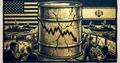
Dollar Rises Moderately on Safe-Haven Demand
The DXY index rose as investors continue to fear an escalation of the conflict in the Persian Gulf, putting pressure on the euro and the pound.
Dollar Rises Moderately on Safe-Haven Demand: The Hidden Divergence Markets Aren't Talking About
At first glance, the news looks like a classic market reaction to geopolitics: the DXY index is rising, investors are fleeing to safe havens due to the escalation in the Persian Gulf, and the euro and pound are weakening. But dig deeper, and the story becomes far more paradoxical. We are witnessing an anomaly that usually precedes a sharp reversal: the dollar is rising amid both falling Treasury yields and a stock market rally. In normal market logic, such a combination is impossible. This means either the market is wrong, or there is something behind it that analysts are not talking about.
[The Core]: What Is Really Happening
The dollar index DXY is holding above the 99.00 mark, trying to break resistance in the 99.30–99.50 area. Yesterday's 0.3% rise was triggered by Trump's statement that peace talks with Iran "have not reached a satisfactory level" and that "we may have to go back and finish this." At the same time, the Pentagon launched new strikes on Iranian military facilities in Bandar Abbas province, intercepting IRGC drones.
But here's the key paradox: on Monday, false reports emerged about a "framework agreement" on the Strait of Hormuz — oil crashed 3.5%, and the stock market soared. One would think hopes for peace should weaken the dollar as a safe-haven asset. But DXY did not fall — it stayed put. And when Trump denied those rumors, the dollar shot up, recouping its losses.
Insiders see the reason: the dollar has ceased to be a pure safe haven — it has become hostage to two competing narratives:
- Geopolitical fear pushes the dollar up (classic safe-haven flow).
- But rising oil prices due to the conflict fuel inflation, causing the market to price in a Fed rate hike — which is also dollar-positive.
The market is pricing in an 80% probability of a rate hike by December 2026. In normal circumstances, this would kill the stock market. But the S&P 500 and Nasdaq are hitting new records. A paradox? No. It means that different groups of investors are living in different universes: some are buying stocks hoping for peace, others are hedging with dollars in case of war.
Timeline and Context
- May 25, 2026: The US strikes Iranian missile launchers in self-defense. Reports of a possible "framework agreement" on Hormuz. Oil falls to $92.8.
- May 26, 2026: US markets closed for Memorial Day. Asia and Europe trade mixed.
- May 27, 2026, morning: Trump says at a cabinet meeting: "Negotiations with Iran have not reached a satisfactory level. We'll see what happens. We may have to go back and finish this — or maybe we don't have to do it right now."
- May 27, 2026, evening: The Pentagon strikes military facilities in Bandar Abbas again. A US official reports that several Iranian drones were intercepted and shot down.
- May 28, 2026, night (local time): Explosions east of Bandar Abbas; Iran's air defense systems put on alert.
- May 28, 2026, Asian session: DXY rises to a new weekly high, trading around 99.30–99.40. The South Korean won falls to 1,504 per dollar. USD/CAD reaches 1.3800 — a high since April 13. EUR/GBP fluctuates above 0.8650.
Who Wins and Who Loses
Winners:
- USD long holders. Especially against currencies vulnerable to oil prices (CAD, JPY — despite the yen being a traditional safe haven, high energy import costs hurt Japan's economy).
- Pair trade traders (long DXY, short EUR/GBP). The monetary policy gap is widening: the market prices in a 91% probability of an ECB rate hike in June, but the Bank of England, on the contrary, may even ease policy due to recession.
- Canadian dollar — unexpectedly. Although CAD is weakening against USD, it is recovering against other currencies as oil (Canada's key export) bounces from three-week lows.
Losers:
- British pound (GBP). GBP/USD remains under pressure, trading in the 1.3416–1.3451 range. The Bank of England is not showing hawkishness, unlike the ECB and Fed.
- Euro (EUR). Despite expectations of an ECB rate hike on June 11, the euro cannot rise because the geopolitical shock hits the eurozone economy harder than the US. ECB Chief Economist Philip Lane warned that the inflationary consequences of the war will outlast the conflict itself.
What the Media Aren't Saying
Insight #1 — "DXY at a Crossroads: The 99.00–99.50 Range Will Decide Everything."
Technically, DXY is at a decisive point. On one hand, the index is holding above the 200-period exponential moving average, which technical analysts see as a sign of a formed bottom. On the other hand, the price has been unable to break the 23.6% Fibonacci retracement level at 99.30–99.50 for several days.
Notice what news headlines are not saying: bitcoin has a moderate negative correlation with DXY (around -0.34). A DXY breakout above 99.50 will put pressure on BTC and other cryptocurrencies. But if the index breaks support at 99.00, it will be a powerful bullish signal for risk assets.
Insight #2 — "PCE on Friday: A Quiet Time Bomb."
The entire geopolitical drama is unfolding against the backdrop of the key inflation report — the Personal Consumption Expenditures (PCE) price index, due out Friday, May 30. Economists expect core PCE to rise 0.3% month-on-month, keeping annual inflation at 2.8%.
If the data comes in above forecast, the market will price in not just 80% but 95% probability of a Fed rate hike this year. DXY will break 99.50 and head toward 100.00–100.10. Meanwhile, the stock market, which is currently ignoring hawkish risks, could crash. This would be a classic risk-off: dollar up, stocks down.
Insight #3 — "The Correlation Collapse Cannot Last Forever."
Analysts at IC Markets warn that several key correlations have broken. The dollar rose, but Treasury yields fell (10-year UST around 4.45% instead of the usual 4.6%+ under such geopolitical risks). Stocks rose. This is impossible in a normal market regime.
My forecast: the collapse will resolve in one direction within 5–10 trading days. Either geopolitical fear wins, DXY breaks 99.50, and stocks correct 3–5%. Or peace hopes return (even on fake news), and the dollar crashes to 98.50, opening the door for a risk asset rally.
Forecast: Next 30 Days and 90 Days
30 days: The key level for DXY is 99.30–99.50. If Friday's PCE is "hot" (above 0.3% month-on-month), the index will break resistance and move to 99.80–100.10. If PCE disappoints (0.2% or lower), the dollar will crash to 98.50. Expect heightened volatility through end of June: range 98.50–100.50 with sharp swings on every piece of news from the Persian Gulf.
90 days: The risk balance is tilted toward dollar strength. The war in Iran will not end quickly — too many parties have an interest in its continuation (including internal elites in Tehran and Washington). Inflation will remain above 2.5%, and the Fed will be forced to raise rates in December. This will push DXY to 101.00–102.00 by year-end. But the main risk: if Trump and Khamenei suddenly strike a deal (20–30% probability), the dollar will crash to 97.00 as markets price in "peace dividends."
Editorial Forecast
Asset: DXY (US Dollar Index). Direction — uncertain with a bullish bias over the next 48–72 hours. Key range — 99.00–99.50. A break above 99.50 opens the path to 100.00. Confidence level — low (45%) because the market is in a state of correlation collapse, making any forecast unreliable. Main risk: a sudden resumption of peace talks (even at the rumor level) could send DXY crashing to 98.50 within hours, as happened on May 25 with fake news about an agreement.
— Editorial Team