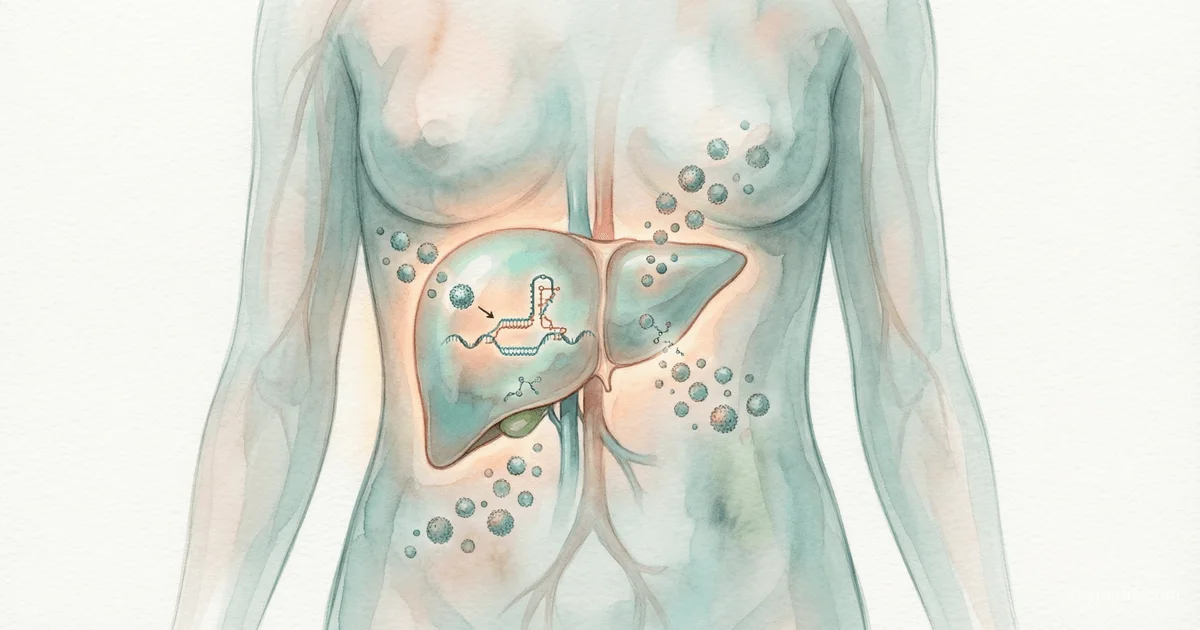
Intellia Files First-Ever FDA Application for In Vivo CRISPR Gene-Editing Therapy
Intellia Therapeutics has begun a rolling BLA submission to the FDA for lonvo-z, a treatment for hereditary angioedema. If approved, it would become the world's first registered therapy that edits genes directly inside the patient's body using CRISPR, showing an 87% reduction in attacks.
Insider: How Intellia Outmaneuvers CRISPR Therapeutics and Prepares a Revolution in 'Butterfly' Treatment While the Market Looks Elsewhere
[The Core]: What's Really Happening
On April 27, 2026, Intellia Therapeutics announced the start of a rolling BLA submission to the FDA for lonvo-z (NTLA-2002) to treat hereditary angioedema (HAE). If you only read the headlines, this is just another gene therapy. But if you're inside the industry, you see three game-changing things.
First, this is the world's first application for approval of an in vivo CRISPR therapy. Casgevy (Vertex/CRISPR Therapeutics) is ex vivo: the patient's cells are removed, edited in the lab, and returned. Lonvo-z is given intravenously once, and CRISPR works directly in the patient's liver. The difference is enormous: ex vivo costs $2.2 million per course, requires chemotherapy to 'clean' the bone marrow, and weeks of hospitalization. Lonvo-z is an outpatient procedure.
Second, the clinical data are nearly perfect. The Phase III HAELO trial (n=80) showed an 87% reduction in attacks (0.26 vs. 2.1 per month for placebo). 62% of patients were completely attack-free and required no therapy during the 6-month observation period. And 100% of patients in the lonvo-z group achieved some reduction in attack frequency.
Third, safety. No serious adverse events in the treatment group. Only mild/moderate infusion reactions and headaches. This is critical because in November 2025, Intellia had to pause Phase III of its other CRISPR asset, Nex-z (NTLA-2001), for ATTR amyloidosis due to a safety signal. Lonvo-z showed the platform still works.
But the main thing the press releases don't say: Intellia is not fighting the disease; it's fighting the HAE market structure. And they have a secret weapon, which I'll reveal below.
Timeline and Context
Technology. Lonvo-z uses lipid nanoparticles (LNPs) to deliver two components to the liver: Cas9 mRNA and an sgRNA targeting the KLKB1 gene. This gene encodes plasma prekallikrein (PKK). When KLKB1 is knocked out, the kallikrein-bradykinin cascade is halted at its root. Bradykinin is the molecule that causes swelling in HAE.
Key Dates:
- 2021 — Start of Phase I/II, first human data
- January 2025 — First patient dosed in Phase III HAELO
- April 2026 — Top-line Phase III results and start of rolling BLA
- Expected Q2 2027 — Potential FDA approval and launch
Numbers You Should Know. The HAE market in 2025 was $5.42 billion, projected to reach $12.55 billion by 2035. The market leader is Takeda with Takhzyro (lanadelumab), generating about $1.7 billion annually. It's a monoclonal antibody that requires injections every two weeks. Lonvo-z is one injection and done.
Who Wins and Who Loses
Winner #1: Intellia Therapeutics. If the FDA approves lonvo-z in 2027, the company will have the world's first in vivo CRISPR drug. Peak sales estimates: $1.5–2.5 billion per year. But there's a catch: on April 23, 2026, Intellia conducted a secondary offering of $180 million at $10.75 per share. Why do they need money if Phase III is successful? Answer: preparing for commercialization. Building reimbursement infrastructure, training physicians, paying partners (Regeneron on Nex-z). The market saw dilution and dropped the stock 15%. But an experienced eye knows this is standard practice before a major launch.
Winner #2: HAE Patients. Current therapy involves lifelong injections every two weeks (Takhzyro), daily pills (Orladeyo from BioCryst), or IV infusions of C1-inhibitor replacement therapy. Lonvo-z offers functional cure after a single dose. In the extended Phase I/II follow-up, patients remained attack-free for up to 32 months.
Loser: Takeda with Takhzyro. Takeda has dominated HAE since 2018. But their patent on lanadelumab expires in the late 2020s. They have no answer to CRISPR. Yes, they have a portfolio (Firazyr, Cinryze), but these are older-generation drugs.
Loser: Ionis Pharmaceuticals with Dawnzera. Ionis received FDA approval in August 2025 for the first RNA-targeted HAE drug. It's an oligonucleotide that also lowers PKK but requires injections every four weeks. Lonvo-z is a direct threat because it offers the same (PKK reduction) but with a lifelong effect.
Quiet Loser: KalVista Pharmaceuticals with Ekterly. Ekterly is the first pill for acute attack treatment, approved in July 2025. Lonvo-z doesn't directly compete (lonvo-z is prophylaxis, Ekterly is acute treatment). But if prophylaxis becomes one-time and reliable, the market for 'emergency' pills shrinks.
What the Media Isn't Saying
Insight #1: The 'Sticky Patient' Problem.
This is the most important point that never makes it into press releases. The HAE market is fragmented, and patients are very conservative. As Miles Minter of William Blair says: 'Patients are attached to their current treatments. If their therapy works, they see no reason to switch, even if something better appears.'
Why? HAE is the fear of death by suffocation (laryngeal edema). A patient stable on Takhzyro for years won't want to risk a new CRISPR therapy, even if it promises 'one-time' cure. Especially after Intellia paused Phase III of Nex-z (another CRISPR asset) in November 2025 due to safety concerns. Fear of long-term oncogenic risks (insertions/deletions, off-target effects) will slow adoption.
What this means in practice: Intellia will have to spend hundreds of millions of dollars not on R&D, but on educating physicians and patients. And their target audience is not 100% of the 7,000 patients in the US, but only about 30% of those still on old C1-inhibitors, or 'switchers' (early adopters). The rest will stay on Takhzyro.
Insight #2: The 2027 filing is an optimistic scenario.
The FDA has never approved an in vivo CRISPR. Their CBER (Center for Biologics Evaluation and Research) will demand unprecedented data on off-target effects. For Casgevy (ex vivo), the FDA required 15-year patient follow-up after approval. For lonvo-z, requirements will be at least as stringent. Rolling BLA is good, but the final decision could be delayed to 2028 if the FDA requests additional preclinical genotoxicity models.
Insight #3: 87% is less than you think.
Yes, 87% reduction is impressive. But compare: Ionis's Dawnzera showed 94% reduction after one year of treatment. And that drug is already on the market. Lonvo-z hasn't yet proven long-term efficacy—6 months of follow-up in Phase III is a short period. And 38% of patients in the lonvo-z group did not become completely 'attack-free' during that period. They showed a 72% reduction, which is good but not a 'cure'. Intellia promises to present more detailed data (including swimmer plots) at EAACI in June 2026. That's where we'll see how many patients still have attacks one year after a single dose.
Forecast: Next 30 Days and 90 Days
30 Days (June 2026):
- Presentation of HAELO data at EAACI (European Academy of Allergy and Clinical Immunology). Intellia will show detailed breakdowns: how long the effect lasts, whether there is waning of editing, what percentage of patients maintain complete attack freedom at 12 months. This is a key moment for the stock. If data show sustained effect, NTLA will soar. If the effect starts to decline, a 20-30% drop is inevitable.
- The FDA will give a formal response on the application status — whether they accept the BLA for standard or priority review. Priority status (PDUFA 6 months) would be a strong positive signal.
90 Days (August 2026):
- Intellia will complete submission of all BLA modules. Expect the final application to be filed in September-October 2026.
- First negotiations with commercial insurers (CVS Caremark, Express Scripts, Optum) will emerge. The level of reimbursement will determine how many patients actually get access. If insurers require step therapy ('first Takhzyro, then lonvo-z if it fails'), that will kill commercial potential.
- A new secondary offering or partnership is likely. Intellia has about $1.2 billion in cash after the April round, but a global launch requires at least twice that. Look for an announcement of a deal with a large pharma (Pfizer? Novartis?) for commercialization in Europe and Asia.
Main risk in the 6-12 month horizon: Any off-target signal in preclinical studies or in the first treated patients (even if not clinically relevant) will stop the FDA. And if Ionis or Takeda launch a FUD campaign (Fear, Uncertainty, Doubt) about 'unknown long-term risks of CRISPR', physicians will prescribe lonvo-z even more slowly.
But now, in May 2026, Intellia has done the impossible: they proved that in vivo CRISPR is safe and effective. Now the battle moves from labs to insurance company boardrooms and allergists' offices. And that will be a much bloodier battle than any clinical trial.
— Editorial Team