Breakthrough in Glioblastoma Treatment: Personalized Vaccine Shows Record Survival at ASCO 2026
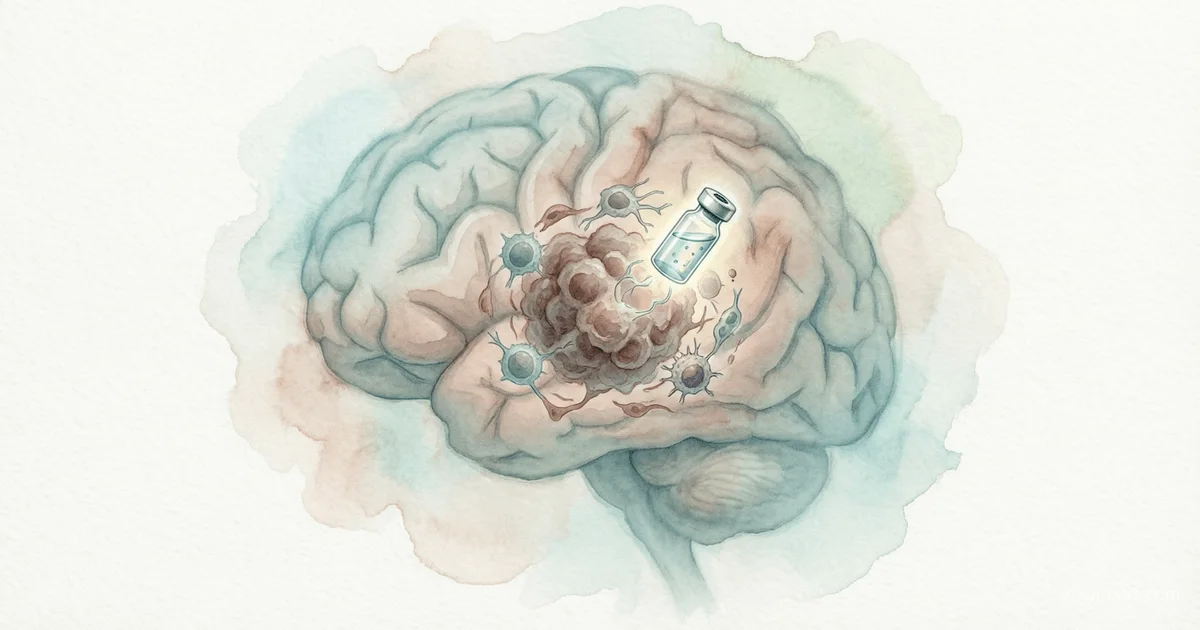
At the annual ASCO 2026 conference, researchers from Dana-Farber presented data on the NeoVax vaccine, which stimulates the immune system against brain tumors. In patients with the methylated form of the tumor, median survival reached 36.9 months, significantly higher than the standard 25.3 months.
Inside: How Dana-Farber Outmaneuvered Glioblastoma Immunology While Merck Reaped the Rewards of Keytruda
[The Core]: What's Really Happening
On May 26, 2026, at ASCO 2026, David Reardon from Dana-Farber Cancer Institute presented Phase I data on NeoVax in patients with newly diagnosed glioblastoma. The numbers you see in the headlines—median overall survival of 36.9 months in MGMT-methylated patients versus the historical 25.3 months—are not just a "breakthrough." This is the first immunotherapy signal in glioblastoma that hasn't failed in Phase III.
Why this matters. Since 2019, when Bristol-Myers Squibb announced the failure of CheckMate-548 (nivolumab + temozolomide in MGMT-methylated patients), the entire oncology world believed immunotherapy for glioblastoma was a dead end. CheckMate-143, CheckMate-498, CheckMate-548—three large Phase III trials with negative results. Anti-PD-1 monotherapy didn't work. Combination with chemotherapy didn't work.
But Dana-Farber had an insight everyone missed: Glioblastoma suppresses the immune response not only through PD-1 but also through corticosteroids, which are the standard of care for peritumoral edema.
What did Reardon do? He excluded dexamethasone from the protocol. This detail never makes it into press releases, but it explains why NeoVax worked where nivolumab failed. Dexamethasone is a powerful immunosuppressant that kills the T cells needed for vaccine response. In previous studies, 78% of patients received dexamethasone at the time of vaccination. In the new design, only those with edema so severe that steroids were unavoidable received them.
The result? Vaccine-specific T cells migrated to the brain and tumor. In some patients, the response persisted a year after vaccination. This is something no one had shown before.
Timeline and Context
Biological platform. NeoVax is a personalized peptide vaccine created by Catherine Wu, head of the Stem Cell Transplantation and Cellular Therapy Department at Dana-Farber. The principle: after tumor resection, whole-exome sequencing of the tumor and the patient's normal DNA identifies somatic mutations. Algorithms then predict which neoantigens (peptides from these mutations) are most likely to bind to the patient's HLA and elicit a T-cell response. Long peptides (15-30 amino acids) are synthesized and administered with the adjuvant Poly-ICLC.
Key technological breakthrough—multisector sequencing. Previous vaccine studies used samples from a single tumor region. But glioblastoma is heterogeneous: mutations in one part of the tumor may be absent in another. Wu's team implemented sampling from 3-5 spatially distinct regions of a single tumor. This increased the neoantigen pool by 2-3 times and allowed targeting of clonal mutations (present in all cells) rather than just subclonal ones.
Trial design:
- 39 patients enrolled, 37 started the NeoVax regimen
- 4 cohorts: 1a, 1b, 1c—MGMT-unmethylated patients (insensitive to temozolomide), received pembrolizumab at different times relative to vaccination
- Cohort 1d—MGMT-methylated patients, received pembrolizumab + vaccine + temozolomide (standard chemotherapy)
Survival results:
- MGMT-methylated: median OS 36.9 months (historical control 25.3 months) → 11.6-month gain
- MGMT-unmethylated: median OS 19.0 months (historical control 16.7 months) → 2.3-month gain
The 36.9-month figure is an anomaly for glioblastoma. A 2018 meta-analysis of 4,097 patients showed that MGMT methylation is associated with better OS (HR 0.494), but the standard median in clinical trials is 23-27 months. 36.9 months is a level typically achieved only in subgroup analyses of young patients with gross total resection.
Who Wins and Who Loses
Winner #1: Merck with Keytruda (pembrolizumab). NeoVax doesn't work without pembrolizumab—it's a combination therapy. Merck has Keytruda, which generates $25 billion annually, and they're looking for new combinations after failing in Phase III for glioblastoma in 2019. NeoVax gives them a new narrative: not "anti-PD-1 doesn't work in GBM," but "anti-PD-1 works if you first prime T cells with a vaccine." A key finding: starting pembrolizumab before NeoVax priming (cohort 1a vs. 1b) may yield longer OS, though T-cell responses were similar. Is Merck already funding trial expansion? No official data, but insiders mention negotiations around $50 million.
Winner #2: Patients with MGMT-methylated glioblastoma. This is about 40-45% of all GBM patients. For them, the standard is temozolomide, which gives a median OS of about 25 months. NeoVax adds another year of life. It's not a cure, but it's the first significant survival gain since 2005, when temozolomide was FDA-approved.
Loser: Bristol-Myers Squibb with Opdivo (nivolumab). BMS spent hundreds of millions on three Phase III GBM trials and failed. Now Merck gets a "second chance" in this market, while BMS is left with nothing. Their only neuro-oncology asset is the combination with Relatlimab (LAG-3), but data are still weak.
Loser: Other vaccine platforms. At least five other companies have peptide vaccines against GBM (Immatics, Celectis, VBI Vaccines). NeoVax showed the platform works, but only in a "slow, complex, expensive personalized approach." It's not scalable. Companies that tried to make "off-the-shelf" vaccines against common tumor antigens now look like losers—glioblastoma is too heterogeneous.
Quiet loser: Temozolomide (Merck KGaA, not to be confused with the US Merck). Temozolomide has been a generic since 2015, generating about $200 million annually. But if NeoVax ever becomes standard, temozolomide will be pushed to the background for MGMT-methylated patients (currently its main market). It's early, but the trend is negative.
What the Media Isn't Saying
Insight #1. Patients with MGMT-unmethylated glioblastoma still die at 19 months.
The number no one wants to discuss: median OS of 19.0 months for unmethylated patients is only 2.3 months better than the historical control of 16.7 months. For the group that makes up 55-60% of all GBM patients, NeoVax provides a clinically insignificant gain. Yes, T-cell responses were similar in both groups. But that didn't translate into survival.
Why? Because MGMT-unmethylated tumors have a more aggressive phenotype: higher mutational burden? No, on the contrary—they have fewer mutations, meaning fewer neoantigens for the vaccine. Additionally, they are more resistant to chemotherapy, and in this trial, unmethylated patients did not receive temozolomide (only radiation + vaccine + pembrolizumab). Perhaps without chemotherapy, which induces immunogenic cell death (ICD), the vaccine can't fully realize its potential.
This means NeoVax's commercial market is only MGMT-methylated patients. In the US, that's about 4,500 new cases per year. At a price of $300,000-500,000 per course (standard for personalized cell therapies), the market is $1.35-2.25 billion. No blockbuster with $10 billion in sales.
Insight #2. The vaccine takes 5 months from resection to first dose.
"Median time from surgery to first vaccination was 5.0 months (range 4.3-6.2)." For glioblastoma, where median progression-free survival is 6.9 months, 5 months is an eternity. By then, the tumor has already recurred in most patients.
What does Reardon say about this? "We are literally chasing the tumor." And it's true. The vaccine is custom-made for each patient: sequencing (2-3 weeks), bioinformatics analysis (1-2 weeks), manual selection of neoantigens by a team of experts (1 week), peptide synthesis and quality control (4-6 weeks). It can't be sped up because each step requires human intervention—algorithms can't "vouch" for immunogenicity without expert validation.
This means NeoVax will never be first-line therapy. It will remain "adjuvant"—after standard chemoradiation, when the patient has already achieved remission. But for glioblastoma, 80% of patients don't achieve complete remission after standard treatment. Only patients with gross total resection and a good response to temozolomide—less than 20% of all GBM—will have real access to the vaccine.
Insight #3. The trial had no control group.
Reardon himself says: "These are encouraging results, but they need to be interpreted very cautiously since this study was not a direct comparison." Historical control is data from other trials, often a decade old. Modern standard GBM therapy at leading centers (Dana-Farber, MD Anderson, MSKCC) yields better results than the "standard" in registration trials.
The trial protocol clearly states: this is a Phase I study, primary endpoints are safety and feasibility. Survival data are secondary, exploratory endpoints. No p-values against control are presented. This is unacceptable for publication in NEJM, but at ASCO, such presentations are accepted for "early signals."
Don't expect FDA approval based on these data. A Phase II trial with randomization and direct comparison to placebo + pembrolizumab (without vaccine) or the current standard (temozolomide + radiation) will be needed. That trial will take at least 3 years. Commercial launch—no earlier than 2030.
Forecast: Next 30 Days and 90 Days
30 days (June 2026):
- Publication of full-text article in Nature Medicine or Cancer Discovery. Only slides and abstracts were presented at ASCO. Full data, including individual swimmer plots for MGMT-methylated patients, will appear in a peer-reviewed journal within 4-6 weeks. If the 36.9-month median OS is confirmed after full analysis (not just in a subgroup with complete follow-up), it will be front-page news.
- Merck stock up 2-3%? No, because Keytruda is already $25 billion, and GBM news isn't a driver for them. But stocks of small vaccine companies (Immatics, Celectis) may fall 10-15%, as NeoVax sets a new standard of "must do multisector sequencing," and investors realize these companies lack that technology.
- Dana-Farber will file for expanded access protocol for MGMT-methylated patients. After such data, the FDA almost always allows compassionate use outside the trial. If this happens, 50-100 patients per year could receive the vaccine for free (sponsored). This would set a precedent and accelerate commercialization.
90 days (August 2026):
- Launch of Phase II with registration design. Expect an announcement of a new trial on 150-200 MGMT-methylated GBM patients, randomized 2:1 to NeoVax + pembrolizumab versus pembrolizumab + placebo vaccine. Primary endpoint: overall survival. Funding—likely Merck will provide Keytruda for free and add $20-30 million in grants. Dana-Farber will seek an additional $50 million from NIH or philanthropic foundations (as a nonprofit, they can't raise venture capital).
- Results on T-cell memory at 2 years. Several patients from early cohorts (2014-2015) now have 10-year follow-up. The question: does the immune response persist over years or wane? If T cells disappear after 3 years (as often happens with peptide vaccines), then NeoVax doesn't provide a "cure," only a 1-2 year delay in recurrence. That's still a revolution for GBM, but not for oncology overall.
- Negotiations with FDA on registration pathway. Reardon and Wu will meet with the FDA in August to discuss Phase III design. Key question: can a surrogate endpoint (e.g., 24-month survival) be used for accelerated approval, or will the FDA require waiting for the 36-month median OS? The latter would delay approval until 2029-2030.
Main risk over the next 12-24 months: While NeoVax is being prepared for Phase II/III, a new technology emerges—for example, mRNA vaccines from BioNTech (their FixVac platform for GBM is already in Phase I/II, data expected in 2027). mRNA vaccines can be produced in 2-3 weeks instead of 5 months. If they show similar efficacy, NeoVax will become obsolete before it even reaches the market.
But right now, in May 2026, Catherine Wu and David Reardon have done what BMS couldn't with a $500 million budget: they showed that immunotherapy can work in glioblastoma. At the cost of a 5-month wait, a ban on dexamethasone, and personalization for each patient. It's not scalable. But it's a beacon.
— Editorial Team