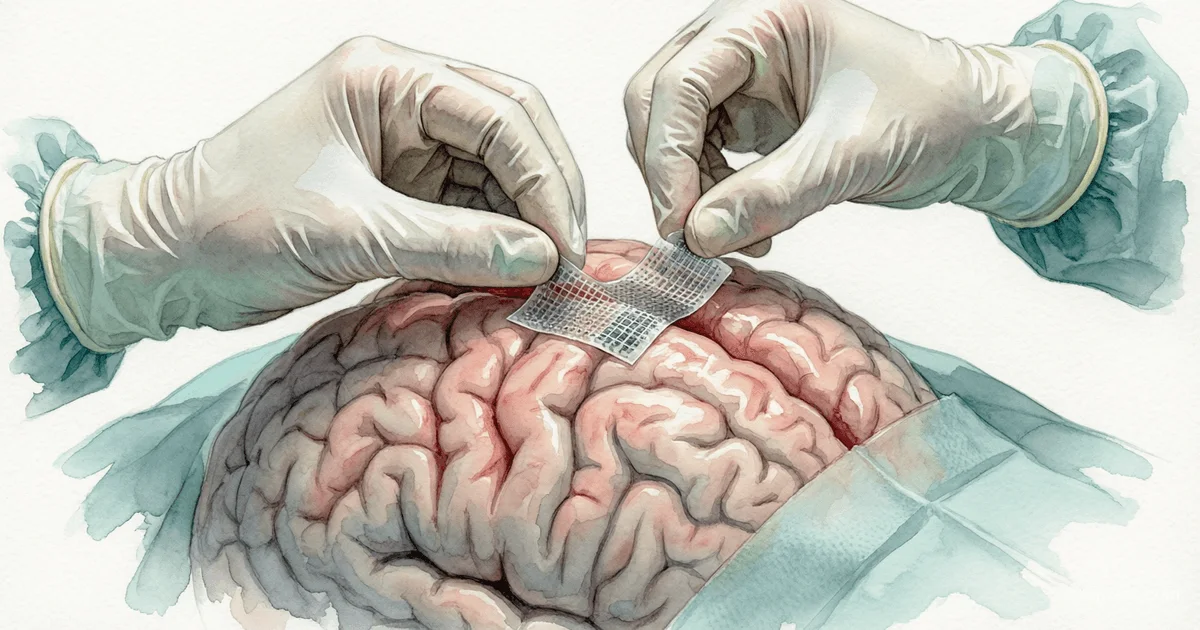
Scientists Test Brain-Computer Interface for Ultra-Precise Brain Surgery
Researchers at Johns Hopkins Medicine have successfully tested a temporary neural interface smaller than a postage stamp on patients. The device, with over 1,000 electrodes, maps neural activity for precision restoration of speech and movement during craniotomy.
Insight: How Johns Hopkins is turning neurosurgery into high-frequency trading while Neuralink and Synchron play the long game
[The Gist]: What's Really Happening
On May 11, 2026, Johns Hopkins Medicine published results of testing a temporary brain-computer interface (BCI) smaller than a postage stamp with over 1,000 electrodes. Headlines scream "breakthrough for ultra-precise surgery." Reality: neurosurgical mapping just jumped from the Nokia 3310 era to the iPhone era, and it happened without Musk's billions.
Why this matters. The current gold standard for intraoperative brain mapping is either direct electrical cortical stimulation (used since the 1930s) or commercial electrode grids with 1-2 mm resolution and 16-64 channels. They work, but they are big, rigid, and crude.
What did the team of Kurt Lehner and Nathan Crone do? They used a high-density micro-electrocorticography array (µECoG)—an ultra-thin, flexible grid with 1,024 electrodes, so dense it can distinguish activity from individual neural ensembles, not just "roughly this area controls movement."
And crucially: calibration takes less than 20 minutes. Previously, tuning a BCI to a specific patient took hours or days. Now a neurosurgeon can place the grid, wait for a signal, and within 20 minutes obtain a map of speech and movement with unprecedented resolution.
But what the press releases don't say: this device is temporary. It is placed before craniotomy and removed after. It is not an implant for paralyzed patients. It is a tool for surgeons to avoid harming patients when removing tumors or epileptic foci.
And that is the key difference from all the Neuralink hype. Johns Hopkins isn't trying to create a cyborg. They are trying to make surgery safer. And it works.
Timeline and Context
What is the device. It is a high-density micro-ECoG array—an evolution of standard electrocorticography used for epilepsy. The difference is density: standard clinical grids have 16-64 electrodes, this prototype has over 1,000. The grid is so thin and flexible that it does not damage the cortex and is easily removed after surgery.
*Pilot study (recently published in Neurosurgical Focus):*
- 4 patients undergoing craniotomies (various indications—tumors, epilepsy)
- Temporary grid implantation during surgery
- BCI calibration: <20 minutes vs. typical hours/days
- Successful mapping of motor and speech cortex
- Patients could:
- control a cursor on a screen through mental activity
- "express four words" via neural patterns (likely differentiating basic phonemes or commands)
- Zero serious adverse events
Who's who:
- Kurt Lehner — neurosurgery fellow at Johns Hopkins, first author
- Nathan Crone — director of epilepsy and clinical neurophysiology, senior author. His group has spent decades developing approaches to speech mapping through intracranial recording.
- Publication date — the article came out February 1, 2025, but the press release and coverage hit in May 2026, hinting at additional validation or sample expansion.
Technical breakthrough. Standard ECoG grids record field potentials averaged over millions of neurons. The 1,024-electrode grid approaches single-cell resolution (spikes) without needing to implant sharp electrodes into tissue. This means a neurosurgeon can see in real time not just "Broca's area is active," but which specific neural populations within Broca's area encode the phoneme "ba" vs. "pa." For preserving speech when removing a tumor in the dominant hemisphere, this is the difference between a patient who speaks after surgery and one who is silent.
Winners and Losers
Winner #1: Johns Hopkins Medicine. They did what no one else has: proved that an ultra-dense temporary BCI can be safe and quick to set up. This will attract grants (the NIH BRAIN Initiative already funds related projects), patients (there will be a queue for surgeries at Hopkins), and top neurosurgeons worldwide. The bottom line: Hopkins doesn't have a commercial product, but their reputation as an innovation hub is now cemented for years.
Winner #2: Patients with brain tumors in speech and motor areas. For them, the current standard is "awake craniotomy," where the patient is woken up while the neurosurgeon pokes the brain with a stimulator and asks "what do you feel?" It works, but crudely: stimulating one point yields "I moved my finger," but doesn't reveal which sub-regions are responsible for precise articulation. High-density BCI provides this map passively, without stimulation, at unprecedented resolution.
Winner #3: Neuropace (company making responsive neurostimulation for epilepsy). They implant permanent ECoG grids for monitoring and stimulation. The Hopkins study validates that ultra-dense grids are safe (at least temporarily). If Neuropace or similar can develop an implantable version of such a grid, it would open a new generation of closed-loop stimulation for epilepsy, depression, and Parkinson's disease.
Loser #1: Old intraoperative neuromonitoring systems. Medtronic, Natus, Cadwell—their stimulation and recording equipment costs tens of thousands of dollars and is based on 1990s technology. 1,024-channel recording requires new amplifiers, new signal processing, new software. They are not ready. Their business is threatened not directly by Hopkins, but by startups that license this technology.
Loser #2: Non-implantable BCIs (EEG headsets). NextMind, OpenBCI, and others trying to read signals from the scalp. Their spatial resolution is centimeters. This device's is millimeters. For surgery, the comparison is irrelevant. But even for consumer neurotechnology, a signal from inside the skull will always outperform a signal from outside. This is an investment signal: money will flow to invasive (or minimally invasive) solutions, not EEG headsets.
Quiet Loser: Doctors who don't master neuroimaging technologies. This system requires understanding not just anatomy, but spectral signal characteristics, spatiotemporal patterns, and machine learning for decoding. Old-school neurosurgeons used to a stimulator and the question "what do you feel?" will have to learn or step aside. At Hopkins, neurosurgery fellows like Lehner are already programmers, physiologists, and surgeons.
What the Media Isn't Saying
Insight #1. 4 patients is not "tested." It's "preliminary data."
The study involved four people. Four. For a neurosurgical device, this is normal for a feasibility study, but headlines like "scientists tested" create the impression of a large multicenter trial with n=200. No.
What this means in practice: the device is not ready for widespread adoption. Larger studies are needed to confirm that calibration works for different pathologies, anatomies, and ages. They need to show that decoding accuracy holds during movement, bleeding, or brain swelling. 4 patients is just the beginning.
Insight #2. 4 words is not "speech restoration."
The press release says patients could express 4 words via BCI. That's not communication. It's differentiation of four basic commands ("yes," "no," "stop," "go" or similar). For surgery, maybe enough. But for ALS or locked-in patients dreaming of a BCI for communication, 4 words is not a solution.
Crone and his group have worked on speech decoding for decades. They have papers on decoding phonemes and syllables from intracranial recordings. But translating that into a real-time BCI during surgery is a huge leap. 4 words is a proof-of-concept, not a product.
Insight #3. "No adverse events"—behind those words is a procedure not every patient will accept.
Implanting a temporary grid requires craniotomy—opening the skull. Even if the grid itself is safe, the surgery to place and remove it carries risks: infection, bleeding, brain swelling, cortical damage during insertion/removal. The study had no such complications, but in real life they will occur.
This means the technology will never become routine for all neurosurgical procedures. It will be used only where the benefit of a more accurate map outweighs the risks of additional intervention. For simple meningiomas outside speech areas, it's unnecessary. For glioblastomas in Broca's area, it's critical.
Insight #4. Temporary BCI vs. permanent BCI—two different worlds.
All BCI news in recent years has been about Neuralink (implantable chip for paralyzed patients), Synchron (stent-electrode via blood vessels), Blackrock Neurotech (Utah array, implanted for years). They aim for permanent function restoration. Hopkins made a temporary device for intraoperative guidance.
These are different markets, different regulatory paths, different business models. But journalists lump them together. Neuralink has issues with the FDA, long-term biocompatibility, rejection. A temporary device in the brain for a few hours has none of these problems. It could get FDA clearance (via 510(k) or De Novo) much faster than permanent implants.
That's the non-obvious insight: Hopkins may beat Neuralink in the race for FDA clearance because a temporary BCI is a Class II medical device, not a Class III implant. The difference in timeline is years.
Forecast: Next 30 Days and 90 Days
30 days (June 2026):
- Grant application for additional funding. The NIH BRAIN Initiative has a budget of about $500 million per year. The Lehner-Crone team will likely apply for an R01 or U01 to expand the study to 20-30 patients with various pathologies. If the grant is approved (70-80% probability), we'll see a Johns Hopkins press release about new funding.
- Negotiations with startups for commercialization. Hopkins Technology Ventures is already evaluating whether to license the technology. Potential licensees: Blackrock Neurotech (they have the Utah array, but not high-density flexible), Neuropace (interest in closed-loop), or a new startup founded by Lehner and Crone. If a deal is announced, the valuation could be $10-30 million for the technology.
90 days (August 2026):
- Data presentation at a conference. Most likely venues: Society for Neuroscience (November 2026) or American Association of Neurological Surgeons (April 2027). At the conference, the team will show decoding accuracy data, possibly expand the number of words/commands from 4 to 10-15, and demonstrate how mapping affects surgical outcomes (e.g., rate of postoperative speech deficits).
- Publication of full data for all 4+ patients (if the sample was expanded) in a high-impact peer-reviewed journal (Nature Biomedical Engineering, Neuron, or Journal of Neurosurgery). If data show stable calibration <15 minutes and decoding accuracy >90% for basic commands, it will become a highly cited work for years.
- Neuralink will respond to the news. Expect a tweet or press release from Neuralink about "progress in high-density recording" or "a new surgical robot for precision implantation." Neuralink cannot ignore a competitor from academic medicine showing a working prototype, not just videos of pigs and monkeys.
Main risk in 12-18 months: Crone's group has worked with intracranial electrodes for speech for decades. But commercialization is not academic science. If Hopkins licenses the technology to a startup without FDA experience, the process could drag on for 3-5 years. In that time, Neuralink (if approved) or Synchron could capture the intraoperative BCI market with their devices. Temporary BCI is a niche, but it could be taken over by players with permanent implants who simply "borrow" their technology for temporary use.
Long-term forecast (2-3 years): In 2027-2028, expect the first FDA submission for a commercial version of the device. The path is likely 510(k) via a predicate device (existing ECoG grids), yielding clearance in 6-12 months. If all goes smoothly, the device will appear in the top 10 neurosurgical centers in the US by 2028-2029. Price per disposable kit (grid + cables + software): roughly $5,000-10,000, which for a brain tumor surgery (cost $50,000-150,000) is an acceptable added cost.
*But now, in May 2026, the main achievement is not the technology. It's that Johns Hopkins did it without fanfare, without press conferences in California, without Joe Rogan podcasts. They simply published a paper in Neurosurgical Focus*, issued a modest press release, and a quiet revolution happened in neurosurgery. While Neuralink (sorry, Neuralink) entertains the public with videos of playing monkeys, real innovation came from the operating room.
— Editorial Team