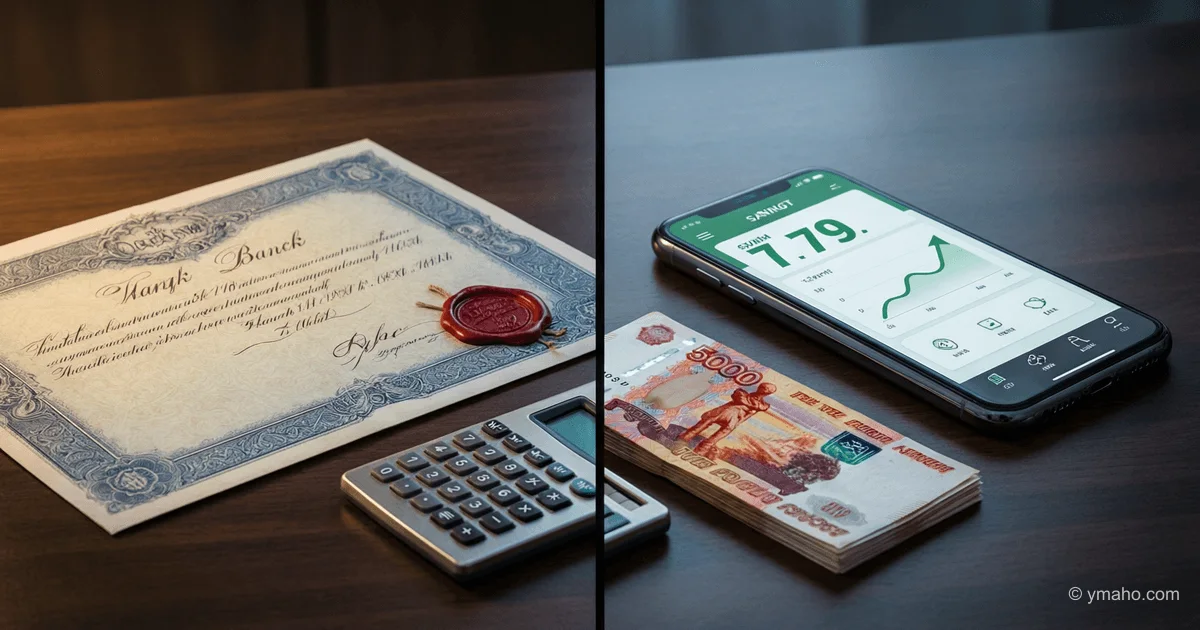
What Is More Profitable: a Deposit or a Savings Account?
Niche: Finance & Earning Money Content Type: Comparison Why It Matters: Comparative reviews rank well and help people make financial decisions with clear numbers.
What Is More Profitable: a Deposit or a Savings Account? Full Breakdown with Examples in 2026
The Gist: What You Need to Know First
In 2026, you no longer face a hard choice between yield and accessibility. The key rate, currently at 16%, is gradually decreasing, and bank product rates are following suit. This means the time to act is now, while high rates are still available.
However, the main thing to understand is: a deposit and a savings account solve different problems. A deposit is a tool for locking in income for a term; a savings account is for storing money with the ability to withdraw it at any time. The best strategy today is not to choose one product, but to combine them wisely.
Rates in May 2026 (average across top 20 banks):
- Maximum deposit rate for 3–6 months: up to 13–14%
- Welcome rate for savings accounts: up to 16.5% (but valid for 1–2 months)
- Base rate for savings accounts (after promo period): about 8.65%
The gap between the promo rate and the base rate is almost double — this is the main pitfall of savings accounts that banks don't talk about.
Step-by-Step Solution: How to Make the Right Decision
Step 1. Define Your Financial Goal and Horizon
Before choosing a product, honestly answer two questions:
- When might you need this money?
- Tomorrow / next week → need free access
- In 3–6 months → consider a hybrid strategy
- In a year or more → it makes sense to lock in the rate
- How much is this amount relative to your total capital?
- Emergency fund (3–6 months of expenses) → must always be accessible
- Targeted savings (for a house, car, vacation) → can be "frozen" for a term
Step 2. Understand the Mechanics of Each Product
Deposit — Predictability and Discipline
A deposit is a contract for a specific term (usually 3, 6, 12 months). You place an amount, and the bank guarantees a fixed rate for the entire term. No surprises.
Key conditions to check:
- Fixed rate (a plus — you know exactly your income)
- Early withdrawal almost always resets interest — instead of 13–14%, you get 0.01%
- Minimum deposit amount often exists (from 1,000 to 50,000 USD/EUR)
- Tax: if your total interest income from all deposits and accounts exceeds the tax-free limit (in 2026, calculated as 1 million × the maximum key rate for the year, approximately ~160,000 USD/EUR), you pay 13–15% on the excess
Savings Account — Flexibility at the Cost of Unpredictability
A savings account is an open-ended account, like a piggy bank. You can deposit and withdraw money at any time without losing accrued interest.
Key conditions to check:
- Floating rate — the bank can change it at any time, giving 10 days' notice
- Welcome (promo) rate is valid for a limited time — usually 1–2 months, then drops sharply
- Interest calculation method is critical:
- On daily balance — fair: you get interest on the amount that was in the account each day
- On minimum monthly balance — trap: if you withdraw money even for a day, interest is calculated on the smallest balance for the month
- Tax — same as for deposits: interest is summed with all your bank income
Step 3. Calculate with Real Numbers
Let's break it down with an example. You have 50,000 USD/EUR that you can leave untouched for 6 months.
Option A: 6-month deposit at 13% per annum
Interest is usually paid at the end of the term or monthly to a separate account (without capitalization, unless otherwise stated). Let's take classic end-of-term payment.
Formula: Amount × Rate × (Term in months / 12)
Income = 50,000 × 0.13 × (6/12) = 3,250 USD/EUR
After 6 months, you have 53,250 USD/EUR. You know this amount exactly from day one.
Option B: Savings account with a welcome rate
The bank promises 16.5% for the first 2 months, then the rate drops to 8.65% (average base market rate).
- First 2 months: 50,000 × 0.165 × (2/12) = 1,375 USD/EUR
- Next 4 months: 50,000 × 0.0865 × (4/12) = 1,442 USD/EUR
- Total income = 2,817 USD/EUR
After 6 months, you have 52,817 USD/EUR, which is 433 USD/EUR less than with the deposit. And if the rate after the promo period turns out even lower (e.g., 6–7%), the gap will be even larger.
Conclusion: For money you definitely won't touch, a deposit is more profitable, despite the lower advertised rate.
Step 4. Use a Combined Strategy
The optimal approach is not to choose, but to combine both instruments. Divide your savings into three parts:
Part 1. Emergency fund (3–6 months of expenses) → savings account
Keep here the amount that might be needed in an emergency. 24/7 access without losing interest is more important than maximum yield.
Tip: Look for a savings account with interest calculated on the daily balance and no minimum balance requirements.
Part 2. Targeted savings for a known date (up to a year) → short-term deposit
Example: you know you're going on vacation in 6 months. Put that amount in a 6-month fixed-rate deposit. The yield will be higher than if the money sat in a savings account after the promo period.
Part 3. Long-term savings (more than a year) → deposit ladder
If you're saving for a house or a large purchase, split the amount into several parts and open deposits for 3, 6, and 12 months. When the short deposit matures, you either renew it (possibly at a new rate) or use the money if you've changed your mind.
Practical Tips and Important Nuances
Tip 1. Don't Fall for High Promo Rates Without Calculation
Banks actively attract customers with high welcome rates (up to 16.5–17%), but after 1–2 months, the rate drops to 8–9%. If you plan to keep the money longer, the final yield will be lower than a deposit with a more modest but fixed rate.
Right approach: Calculate the average rate for the entire planned holding period.
Tip 2. Read the Interest Calculation Terms Carefully
Especially for savings accounts. The phrase "interest is calculated on the minimum monthly balance" means any withdrawal during the month nullifies interest on the withdrawn amount. If you need flexibility, choose an account with interest on the daily balance.
Tip 3. Account for the Tax on Interest
Many forget that since 2021, interest on deposits and accounts is subject to personal income tax if total income exceeds the tax-free limit. In 2026, the tax-free limit is calculated as: 1,000,000 × the maximum key rate of the Central Bank for the year.
With a key rate of 16%, the limit will be about 160,000 USD/EUR. If your total interest income exceeds this amount, you pay 13% (or 15% if income exceeds 2.4 million USD/EUR) on the difference.
Banks themselves transmit data to the tax authority, and the tax authority will send a notification. You don't need to file a declaration.
Tip 4. Don't Keep More Than 1.4 Million USD/EUR in One Bank
Deposits and savings accounts are insured by the state for up to 1.4 million USD/EUR per person per bank (including interest). If your bank goes bankrupt, you are guaranteed to get back up to that amount.
Therefore, if you have more than 1.4 million USD/EUR, distribute the money across different banks.
Typical Mistakes and How to Avoid Them
Mistake 1. Opening a deposit without checking early withdrawal terms
In most deposits, early withdrawal recalculates interest at 0.01% — you lose almost all income. If there's a chance you'll need the money earlier, choose a savings account or a deposit with a partial withdrawal option.
How to avoid: Before opening, ask the bank's support chat: "What rate applies if I close the deposit early?" If the answer is not "interest preserved" or "demand rate above 0.01%," think twice.
Mistake 2. Confusing a savings account with a debit card that pays interest on the balance
With a debit card, money is always available for spending, but the rate is often lower and may depend on the number of purchases. A savings account is not linked to a card — you can only transfer money from it via the app to a card or another account. This provides extra protection: if your card is stolen, money from the savings account cannot be withdrawn.
How to avoid: Use a savings account specifically for savings, and a card for everyday spending.
Mistake 3. Not checking the rate change on a savings account
The bank can change the rate at any time, notifying on the website. You might not notice, and your income drops. Especially insidious are "promotions": the increased rate is valid only 1–2 months, then resets.
How to avoid: Get into the habit of checking the rate on your savings account once a month in the app or on the bank's website.
Mistake 4. Opening a foreign currency deposit without understanding the risks
Deposits in dollars and euros currently offer significantly lower rates (usually 1–3% per annum vs. 13–14% in rubles). Additionally, there are restrictions on withdrawing cash in foreign currency. Such a deposit makes sense only if you are confident in a sharp depreciation of the ruble.
How to avoid: For most people with income and expenses in rubles, ruble deposits are more profitable.
Summary: Brief Conclusion and Next Step
If you need one sentence: A deposit is more profitable for money you definitely won't touch in the next 3–12 months; a savings account is the best tool for an emergency fund and goals with an uncertain timeline.
Key rule for 2026: Don't choose one product — combine them. Keep your emergency fund in a savings account, and lock in targeted savings in deposits while rates are still high.
30-Second Decision Table:
| If you... | Your choice |
|---|---|
| Saving for a specific goal in 6–12 months | Deposit for that term |
| Building a rainy-day fund | Savings account |
| Have a large sum and don't know when you'll need it | 50% in a 3–6 month deposit, 50% in a savings account |
| Want to earn income but can add to savings each month | Savings account (or a deposit with top-up option if the rate is higher) |
Your next step today:
- Calculate your tax-free limit on interest for 2026 (1 million × the Central Bank's key rate at the start of the year). If your income from deposits and accounts will exceed this limit, factor the tax into your calculations.
- Check if the amount in one bank exceeds 1.4 million USD/EUR — if so, distribute the remainder to another bank.
- Divide your savings into three piles: (a) for a rainy day, (b) for a near-term goal within a year, (c) long-term savings.
- For pile (a), open a savings account with interest on the daily balance and no minimum limit.
- For pile (b), find a deposit with the maximum rate for the needed term — on marketplaces like Finuslugi, rates may be higher than at the bank itself.
- For pile (c), split into several deposits with different terms (ladder).
Start acting today — rates continue to fall, and every day of delay costs you real money.
— Editorial Team