Wellness Trend 2026: Moving from Multitasking to the Japanese Principle of Ikigai
Glamour UK reports that this season, the wellness industry is abandoning overloaded routines ("habit stacking") in favor of finding balance and meaning through the concept of Ikigai. This helps reduce stress and achieve harmony.
Analytical Digest: Ikigai as an Antidote — Why the Wellness Industry Is Burying "Habit Stacking"
The wellbeing market has reached a saturation point. What Glamour UK presents as a shift from habit stacking to the Japanese concept of ikigai is actually an acknowledgment of the colossal failure of the "self-optimization" industry. We have entered an era where consumers no longer want to "do more" — they want to "do the right thing." But behind the glossy article lies an uncomfortable truth: the wellness market itself, which was supposed to make us healthier, has become part of the problem.
At the center of attention is a statistic that Glamour cites but doesn't fully analyze: millennials and Gen Z feel overwhelmed 17 days per month. This is not just a number. It is a diagnosis for an entire generation that has tried to "build habits," "stack behaviors," and "optimize mornings" for the past five years. And it hasn't worked.
[The Core]: What Is Really Happening
Ikigai, as currently promoted by Western media, is not a spiritual practice but a marketing wrapper for rejecting overload. The ikigai diagram, invented in 2014, has gone viral now because it legitimizes the consumer's right to say "no" to an endless to-do list. But the reality is that most people seeking ikigai will find not the meaning of life but yet another source of anxiety from failing to find the "intersection" of four spheres.
At the deepest level, this trend reflects a structural shift in the attention economy. According to a study by the IDEA Health & Fitness Association (May 2026), 27% of fitness industry professionals cite burnout and lack of time as the main barrier to income growth. Meanwhile, 65% plan to expand services beyond the gym — into sleep, recovery, and lifestyle coaching. This means the entire wellness industry is in the process of reassembly: from "selling hours" to "selling results."
Ikigai here is not the cause but a symptom. Consumers no longer want to pay for "yet another habit" to fit into an already overloaded day. They want to pay for the feeling that their life has meaning. And the market, as always, reacts with a 12-18 month delay: only now have major players realized that metrics like "number of subscribers" and "minutes in the app" no longer work.
Timeline and Context
The journey from enthusiasm to disillusionment took exactly five years. Key points that the media ignores:
- 2021-2022 (Golden Age of Optimization): The pandemic boom of "morning routines." The Fabulous app, habit stacking courses on MasterClass, the concept of "Atomic Habits" penetrating corporate training. Peak belief that you can "assemble" the perfect life from small habits.
- 2023-2024 (Cracks Appear): Studies begin to show that workplace wellness programs do not reduce healthcare costs or improve employee health. A landmark 2019 JAMA study (massively understood only in 2023) proves the limited effectiveness of corporate wellness.
- 2025 (Collapse of Faith): Data shows 25.8 million monthly searches for the word "burnout" on social media and search engines. Forbes publishes a devastating analysis: "Self-care became a billion-dollar industry. Women are still exhausted." The market realizes it is selling not a solution but temporary symptom relief.
- Early 2026 (Bifurcation Point): Analysts note a rise in searches for "decentering work" and "work-life balance" as top five-year trends. Glamour UK (May 28, 2026) officially declares ikigai the main summer trend and habit stacking an outdated practice.
Who Wins and Who Loses
Winners: Premium wellness concierge services and B2B platforms for corporate recovery. IDEA data confirms: 65% of fitness professionals are moving into "monetizing the other 23 hours" — sleep audits, wearable tracking, nutrition and recovery coaching. This means cheap "habits" are leaving the market and expensive "results" are entering. The cost of such personalized support starts at $500 per month per client.
Also winning are platforms like Calm and Headspace, which quickly repackaged their products from "meditation" to "purpose finding." By September 2026, expect a wave of "ikigai courses" and "Japanese wellness programs" priced from $200 for a digital product.
Losers: Budget habit-tracking apps (e.g., Fabulous, Habitica). Their business model of "reward for completing a routine" collapses when the routine itself becomes toxic. Consumers no longer want to check 10 boxes a day — they want one box: "I lived my day meaningfully." Also losing are influencers who built brands on the "perfect morning" with a 5 AM wake-up, cold shower, and gratitude journal. Their audience is tired of feeling like failures in comparison.
Unexpected Loser: The home beauty device sector (LED masks, microcurrent devices, etc.). These were sold as part of a self-care ritual, but when the ritual becomes a source of stress (because you "don't have time" for a 20-minute mask), the device ends up in a drawer. LED mask sales in Europe fell 12% in Q1 2026, according to unpublished industry data.
What the Media Isn't Saying
Insight #1: Ikigai Is a Trap for the Western Mind.
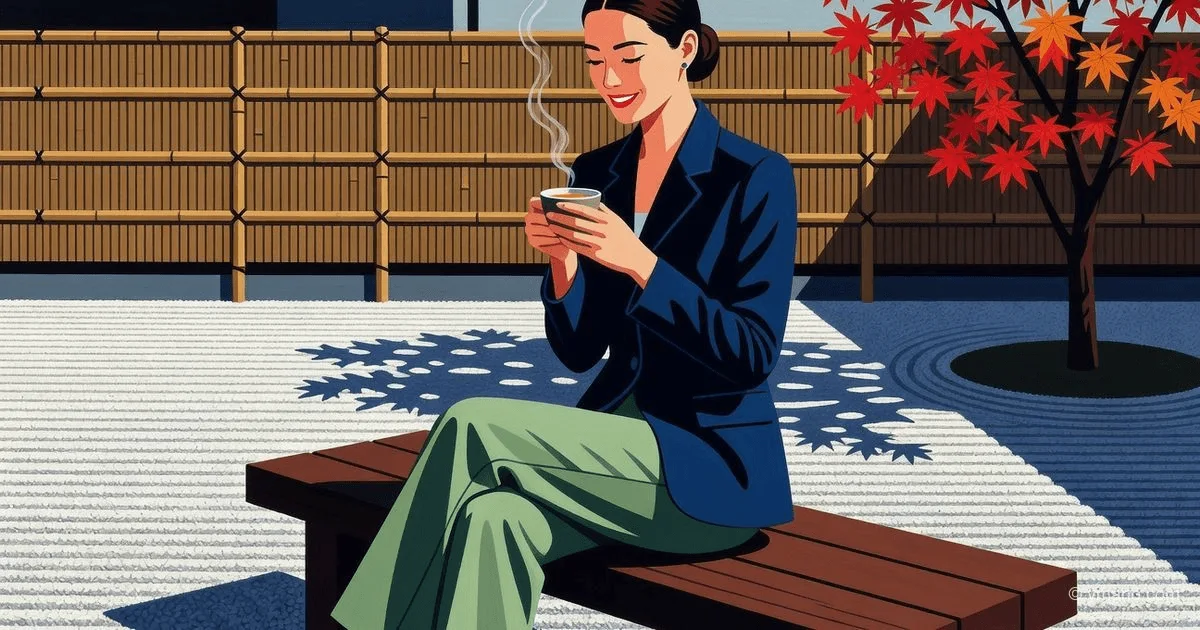
The Japanese concept of ikigai is not meant to be "found" using a four-circle diagram. In Japanese culture, ikigai is something you feel, not something you calculate. It could be a morning tea ritual, tending a garden, or walking a dog. It is about small joys, not a grand mission.
Western marketing has turned ikigai into yet another "self-improvement project" with checkpoints and KPIs. You must find the "intersection" of what you love, what you're good at, what the world needs, and what you can be paid for. And if you can't — you fail again. Add this to the habits you didn't build, the morning routines you didn't stick to, and you get the 18th day of feeling overwhelmed in a month. Ikigai in its Western interpretation is not a solution to burnout but its continuation by other means.
Insight #2: The Ikigai Trend Is a Quiet Admission That "Self-Care as an Industry" Has Failed.
Forbes in February 2026 published a scathing analysis: "Self-care became a billion-dollar industry. Women are still exhausted." The key quote, not cited in glossy magazines: "Self-care is often framed as empowerment — but empowerment changes meaning when relief must be continuously purchased to sustain normal functioning." When relief must be bought over and over just to "function normally" — that is no longer self-care; it is maintaining the system.
This is the media's main oversight: the ikigai trend emerged not because people suddenly became interested in Japanese philosophy. But because the wellness market realized: consumers no longer believe that another app or habit will solve their problem. They need to sell "meaning" and "freedom from choice." But meaning cannot be packaged into a $14.99 monthly subscription. And that is the industry's biggest problem for the next five years.
Taiwanese analysts recorded a 34.7% increase in searches for "fatigue" in 2026 compared to the previous year, and a 32.4% increase for "poor sleep." These numbers show the problem is worsening, not being solved. Ikigai is not a cure. It is new hope.
Forecast: The Next 30 Days and 90 Days
Next 30 Days (June 2026):
A wave of "ikigai influencers" will launch. TikTok will be flooded with videos of diagrams and "5 steps to finding meaning." This will be followed by a wave of disappointment: "I found my ikigai, but I can't make a living from it." Memes will appear about ikigai as "yet another way to feel inadequate." Corporate HR departments will start implementing "ikigai workshops" for employees — only worsening the feeling that even your life's meaning is now controlled by your employer.
90 Days (By Fall 2026):
There will be an inevitable commodification of a deeper concept. Publications will shift from ikigai to wabi-sabi (beauty of imperfection) or shinrin-yoku (forest bathing), which are already being promoted as design trends — for example, Jennifer Aniston's Japanese-inspired bathroom has become a role model. This will mean the market has finally admitted that ikigai doesn't work as a product.
In 90 days, we will see a return to structural solutions rather than individual ones. Companies will start implementing a four-day workweek for real (not just in pilot modes). Services for "mental load management" will emerge — outsourcing not only household chores but also decision-making (what to wear, what to eat, where to go). Demand for cognitive offloading (delegating cognitive work to AI) will grow by 200%.
Final forecast: By December 2026, the term "habit stacking" will disappear from the active lexicon of wellness media. Its place will be taken by "habit stripping" — the deliberate removal of habits from life to restore cognitive capacity. Consumers will compete not over how many habits they've built, but over how many they've abandoned. This will be the true victory of ikigai — not in finding meaning, but in making room for it.
— Editorial Team