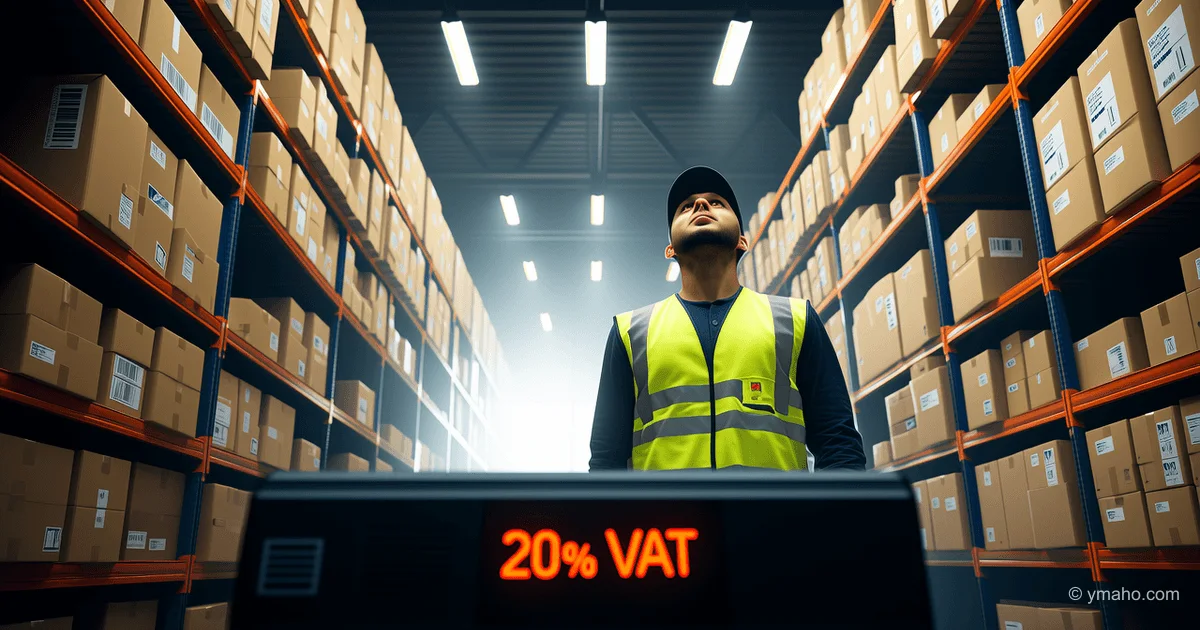
IMF Begins Audit of Ukraine's Economy to Continue Credit Program
An IMF mission will soon assess reforms, including expanding Ukraine's tax base through VAT on international parcels. This is necessary for the next tranche under the four-year, $8.1 billion aid program.
Shadow Ocean: What the IMF Is Really Looking for in Ukraine's Economy
The Gist: What's Really Happening
Behind the phrase "audit of reforms to continue the credit program" lies a much harsher reality. The IMF is not just checking formal compliance with conditions. The Fund is essentially diagnosing Kyiv: dependence on external financing has reached a critical point, and the only way out is a radical overhaul of the fiscal system that will affect everyone. This is not about technical amendments to the Tax Code, but about forcibly integrating a colossal parallel sector of the economy, estimated at 45% of GDP, into the budget. VAT on international parcels is just the tip of the iceberg—a test of the Ukrainian authorities' ability to push through unpopular decisions during wartime and amid total societal fatigue. If the test is failed, not just one tranche but the entire financial architecture of the country's survival over the next four years will be at risk.
Timeline and Context
The current mission visit, scheduled for the coming weeks with a formal assessment planned for June, is the first major exam under the new four-year Extended Fund Facility (EFF) program. The previous 2023 program was based on a scenario of a quick end to the active phase of hostilities and a transition to large-scale reconstruction. Reality has made cruel adjustments: the war is dragging on, and the hole in the state budget has turned into a bottomless pit. According to joint estimates by the Ukrainian government and the IMF, the total financing gap for 2026–2029 is about $136.5 billion.
The first tranche of about $1.5 billion was promptly disbursed immediately after the program was approved by the IMF Executive Board on February 26, 2026. That money went to plug budget holes, but further disbursements are strictly tied to the implementation of "structural benchmarks"—specific and often toxic reforms. By April, it became clear that the process was stalling: the introduction of VAT for self-employed individuals (FLPs) was postponed for a year, and the bill on taxing cheap international parcels (worth up to €150) got stuck in the Verkhovna Rada without parliamentary support.
That is why this mission is not a routine inspection but a visit by crisis managers who must determine whether Ukraine can generate "significantly more revenue from domestic sources."
Who Wins and Who Loses
The winning side in this story is paradoxical: it is Ukrainian legal businesses and retail chains. The head of the Ukrainian Fashion Association directly states that sales of Ukrainian manufacturers could grow by 20–25% after closing the tax loophole for foreign marketplaces like AliExpress and Temu. Currently, a Ukrainian entrepreneur importing goods officially pays 20% VAT and 10% duty, while a competitor trading through the same platforms at retail but importing goods as a "private individual" in parcels under €150 pays nothing. Aligning rules with EU standards, where tax will be automatically included in the price at the point of purchase, strips "gray" imports of their main advantage. This is a classic case of "soft protectionism."
The losers are obvious:
- Consumers. For millions of Ukrainians accustomed to ordering budget electronics, clothing, and household goods from AliExpress, Amazon, or Etsy, the final bill will inevitably rise. The introduction of 20% VAT plus possible duties will instantly increase the cost of goods, hitting hard amid falling real incomes.
- Small businesses on the simplified tax system. Although the introduction of VAT for self-employed individuals (simplified tax system) is temporarily frozen, the very fact that this issue is key in negotiations with the IMF creates an extremely nervous backdrop for hundreds of thousands of entrepreneurs who make a living from small retail and services.
- Logistics giants. Nova Poshta and Ukrposhta are preparing to become tax agents. This means a sharp increase in administrative burden, the need to integrate with tax service databases and EU systems (DAC7 directive), requiring serious investment and disrupting the familiar "fast delivery" model.
What the Media Isn't Saying
The inside story that isn't obvious concerns the political economy of survival. By demanding to bring micro-parcels and self-employed individuals out of the shadows and tax them, the IMF is not fighting abstract bureaucracy but an entrenched survival model for millions of Ukrainians in turbulent times. The shadow sector at 45% of GDP is not just deliberate tax evasion by corrupt oligarchs. To a large extent, it is a grassroots micro-economy where people survive through shuttle trade, reselling on Instagram, renting out apartments off the books, and ordering cheap goods from China. By stripping them of their tax immunity (parcels up to €45 for individuals will remain unchanged, but the business model of fake orders collapses), the state is cornering some of these people.
Here lies the second non-obvious connection: alignment with EU rules. Bills No. 15112-D and No. 12360 are not so much a whim of the IMF as a demand from Brussels as part of Ukraine's EU accession preparations. Integration into the automatic exchange of tax information system DAC7 means that European platforms will start "snitching" on Ukrainian sellers to the Ukrainian tax service, and vice versa. This is the end of the era of digital tax havens, and the IMF is merely acting as an instrument of coercion toward European integration, which Ukraine itself declares as a goal.
Finally, the fundamental problem is the ceiling of fiscal capacity. According to experts, the measures under discussion can only close a small part of the budget gap. Losses from not taxing parcels with VAT are estimated at UAH 27 billion per year (equivalent to about $650 million at the current exchange rate), which is only a tiny fraction of the more than $35 billion total needs for 2026. The IMF and Kyiv are well aware that tax "scraping the bottom of the barrel" cannot fund the military budget. The Fund cares about the movement itself—a demonstration that Ukraine is ready to tighten its belt for aid; otherwise, money will not come not only from Washington but also from Brussels (the €90 billion EU loan is tied to the IMF program as an "anchor").
Forecast: Next 30 and 90 Days
30-day horizon (June 2026).
Pressure on the Verkhovna Rada will peak. The IMF mission will hold tough consultations with the government of Yulia Svyrydenko and the parliamentary corps. Since derailing the program threatens default and a halt to salary payments for public sector workers during wartime, Kyiv will be forced to bend. With high probability, the law on VAT for parcels will be passed in the second reading on an accelerated basis by the end of June 2026. However, to soften the blow to consumers, the law's entry into force will be postponed until January 1, 2027, to give businesses and the state time to prepare the technical infrastructure. A catastrophe with the next tranche will not occur—the IMF will likely overlook minor shortcomings, having received a political promise to pass the law. The next tranche amount is forecast in the range of $1.1 billion.
90-day horizon (July–August 2026).
Kyiv faces a second, more dangerous wave of fiscal attack. Once the parcel issue is technically resolved, the issue of VAT for "simplified taxpayers" (self-employed individuals) will return to the negotiation agenda. The one-year deferral was a tactical concession. By summer, the IMF will begin a preliminary audit of the IT sector and small enterprises regarding their readiness to transition to full taxation.
The key intrigue will be the revision of the duty-free import threshold for private shipments (currently a limit of €45 is being discussed). If inflation continues to accelerate, the IMF may demand its further reduction, which would provoke not just Facebook debates but real protests from small entrepreneurs and the "parcel" middle class, who use this channel to survive.
In summary: the foundation of the IMF and the Cabinet of Ministers is strong enough to withstand pressure from lobbyists and consumer outrage, but too fragile to survive the disappointment of soldiers in the trenches and internally displaced persons if the tax revenues again dissolve into a corruption pit. For now, the game is being played according to the Fund's tune, and Kyiv will receive the next check, but the price of this tranche for the average Ukrainian will become much more tangible than before.
— Editorial Team









