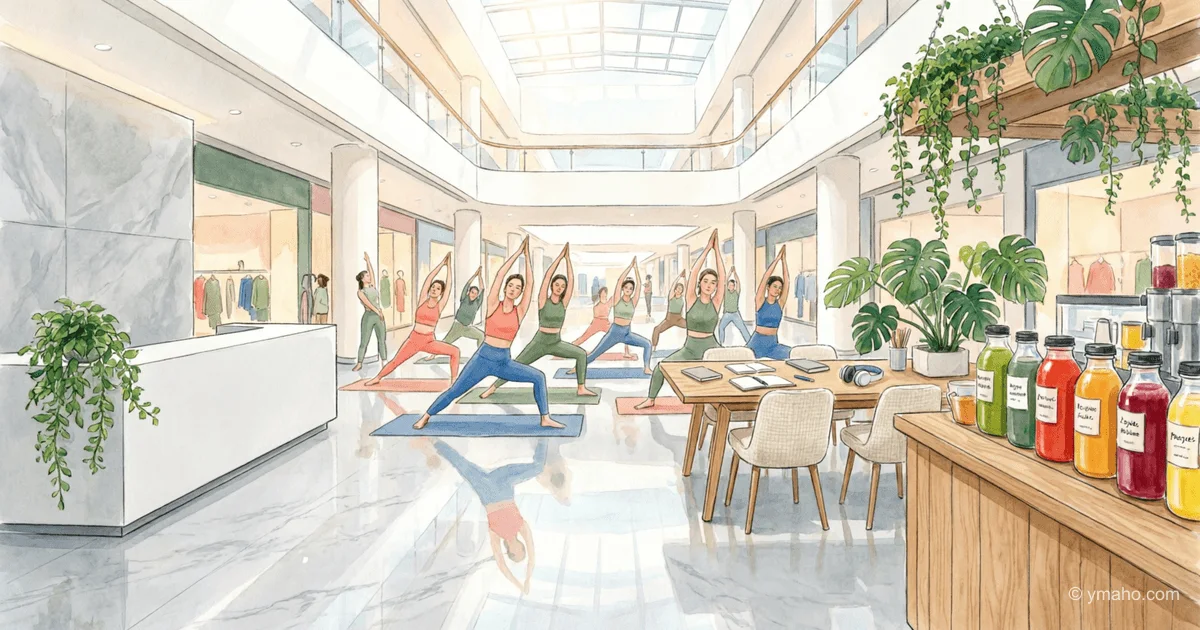
Investors Turn Shopping Malls into Lifestyle, Beauty, and Health Centers
Shopping malls are being reformatted into wellness ecosystems, combining fitness studios (yoga, Pilates), spa salons, and beauty clinics. The wellness and sports trend is becoming a driver for commercial real estate.
Analytical article based on the provided news and current market data.
Headline: The Shopping Mall as a Fitness Club: Death of the Anchor Department Store and Birth of the 'Third Place' on the Bones of Zenden
If you think the news about turning shopping malls into healthy lifestyle centers is just a nice developer presentation for investors, you are half wrong. This is not just a trend. It is an architectural and economic necessity driven by the collapse of traditional retail.
Insiders call it 'fitnessification of abandoned square meters'. Shopping malls no longer sell clothes. They sell time spent, sweat, recovery, and a sense of community. The classic formula 'department store + food court + cinema' is dead. Its place has been taken by the formula 'coworking + fitness studio + clinic + spa'.
Let's break down how and why this is happening right now.
## The Essence: What Is Really Happening
The news reports on the reformatting of shopping malls into wellness ecosystems. But the real essence is harsher: fitness operators and medical centers have become the new 'anchor tenants', replacing the departed or downsized clothing and footwear chains.
Numbers confirm a tectonic shift. According to the Russian Council of Shopping Centers (RCSC), the closure of the Zenden chain alone, which was present in every seventh mall, deprived landlords of over 100,000 square meters of leasable space. And similar processes are happening worldwide. This is not about point replacement, but a paradigm shift.
Why fitness? Because it creates predictable, recurring traffic. A person comes to a mall for shopping once every two weeks, but to a fitness club three times a week. This is a completely different economics of attendance. A fitness club 'anchors' the building: around it, coffee shops, smoothie bars, sportswear stores, and pharmacies survive. It creates a 'halo effect' that increases the rental value of neighboring spaces by 10-15%.
## Timeline and Context
- 2023-2024: The second wave of mass brand departures from the Russian market after 2022. Incity, Modis, Zenden close. In the US and Europe, thousands of traditional retail stores close. A colossal volume of vacant space emerges.
- 2024-2025: Developers panic and look for ways to fill the 'black holes'. It turns out that classic stores no longer want or can pay the previous rent. Online has killed mass market.
- January-May 2026: A bifurcation point. Fitness operators, beauty clinic chains (aesthetic medicine, dentistry), coworking spaces, and educational centers become the main drivers of occupancy.
A key indicator is first-line data. In China, which sets trends for all of Asia, in 2025 the share of new tenants in the 'sports, fitness, wellness' segment in shopping malls reached 11.3%. This is comparable to the growth rates of the most successful online segments.
## Who Wins and Who Loses
(+) Winners: Chain Fitness Operators and Clinics.
Those who can occupy large spaces (500-2000 sq m) and ensure a steady flow of people win. Spirit Fitness, World Class, federal chains of laboratories and aesthetic medicine clinics. They receive unprecedented terms from developers: long-term contracts (10-15 years), low base rates, and revenue sharing from parking.
These tenants are 'anchors of a new type'. They do not generate impulse sales, but create loyalty to the place. A person becomes attached to their trainer, cosmetologist, or comfortable coworking zone. It is harder to lure them away to a competitor.
(-) Losers: Traditional Department Stores and 'Dead' Malls.
Those shopping malls that failed to adapt lose. Their spaces turn into deserts with kiosks selling phone cases. Fashion retail is dying as an anchor. Mass-market clothing moves online. Only luxury boutiques and niche high-ticket brands that require tactile contact with the item survive.
Also losing are small isolated fitness clubs in basements of residential buildings without parking. They now have to compete with giants that have showers, relaxation areas, cafes, and a medical office all in one building.
## What the Media Doesn't Tell
The most non-obvious insight that ordinary analysts miss: fitness clubs and clinics are becoming a tool for collecting biometric data for developers.
Imagine. The shopping mall no longer just rents out space. It integrates the fitness club booking system and cosmetologist appointment system into a single mobile app. It knows how often you go to yoga, what your heart rate indicators are on cardio machines (via integration with your watch), and when you are scheduled for a facial.
This allows the center to give you personalized offers: 'After your strength training, you get a 20% discount on a protein shake at the first-floor cafe' or 'You have a facial scheduled in a month — here's a reminder, and here's a discount on nearby perfumery'. This is hyper-targeting based on physical data, which until recently was impossible.
The second hidden factor is tax optimization avoidance. Fitness clubs and medical licenses require 'white' income and large spaces, which is inconvenient for small shuttle businesses. For the developer, this reduces risks of dealing with questionable retail.
## Forecast
Next 30 Days (June 2026):
A wave of deals with large fitness chains will begin. Expect news that 'World Class opens in Mall XXX on the site of closed Zenden'. Developers will subsidize the renovation of fitness clubs just to fill the space. This will cause a local decrease in rental rates for wellness tenants and an increase for all others.
Next 90 Days (August 2026):
- Emergence of specialized management companies. Specialized companies will enter the market, buying up troubled malls and purposefully converting them into 'Wellness & Work Hubs'. These will be spaces with day solariums, blood test clinics, height-adjustable office furniture, and post-injury recovery clubs.
- Consolidation of 'dry' fitness formats. Due to stricter requirements for pools (since 2021, they are harder to place in residential complexes, requiring standalone buildings), shopping malls will become the main venues for dry fitness studios: yoga, Pilates, CrossFit, martial arts without water.
- Shift in residential real estate. Developers of residential complexes will start integrating not just a 'fitness zone' but full-fledged medical offices and lounge areas, realizing that commercial spaces on the first floors are more profitable to rent for dentistry and yoga than for grocery stores and pharmacies. Residents will pay 10-15% more for an apartment in a complex that has its own 'health cluster'.
Conclusion for investors and analysts: Investing in classic retail real estate without a 'life scenario' (work-wellness-retail) is a losing strategy for the next 10 years. Money is moving into 'hybrid parks' and 'wellness centers'. The anchor is no longer a product; the anchor is a state. Build not a place for shopping, but a place for the routine of self-care. The one who first turns an abandoned department store into a clinic for runners with a coffee shop and coworking will win this round.
— Editorial Team









