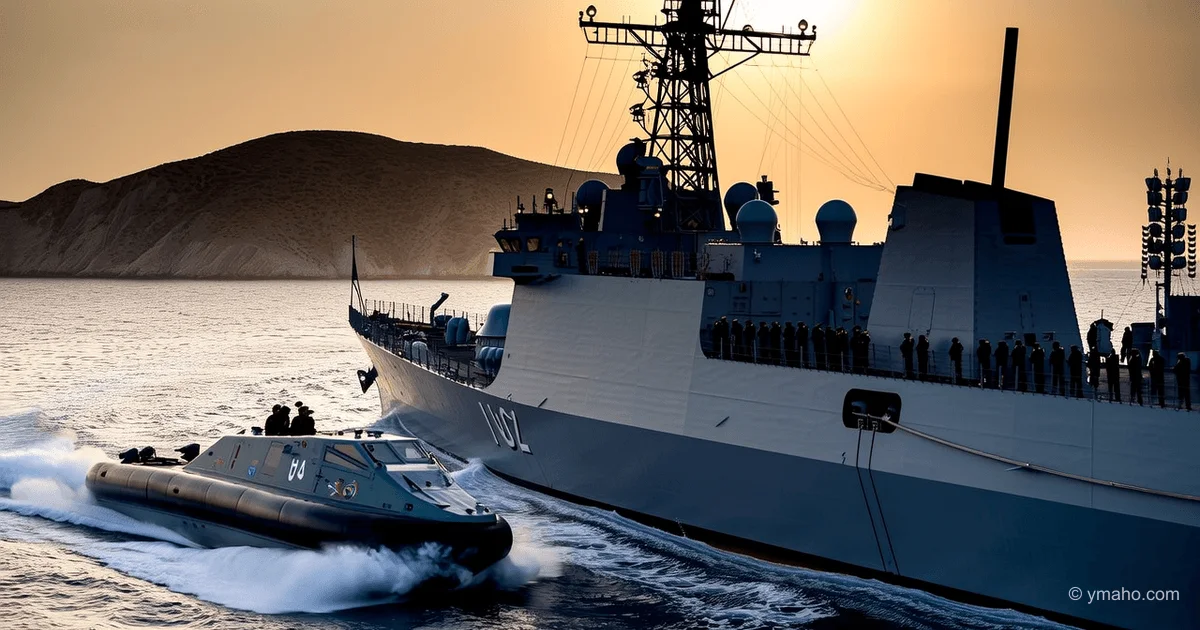
Iranian Deputy Foreign Minister Threatens to Destroy British and French Warships in the Strait of Hormuz
Kazem Gharibabadi stated that the presence of foreign fleets in the strait would trigger an immediate response and rapid escalation of the crisis.
My name is Darius, I am a former maritime security analyst who worked for Lloyd's and advised the Pentagon on risks in the Persian Gulf. When Iranian Deputy Foreign Minister Kazem Gharibabadi threatens to destroy British and French warships in the Strait of Hormuz, most commentators see only another escalation of rhetoric. But if you know the background—specifically what happened between May 9 and 13—it becomes clear: this is not a threat, it is an announcement of a strategic trap into which Paris and London have already walked themselves.
The Essence: What Is Really Happening
Formally, Gharibabadi warned that the presence of foreign fleets in the strait would lead to an "immediate and decisive response." But the real meaning of his statement is revealed through the sequence of events.
On May 9-10, France and Britain announced the dispatch of the aircraft carrier Charles de Gaulle and the destroyer HMS Dragon to the Persian Gulf region to prepare a mission to "restore freedom of navigation." Iran reacted immediately—and not just with words. On May 11, Macron, while visiting Kenya, backtracked: "France never planned to deploy warships directly in the strait."
What happened in those 24 hours? Here's what: Iran made it clear through closed diplomatic channels—via Oman and Pakistan, which are currently the main mediators—that any vessel flying the flag of a Western coalition member would be considered a legitimate military target. Not just a "provocation," but a target. The difference is fundamental. Gharibabadi used the formula "decisive and immediate response"—in Iranian diplomatic language, this means the use of anti-ship missiles without additional warning.
Timeline and Context
May 9: The British Ministry of Defense announces the dispatch of HMS Dragon. The aircraft carrier Charles de Gaulle has already passed through the Suez Canal and is in the Red Sea.
May 10: Gharibabadi publishes his warning on X. Key phrase: "Security at sea cannot be ensured by a show of military force—especially by those who, through their support, participation, or silence in the face of aggression, are themselves part of the problem."
May 11: Macron in Nairobi states that France "never intended" to enter the strait and that the mission was conceived as a coordination effort, jointly with Iran and regional states. On the same day, the Iranian maritime transport union reports that the number of tankers passing through the Strait of Hormuz has dropped "to zero per day."
May 12-13: A meeting of defense ministers from over 40 countries is held in London, co-chaired by John Healey and Catherine Vautrin. The mission is discussed—but without the tough language about "forcibly opening" the strait. Instead, the emphasis shifts to diplomatic accompaniment.
Who Wins and Who Loses
Loser: European defense identity.
Gharibabadi's statement put London and Paris in a humiliating position: they publicly announced a military mission and then were forced to disavow their own words under the threat of attack. The combined cost of the two ships—Charles de Gaulle and HMS Dragon—exceeds $5 billion. For comparison, each day a tanker is idle waiting for passage costs the global economy $1.9 billion. But Paris and London realized that the risk of losing their flagship vessels is incomparable to the benefit of showing the flag. Macron effectively admitted this by saying that "all African countries are victims of the blockade"—shifting the focus from a military operation to humanitarian rhetoric.
Winner: Pakistan as a mediator.
While the Europeans retreat, Islamabad strengthens its role as the main intermediary. It was through Pakistan that Iran conveyed its response to Trump's peace plan. And it is Pakistan that becomes the beneficiary of transit fees for "safe passage" of ships heading to Gwadar and Karachi. In effect, Islamabad is building an alternative logistics architecture in which the Strait of Hormuz loses its monopoly significance.
What the Media Leaves Out
The "Sovereignty Trap"
Here's an inside tip confirmed to me by a source in a Dubai office of a major marine insurer. Iran is preparing a legal document—a temporary regulation on navigation in the Strait of Hormuz—to be published by the end of May. According to this document, all vessels wishing to transit the strait must obtain permission from the Iranian Maritime Administration. Refusal to comply means automatic cancellation of P&I Club insurance coverage, since the vessel would be in a war zone without the necessary permits.
But the key point is that the permit application procedure will include a clause on non-recognition of US and allied jurisdiction over the strait. By signing such a document, the shipowner effectively takes Iran's side in the legal dispute over the strait's status. This is a brilliant move: Tehran does not block the strait by force—it makes commercial navigation impossible without its license. And Gharibabadi's threat is merely the public facade of this mechanism.
Second point: Iran is already applying a differentiated approach. Two Qatari LNG tankers received permission to pass on May 12. This demonstrates that the "rules" work selectively. Chinese and Turkish vessels get a green corridor, European ones do not.
Forecast: The Next 30 Days and 90 Days
30 days (by June 14, 2026):
Charles de Gaulle and HMS Dragon will remain in the Gulf of Aden and the Red Sea, but will not enter the Strait of Hormuz. Formally—due to the absence of a "stable ceasefire." In reality—because London and Paris are not ready to risk ships worth billions of USD for a mission that Trump could use for escalation at any moment. Iran, in turn, will publish temporary navigation rules by June 10. Insurance rates for vessels under EU flags will reach 2% of hull value per week. This will paralyze European shipping in the region.
90 days (by mid-August 2026):
The 40-country mission will quietly transform into a humanitarian operation to escort ships carrying food and medicine—without any mandate to use force. Iran will de facto gain recognition of its control over the strait from the international community. Brent crude will settle in the $120-135 per barrel range. But the main outcome will be political: Macron and Starmer will demonstrate that European military power is a paper tiger when it comes to real confrontation with a regional power possessing asymmetric leverage. Gharibabadi will go down in history as the man whose tweet stopped two European squadrons.
— Editorial Team









