Iran Threatens to Expand Conflict if US Strikes Resume
Representatives of the Islamic Revolutionary Guard Corps warned that resuming bombing of Iran in any form threatens to push the conflict beyond the Middle East region. Iran has promised to deliver "crushing blows to places Washington can't even imagine."
The Next Round Beyond the Middle East: Why Iran Strikes Where the US Has No Military Base
Author's Analytical Review
[The Gist]: What's Really Happening
When the Islamic Revolutionary Guard Corps declares that the next round of war will extend beyond the Middle East and that crushing blows will be delivered in places Washington can't even imagine, an experienced analyst must ask: what exactly are those places?
Most commentators have focused on the obvious—US military bases in the region. But I see a different picture. The threat of the conflict expanding "beyond the region" is not about Qatar, Bahrain, or the UAE. It's about global targets that are non-military in nature but carry enormous economic value.
Notice the IRGC statement: "Although they attacked us using all the capabilities of the two most expensive armies in the world, we have not deployed the full potential of the Islamic Revolution against them."
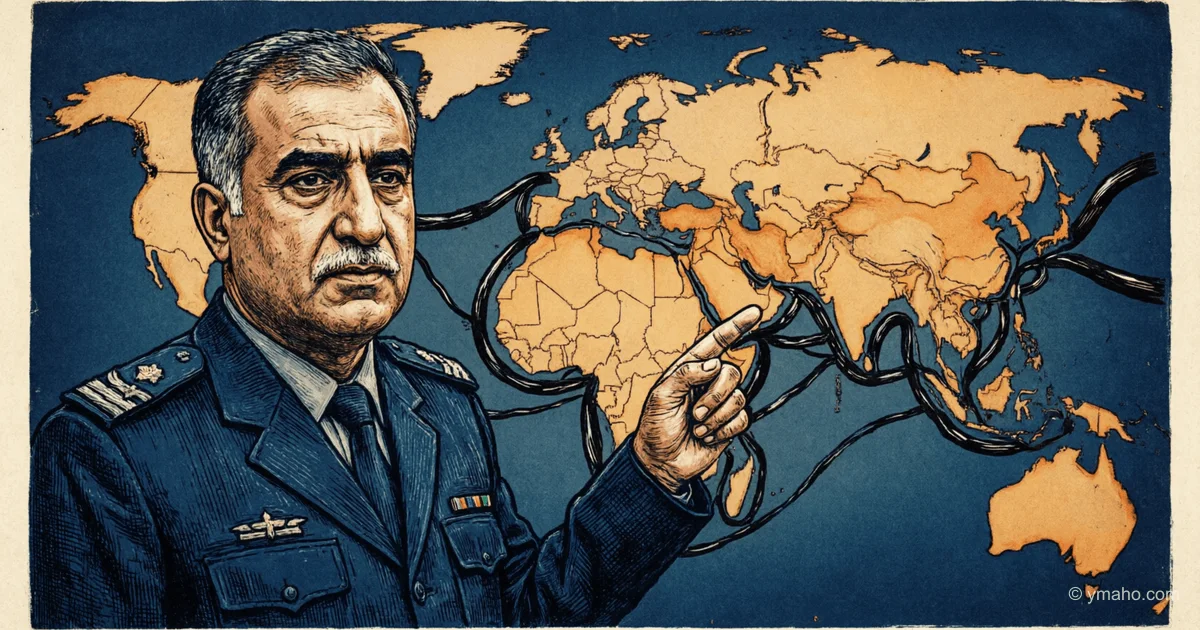
Let me translate from military rhetoric into financial language. Iran still has unused "asymmetric" tools. And the scariest one is not missiles capable of reaching Europe. The scariest is the ability to disrupt global digital connectivity and cause multi-billion-dollar losses in a matter of hours.
Timeline and Context
Let's look at the sequence of events that led to this statement. The timing is no coincidence.
February 28, 2026 — The US and Israel launch a military operation against Iran. The conflict lasts 39 days. Iran retaliates against US bases in the region and closes the Strait of Hormuz.
April 8, 2026 — A truce is declared. Formally, a two-week pause. In reality, a frozen conflict with no real progress.
May 18-19, 2026 — President Trump states he was "an hour away" from ordering a new bombing campaign against Iran but postponed strikes to give diplomacy a chance.
May 20, 2026 — The IRGC issues a statement warning of the conflict expanding beyond the region.
May 22, 2026 — The NPT Review Conference ends without a final document for the third consecutive time. The US blames Iran. Iran blames the US. Russia supports Iran.
May 24, 2026 — Senior IRGC official Mohsen Rezaei states that Iran could withdraw from the Nuclear Non-Proliferation Treaty and break the naval blockade in the event of new US aggression.
May 25, 2026 — I write this analysis. Fox News, citing sources, reports that a framework agreement between the US and Iran is about 95% complete, but signing may take another 5-7 days. If no agreement is reached, the US military could resume airstrikes on Iran.
What's important in this timeline? The IRGC made its statement on May 20 — 4-5 days before the Fox News report about the nearly completed agreement. In other words, Iran's military was not waiting for a diplomatic breakthrough and was not betting on it. They were preparing for the worst-case scenario: the resumption of strikes.
Who Wins and Who Loses
Winner #1 — Gold. If the conflict expands beyond the Middle East, traditional safe-haven assets (dollar, Treasuries) could come under threat if Iran's targets include US or European infrastructure. Gold is the only asset that does not depend on anyone's jurisdiction.
Winner #2 — Chinese telecom and infrastructure companies. If Iran starts attacking undersea communication cables in the Red Sea and Arabian Sea, global internet traffic (including financial transactions) will be at risk. China, which is actively building alternative routes and cables under the "Digital Silk Road," will gain a strategic advantage.
Loser — Companies dependent on global supply chains and internet connectivity. Imagine: Iran attacks not a military base but an undersea cable hub in the Bab el-Mandeb Strait. The result is not just a rise in oil prices. The result is massive disruptions in financial transactions, internet slowdowns between Europe and Asia, and cloud service outages. Losses could run into tens of billions of dollars per day.
Unobvious loser — Undersea cable infrastructure. Dozens of fiber-optic cables connecting Europe, Asia, and Africa pass through the Bab el-Mandeb Strait. Yemen's Houthis, acting in coordination with Iran, have already warned that this strait could be used in a broader confrontation. For the financial world, this means the next crisis may not be an oil crisis but a digital crisis.
Those not named but in the game — Iranian-linked hacker groups. The IRGC has already demonstrated capabilities in cyberspace. Expanding the conflict "beyond the region" could mean massive cyberattacks on US and European financial infrastructure: exchanges, payment systems, banks. This is not a hypothetical threat. Iran has attacked US financial institutions in the past.
What the Media Leaves Out
Insight #1 — About "places Washington can't even imagine."
This IRGC phrase is the key to understanding Iran's strategy. What places can't Washington imagine? The obvious answer is Iran's missile silos hidden underground. But that's not quite right. US intelligence has a good picture of Iran's military infrastructure.
No, "places Washington can't even imagine" are civilian targets outside the Middle East that are not guarded by the Pentagon because no one considers them military objectives. For example:
- Undersea cable landing stations in countries not involved in the conflict.
- Gas terminals in Europe from which LNG goes to the US (via re-export).
- Data centers of major financial corporations.
- Communications satellites in low orbit.
Iran cannot attack a military base in Germany—that would mean war with NATO. But it can attack a civilian facility that serves US financial flows. And proving that Iran did it would be difficult.
Insight #2 — About nuclear blackmail as a financial tool.
On May 24, Rezaei stated that withdrawing from the NPT is a "strategic option" for Iran in the event of new aggression. This is not just a political statement. It is a signal to insurance and financial markets.
If Iran withdraws from the NPT, it is no longer obligated to allow IAEA inspectors into its nuclear facilities. This means no one can confirm whether Iran is working on nuclear weapons or not. Such uncertainty immediately adds a risk premium to oil, gold, and the dollar.
Now imagine Iran not only withdraws from the NPT but also announces a nuclear test. The price of oil skyrockets to $200 per barrel. This is a catastrophe for the global economy. And Iran knows it. The threat of NPT withdrawal is not a military tool. It is a financial tool of pressure.
Insight #3 — About why the US is forced to tolerate even the harshest threats.
Read the US State Department statement from May 24 carefully. Tommy Pigott says the US "regrets" the collapse of the NPT conference but reaffirms its "firm commitment" to the three pillars of the treaty.
Where are the threats? Where is the tough response to the statement about NPT withdrawal? Nothing. Silence.
Why? Because the US is in a zugzwang—a situation where any move worsens its position. If the US responds harshly to the NPT withdrawal threat, negotiations collapse. If the US ignores it, Iran gets the signal that it can blackmail with impunity.
The Trump administration chose the second option. Silence. But silence is also a signal. And that signal tells markets: the US is not ready for escalation, despite all the threats. This is a bearish signal for the dollar and bullish for oil.
Forecast: Next 30 Days and 90 Days
Next 30 Days:
- US-Iran negotiations — 95% of the framework agreement is ready, but the last 5% could take weeks. Key question: who controls the Strait of Hormuz after the agreement?
- Brent crude — if an agreement is signed (probability 50-60%): decline to $85-92. If talks collapse (probability 30%): rise to $115-125.
- Gold — if escalation: rise to $2900-3000 per ounce. If peace: correction to $2600-2700.
- Tech stocks — under pressure due to risk of cyberattacks and undersea cable disruption.
Next 90 Days:
Baseline scenario (probability 55%): framework agreement signed within 2-3 weeks. Strait of Hormuz gradually reopens. Iran remains in the NPT. IRGC threats remain rhetoric. Oil at $90-100. Markets stabilize.
Escalation scenario (probability 30%): negotiations collapse. US resumes strikes. Iran withdraws from the NPT and strikes targets outside the Middle East (undersea cables, gas terminals, cyberattacks). Oil at $140-160. Global recession probability 50%+.
"Grand Bargain" scenario (probability 15%): US and Iran reach a comprehensive peace agreement, including sanctions relief, unfreezing of Iranian assets (estimated $50-100 billion), and normalization of relations. Oil at $75-85. Powerful rally across all markets.
Editorial Forecast
Asset: Brent crude (futures for August 2026)
Direction: Up in the next 24-72 hours
Key levels: current level around $96-100. If rhetoric escalates (new threats, talks collapse) — quick test of $108-112. If progress news — decline to $90-92.
Confidence level: high (65%). IRGC threats are real, not rhetorical. The market has not yet priced in scenarios of attacks on undersea cables and NPT withdrawal — this creates a risk asymmetry favoring higher oil prices.
Main risk: Sudden signing of a framework agreement with Iran within the next 5-7 days (as Fox News sources suggest). In that scenario, oil could drop 8-12% in 48 hours, wiping out all short positions.
This forecast is an analytical opinion of the editorial board and does not constitute individual investment advice. Make decisions based on your own risk assessment and consultation with licensed financial advisors.
— Editorial Team









