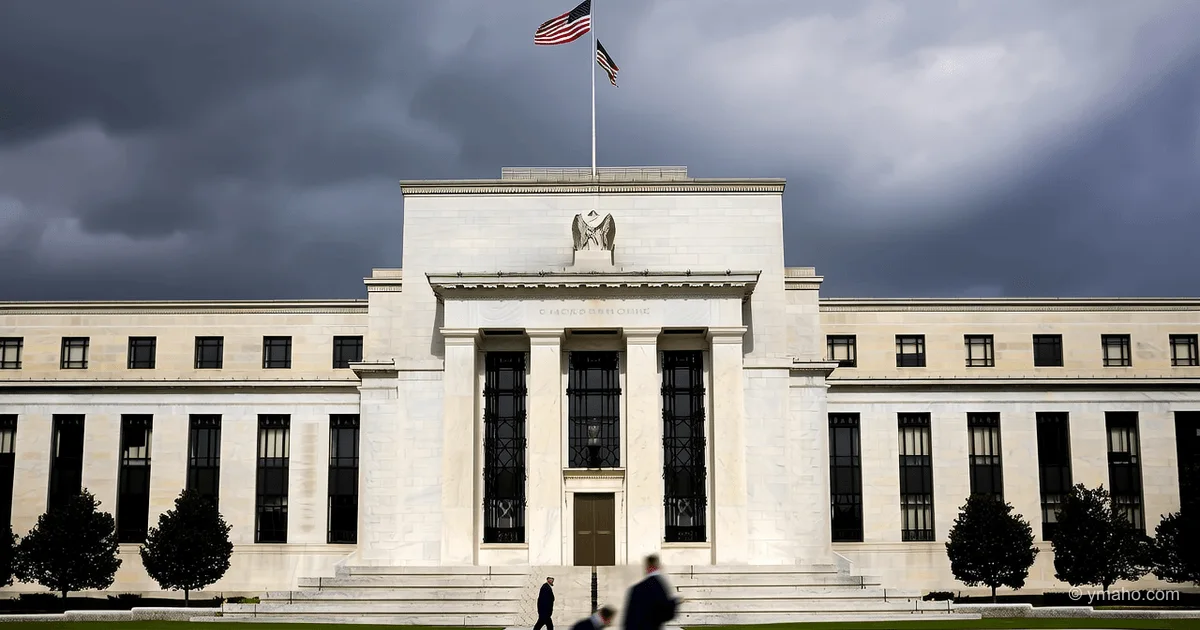
US Senate Confirms Kevin Warsh as New Federal Reserve Chair
Kevin Warsh has been officially confirmed as the head of the Fed, replacing Jerome Powell. This comes amid ongoing market volatility driven by high inflation and geopolitical risks.
The Gist: What's Really Happening
The confirmation of Kevin Warsh is not just a personnel change; it is the most controversial transfer of power at the Fed in decades. The 54-45 vote was the narrowest margin in the history of confirming a US central bank chief, and that is not a technical detail but a diagnosis. Political polarization, which previously spared the Fed, has now permeated it. Warsh takes office not as an independent technocrat but as a Donald Trump appointee, from whom rate cuts are openly demanded, regardless of inflation fueled by the Middle East conflict. Meanwhile, former Chair Jerome Powell is not leaving the Board of Governors and will remain there until 2028—something that hasn't happened in over 70 years. This creates a unique situation: a "shadow chair" within the Fed itself will remind markets that Warsh has no mandate for reckless easing.
Timeline and Context
The formal timeline looks like this: On May 13, 2026, the Senate confirmed Warsh's nomination, and on May 14, he assumed office as Powell's term as chair expired. But the real story began earlier. Trump announced Warsh's nomination in late January, and the appointment was initially met with cautious optimism by markets—Warsh did not appear to be a radical rate-cutter, unlike other candidates. However, by the time of the vote, the external environment had changed dramatically: the April Producer Price Index surged to 6.0% year-over-year, and consumer inflation hit a three-year high of 3.8%, fueled by a spike in oil prices due to the US-Israeli conflict with Iran.
A crucial context many overlook: Warsh is not just a Trump loyalist. He served as a Fed governor under Bernanke from 2006 to 2011, and back then he was a classic "inflation hawk," leaving the Board of Governors due to disagreement with aggressive easing. Now, to secure the post, he has publicly endorsed Trump's calls for rate cuts. The key question—whether he will remain more loyal to the White House or to his own understanding of monetary discipline—is one to which the bond market is responding with rising yields.
Who Wins and Who Loses
The biggest winners are large banks and hedge funds that have long awaited deregulation. Warsh has consistently criticized the Fed's bloated balance sheet and advocates for reducing the central bank's role in asset markets. In practice, this means accelerated quantitative tightening (QT) and abandoning the "Fed put"—the implicit insurance markets have enjoyed for the past two decades. For Goldman Sachs and JPMorgan, whose trading desks thrive on volatility, this is a goldmine. But the true beneficiary is Trump himself, who gains a perfect scapegoat: if rates cannot be cut due to inflation, the blame will fall on "indecisive" Warsh, not the administration.
Paradoxically, the losers are small and medium-sized enterprises. One might think Warsh's promise to ease regulation on community banks and improve lending conditions would help. But in reality, with inflation at 3.8% and 10-year yields at 5.8%, small businesses face not cheap loans but exorbitant borrowing costs. And if Warsh, despite Trump's pressure, cannot quickly lower rates—and he cannot with such PPI—entrepreneurs will be squeezed between cost inflation and expensive money. Separately, the Democratic camp and Senator Elizabeth Warren, who called Warsh a "Trump puppet," lose: their opposition failed, and their influence on monetary policy is now minimal.
What the Media Isn't Saying
The main underreported story is a conflict of interest unlike any the Fed has seen. According to Warsh's financial disclosure, his personal wealth is estimated between $131 million and $209 million, making him potentially the richest Fed chair in history, surpassing even Powell's $19-75 million. The bulk of his wealth comes from investments in hedge funds, including a mysterious Juggernaut Fund with two positions each worth over $50 million, as well as stakes in Polymarket, SpaceX, and several cryptocurrency companies. Warsh has promised to divest these assets after confirmation, but even the sale process could move markets. More importantly, his wife is Jane Lauder, heiress to the Estée Lauder empire, with a net worth of $1.9 billion. Never before has a Fed chair been part of a family with such a consumer business critically dependent on exchange rates and consumer demand.
The second hidden story is Powell remaining on the Board of Governors. This is a legal and political precedent: since the 1950s, no former chair has stayed on the board after leaving the post. Powell becomes a built-in counterweight: every vote he casts for a rate hike will be seen by markets as a signal that White House policy does not have total control over the Fed. And he has enough influence to block Warsh's most adventurous initiatives.
Forecast: Next 30 Days and 90 Days
Over the next 30 days, the key event is the FOMC meeting on June 17-18, where Warsh will first act as chair. Given PPI at 6.0% and inflation at 3.8%, the probability of a rate cut is virtually zero, as even Trump allies like Steve Bannon acknowledge. Warsh will try to soften rhetoric, perhaps hinting at one cut by year-end, but no more. Trump's reaction will be swift and public—he will likely call Warsh "not aggressive enough" by the end of June.
Over the next 90 days, the September meeting will be the moment of truth. If the conflict with Iran drags on and oil stays above $100, PPI inflation will feed into CPI, and the Fed will face the need not to cut but to raise rates. For Warsh, appointed to lower the cost of money, this will be an existential crisis. My forecast: he will sacrifice loyalty to Trump to prevent an inflationary spiral and keep rates at current levels, accelerating quantitative tightening. By October, 10-year Treasury yields will break 6.2%, the dollar will strengthen against a basket of currencies to 2022 levels, and the S&P 500 will correct 15% from current highs. Warsh will go down in history not as Trump's man, but as the chair forced to become a hawk despite his own promises.
— Editorial Team









