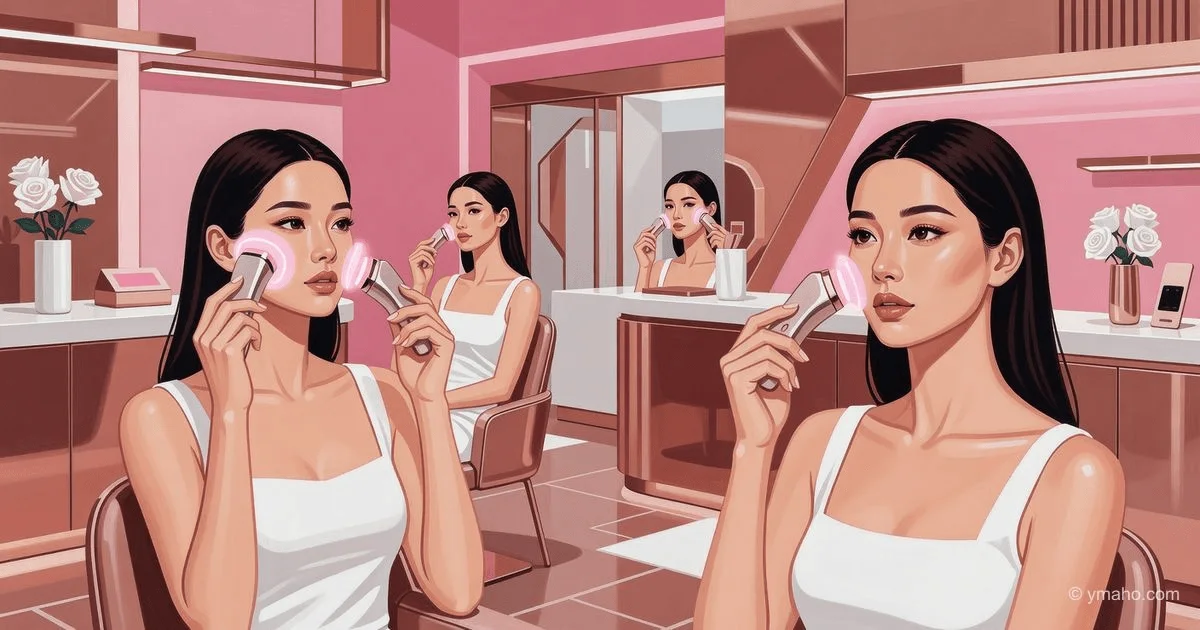
MediCube Unveils ‘Pink Lounge’ in Seoul: Cutting-Edge Beauty Tech with Age-R Booster Pro X2
From June 3 to 14, the pop-up space “Pink Glow Tech Lounge” from MediCube is open at Jamsil Lotte Department Store. The star attraction is the Booster Pro X2 device, along with the full range of AGE-R beauty devices for at-home care.
Gaming Zone for the “Home Clinic”: Why MediCube Sells an Ecosystem, Not Just Devices
You might think opening a pop-up store is just retail theater. A brand rents space in Jamsil Lotte Department Store, scatters pink cushions, and invites influencers. In 2026, every other brand does the same.
That’s a surface-level take. What MediCube (under APR) launched on June 3, 2026, in Seoul isn’t about sales. It’s about reshaping consumption in beauty-tech. They aren’t showcasing a “new gadget.” They’re presenting a skin-management station.
The reason is straightforward: the at-home beauty-device market is oversaturated. Amazon and Olive Young are flooded with “ultrasonic brushes” and “LED masks” priced between $50 and $200. Consumers no longer know what to pick. Margins on “just a massager” have dropped below 30%. So APR isn’t releasing another single-function device. APR is launching a multi-tool—a device that performs seven functions at once—and an ecosystem that keeps users inside the brand.
[The Core]: What’s Really Happening
What’s actually unfolding is functional consolidation and a shift to software. Booster Pro X2 isn’t merely a “second version” (even though it formally replaces the two-year-old model). It embodies the philosophy: “one device covers every need.” It offers seven modes. It works on the face and eye area with adjustable intensity (five to six levels) and different LEDs.
But the real story isn’t the hardware. Yes, the Dual Mode that lets you run electrophoresis on one side of the face and microcurrents on the other is technically impressive. And a 1,332% increase in serum absorption sounds like science fiction. That’s normal for K-Beauty.
What matters more is the brand’s move into an AI assistant. Mode 7—AI Smart Mode—analyzes usage history, skin condition, and habits to recommend a daily routine. Consumers no longer wonder “what should I do?” The machine says: “Your pores are clogged today—start with Air Shot, then apply a mask.” This lowers the barrier for beginners and boosts loyalty among users whose devices sat idle for three months.
A subtle insight: APR isn’t really competing with L’Oréal. They’re competing with aesthetic-medicine clinics. The device costs roughly $220–230 (a bit over 30,000 yen or 33,000 won). A single session with a dermatologist in Korea or the USA runs $150 or more. Buying Booster Pro X2 gives users a “facial gym membership” for two to three years. Meanwhile, APR keeps selling consumables—Zero Pore Pad, collagen masks, and serums.
Timeline and Context
Looking at the brand’s history and launches reveals a clear strategic thread.
March 2026: APR officially announces Booster Pro X2 in Korea, highlighting AI and Dual Mode. Note: this came exactly 2.5 years after the first version (Booster Pro). The 30-month cycle isn’t random—it’s the average time before users start considering an upgrade.
April–May 2026: The device hits shelves in Japan (including Daimaru) and Hong Kong. Pricing stabilizes, YouTube reviews appear, and retail chains promote it as a Mother’s Day gift—signaling the brand’s mainstream status in Asia.
Early June 2026 (right now): Global promo tour kicks off with the Seoul pop-up. Concept: “Pink Glow Tech Lounge.”
Why this timing? Summer 2026 is “pre-vacation prep” season. June in Korea and Japan is when people spend on beauty treatments before summer holidays and the rainy season (which starts late June). The lottery, games, and consultations target impulse buyers seeking a “quick fix” before the beach.
Winners and Losers
Winners:
- APR (MediCube). They’re building vertical monopoly. Buy their device and you’re locked into their consumables because “Mask Mode” is optimized for their sheet masks. Download their app and you hand over skin data—information worth billions. By 2026, APR has sold six million devices worldwide, with 60% of sales outside Korea (USA and Japan). They’re shifting from extensive growth (selling devices) to intensive growth (monetizing users over two to three years).
- Consumers in Asia and the USA. They get clinical-grade technology (electroporation, microcurrents, EMS) in an on/off format. Cost per month drops dramatically—$230 over two years equals about $9.50 monthly, cheaper than any dermatologist visit.
- Retailers like Olive Young and Lotte. They gain foot traffic. Pop-ups act as magnets for Gen Z in Seoul and Tokyo. People come to “pet the pink lamp” and leave with a full skincare haul.
Losers:
- Classic Western mass-market brands (Nivea, L’Oréal Paris). Their business is built on creams. A device makes cream application ten times more effective. With Booster Pro X2, users can apply an inexpensive moisturizer and achieve results comparable to a $100 serum. This erodes price elasticity in the “active ingredients” segment.
- Single-function device makers (pure LED masks without current). They have no chance. Comparing a $150 LED mask to a $220 MediCube that delivers LED + current + vibration + AI, consumers will always choose the latter.
- Small aesthetic clinics without unique protocols. Their core business—basic facials and light RF—collapses. Why visit a dermatologist for “hydration” when you can run “Mask Mode” at home daily? Clinics must pivot to next-level equipment (lasers, microneedling RF, aggressive peels) that can’t be bought for home use. This raises the entry barrier: they need expensive gear to compete with the “home multi-tool.”
What the Media Isn’t Saying
Everyone writes about “innovation” and “AI.” No one mentions the truth about lifespan and software dependency.
First. Press releases are silent on the fact that lithium-ion batteries in these devices lose capacity after two to three years. That’s exactly the refresh cycle APR is counting on. Buy X2 in 2026; by 2028 the battery will be down 30–40%. You’ll charge it more often—just as APR releases X3. Coincidence? No. Planned obsolescence disguised as progress.
Second. “AI Mode” sounds sleek. But the learning algorithm only works if you open the app every day. APR gains access not just to your skin but to your habits, sleep schedule, and location. Korea and Japan have strict data-protection laws. The USA? Data from U.S. Booster Pro X2 users is a goldmine for insurers and pharma marketers. Want to bet that within six months APR will aggressively target collagen-supplement ads at users whose AI script flagged “reduced elasticity”?
Third. Information that Asian and Western versions may differ. The European market (which loves “safety”) often receives downgraded power levels so the device passes CE certification as a “massager” rather than a “medical device.” Buying X2 in Germany or France risks getting a toy, while the Korean version is a full clinical tool. Press releases stay quiet on this, of course.
Forecast: Next 30 Days and 90 Days
Next 30 days (July 2026):
The Seoul pop-up closes June 14. But that’s not the end. Expect APR (MediCube) to announce a partnership with a global retailer such as Sephora or Amazon Luxury Stores for exclusive U.S. promotion of Booster Pro X2. Timing is perfect—summer, bare-skin season. Sales could surge 200–300% as people want to look flawless on vacation.
Also watch for the first wave of “TikTok results.” Users who bought in March will now (after three months) start posting before-and-after photos, triggering avalanche demand for pop-ups in Los Angeles and Tokyo. Be ready for shortages. APR may struggle with production as components (batteries, AI chips) rise in price.
Next 90 days (Fall 2026):
Korean and Japanese brands (and likely Western giants like Foreo) will launch “clones” of Dual Mode. The simultaneous multi-current technology isn’t heavily patented; APR simply executed it elegantly. A price war will erupt in the “smart device” segment. Foreo will push a firmware update for older devices to emulate AI Mode via its app. Yet they lack MediCube’s penetration in Asia.
APR’s main risk is reputational. By fall, Reddit threads and Korean forums will feature posts claiming “AI suggests the same routine every day” or “after four months my skin adapted and there’s no effect.” This is normal with microcurrents—muscles adapt. But if APR doesn’t release a timely software update with new training protocols, users will grow disappointed.
The final note of fall 2026: APR will launch Booster Pro X2 in China via Tmall and Douyin (Chinese TikTok). Different regulations mean AI features will likely be disabled or rerouted to Alibaba cloud servers. Yet simply entering China will make APR the number-one global player in beauty-tech, overtaking Japan’s YA-MAN and America’s NuFace.
Remember: they aren’t selling hardware. They’re selling a subscription to youth—one that costs $220 upfront plus ongoing spend on masks and serums. It’s the most profitable business model in cosmetics for 2026.
— Editorial Team