International Consortium Develops First CAR-T Therapy for Selective Elimination of Senescent Cells
In light of publications in Nature Methods and reviews in Signal Transduction and Targeted Therapy, the development of senolytic CAR-T cell technology is confirmed, enabling the immune system to precisely eliminate senescent cells to combat age-associated diseases.
CAR-T Against Aging: How Immune Surgery Gets to the Root of Diseases
[The Essence]: What Is Really Happening
At the turn of 2025 and 2026, an event occurred that most analysts have yet to fully comprehend. This is not about a single paper, but a cascade of publications united by one idea: CAR-T cells targeting the uPAR protein can simultaneously address aging, fibrosis, and solid tumors. On March 30, 2026, a study by Scott Lowe's team at Memorial Sloan Kettering was published in Cell, showing that uPAR CAR-T cells destroy not only cancer cells but also the tumor-supporting stroma. A month earlier, Nature Aging published a study by the same group on the use of anti-uPAR CAR-T cells to rejuvenate the gut in aged mice.
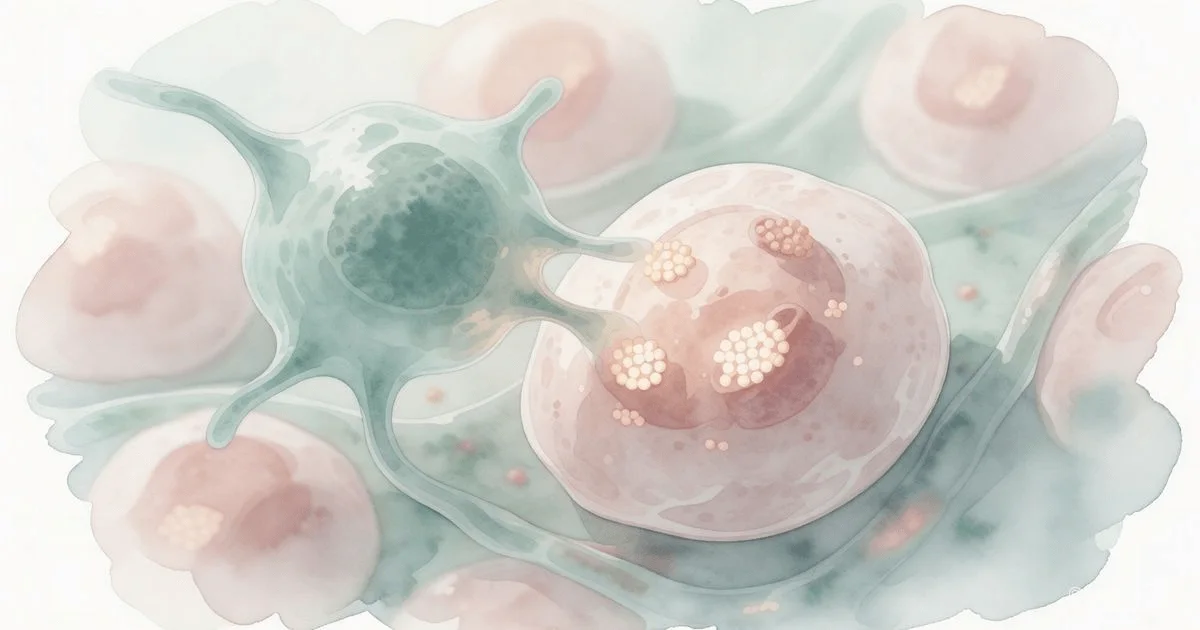
The essence of what is happening goes much deeper than "yet another CAR-T." uPAR is not a cancer antigen in the classical sense. It is a marker of cellular state, not cell type. It appears on the surface of cells that have entered the senescence program, regardless of whether it is a cancer cell, fibroblast, or intestinal epithelial cell. The same "anchor" is present on cells in liver cirrhosis, pulmonary fibrosis, chronic intestinal inflammation, and the most aggressive cancer cells with TP53 and RAS mutations.
The paradigm shift here is that therapy ceases to be "targeted" in the old sense—aimed at a specific mutation or tumor type. It becomes "state-centric." It treats not lung cancer or pancreatic cancer, but the "uPAR-positive state," which can arise in dozens of different tissues in various diseases. This is the universal key that pharmaceutical companies have been seeking for decades.
Timeline and Context
The evolution of this technology began long before 2026. In 2020, the same group of Scott Lowe and Michel Sadelain (one of the pioneers of CAR-T) published a paper in Nature showing for the first time that uPAR CAR-T cells could safely eliminate senescent cells and reverse liver fibrosis in mice. At the time, it was seen as a curiosity—a beautiful idea, but far from clinical application.
In 2024, a team led by Corina Amor (then a postdoc in Lowe's lab, now an independent researcher) showed that a single infusion of uPAR CAR-T cells improved metabolic parameters in aged mice and mice on a high-fat diet, with the effect persisting long-term due to the formation of memory T cells. This was the first signal that the therapy could work not as a "hit and forget" but as long-term prophylaxis.
A key point that most commentators miss: the 2026 Cell paper is not just "another study." It unites two directions that previously existed in parallel. On one hand, senolytic CAR-T against aging (Nature 2020, Nature Aging 2025). On the other hand, attempts to use CAR-T against solid tumors. It turns out they are the same: the tumor creates a "senescent niche" around itself from stromal cells that also express uPAR. By destroying this niche, CAR-T cells deprive the tumor of support.
The timeline here is critical. The Cell paper was submitted on August 19, 2025, and accepted on March 2, 2026. This is incredibly fast for Cell (usually 6-9 months of review). The editors clearly understood they had something important in hand. And on May 31, 2026, when the news about "development of the first CAR-T for destroying senescent cells" came out, it was no longer news but a summary of a six-month discussion. The media were six months late.
Who Wins and Who Loses
Winner #1: Scott Lowe, Michel Sadelain, and Memorial Sloan Kettering. This work is the culmination of more than five years of effort. Lowe has already received Howard Hughes Medical Institute Investigator status, and Sadelain is considered one of the fathers of CAR-T (his work on CD19 CAR-T transformed hematology). Now they have a platform potentially applicable to dozens of diseases. Patents on uPAR CAR-T have already been filed (though specific numbers are not disclosed). Expect MSK to license this technology for sums in the hundreds of millions of dollars.
Winner #2: Corina Amor (Cold Spring Harbor Laboratory). She was the first author on the 2020 Nature paper, lead author on the 2024 metabolic health study, and co-author on the 2025 Nature Aging paper. She now runs her own lab at CSHL and is the world's leading expert on senolytic CAR-T. If the technology reaches humans, a commercial ecosystem will be built around her. Pharma companies are likely already negotiating with her.
Winner #3: Patients with fibrosis and age-related intestinal diseases. Nature Aging showed that anti-uPAR CAR-T cells restore gut barrier function in aged mice, improve microbiota composition, and reduce inflammation. For millions of people with inflammatory bowel disease (IBD) and age-related "leaky gut syndrome," this is a potential cure—not an improvement, but an elimination of the cause.
Loser #1: Companies developing small-molecule senolytics (Unity Biotechnology, Senolytic Therapeutics, etc.). Their approach is periodic pill intake (e.g., dasatinib plus quercetin or fisetin) to kill senescent cells. CAR-T has a fundamental advantage: a single infusion creates memory T cells that patrol the body for years. The pill must be taken repeatedly. Investors will see this. Unity Biotechnology trades around $1-2 per share (down from $40 at IPO in 2018). The news about uPAR CAR-T is another nail in the coffin.
Loser #2: EsoBiotec and AstraZeneca. In parallel with uPAR work, an alternative approach—in vivo CAR-T, where a viral vector is injected directly into the blood to reprogram T cells inside the body—was developing. In March 2026, results from an early trial of ESO-T01 were revealed: of five patients, all had severe side effects (CRS grade 3-4), and one patient died. AstraZeneca paid $425 million upfront and up to $575 million in milestones for this technology. That money is now likely written off. uPAR CAR-T uses traditional ex vivo technology (cells are harvested, edited in a dish, and returned)—more expensive to manufacture but safer because the infusion can be controlled and hyperactivation can be managed with steroids.
Unobvious winner: Researchers working on uPAR as a biomarker. It turns out that soluble uPAR (suPAR) circulates in the blood and correlates with the severity of chronic kidney disease, cirrhosis, and pulmonary fibrosis. Now that uPAR has become a therapeutic target, diagnostic companies (Bio-Rad, R&D Systems, Abcam) will gain a market for test systems to select patients for therapy. This is a classic companion diagnostic scenario. No one writes about it, but this is how smart biotech investors make money.
What the Media Are Not Saying
First: This is still mice, not humans. All the studies in question are preclinical. Not a single patient has been treated with uPAR CAR-T yet. The transition from mouse to human in CAR-T is a huge leap. The mouse immune system has no pre-existing immunity to CAR constructs, but the human one does. Plus, humans have "cytokine release syndrome" (CRS)—the main cause of mortality in CAR-T therapy. In mouse models, CRS is hardly reproducible. What is safe for a mouse can kill a human.
Second: Even in mouse models, the effect is not absolute. The Cell paper shows that uPAR CAR-T works well against tumors with TP53 and RAS mutations. But what about tumors without these mutations? They were simply not studied. Moreover, in some models, chemotherapy (cisplatin) was required to "raise" uPAR levels on tumor cells to a therapeutic threshold. Without chemo, CAR-T did not recognize the target. This means that in real clinical practice, combination with toxic chemotherapy may be mandatory—reducing the advantage of a "gentle" therapy.
Third: The technology is extremely expensive. Manufacturing CAR-T for one patient costs $400,000-800,000 (including leukapheresis, editing, quality control). Even if uPAR CAR-T works perfectly, only a few can afford it. For comparison, a course of small-molecule senolytics (e.g., fisetin) costs a few hundred dollars. Yes, they need to be repeated. But for the price of one CAR-T, you can buy 20 years of fisetin. Healthcare systems will conduct pharmacoeconomic analysis, and CAR-T's chances of winning are not obvious.
Fourth (most unobvious): uPAR is expressed on normal blood cells. Yes, the authors claim that uPAR density on normal cells is below the threshold required for CAR-T activation. This was shown in mice with a "humanized" immune system. But mice are not humans. In humans, neutrophils and macrophages normally express uPAR. If CAR-T cells start attacking them, the patient will develop neutropenia (risk of fatal infections) or macrophage activation syndrome (another form of cytokine storm). In the ESO-T01 (in vivo CAR-T) study, these exact complications were observed. The uPAR target may be "clean" on paper but "dirty" in a real body.
Forecast: Next 30 Days and 90 Days
Next 30 days: I expect at least three biotech companies to announce the launch of uPAR CAR-T programs. I'll name names: Fate Therapeutics (already mentioned on investor forums in connection with uPAR), Century Therapeutics (works with iPS-derived NK cells; uPAR could be a target), and possibly Sana Biotechnology (has in vivo delivery technologies; will switch to ex vivo after ESO-T01's failure). Shares of these companies will rise 15-25% on the news, even without clinical data. This is a speculative bubble, but it will be real.
Next 90 days (by September 2026): Watch for FDA applications for Phase I clinical trials. The most likely first target is not cancer but an age-related disease with high uPAR levels and a clear endpoint. I'm betting on idiopathic pulmonary fibrosis (IPF) or age-related macular degeneration. In these diseases, uPAR is elevated, tissue is accessible for biopsy (lungs via bronchoscopy, retina via imaging), and there are surrogate endpoints (forced vital capacity, choroidal thickness). The FDA may allow Phase I as early as 2026—if the mouse data are convincing.
Long-term trend (12-18 months): The most interesting phase will begin when the first group of patients receives uPAR CAR-T. Two scenarios are possible. Scenario A (60% probability): the therapy works and is safe—then this is a Nobel Prize for Lowe and Sadelain (they haven't received a Lasker Award yet, but they will), and a revolution in gerontology. Scenario B (40% probability): severe immune complications, patient death, or trial halt—as with ESO-T01. Then the entire approach will be discredited for years. I lean toward Scenario A because the preclinical data are too good to ignore. But in biotech, "too good to be true" often means "we didn't test the most important thing." Either way, the next 18 months will be decisive for an entire therapeutic direction that blurs the boundaries between oncology and geriatrics.
— Editorial Team