Eurozone Economic Growth to Slow to 1% in 2026 Due to Conflict Side Effects
BNP Paribas analysts have downgraded their eurozone GDP growth forecast amid the energy shock from the Middle East war, which will hit consumer spending and real household incomes.
Silent Stagflation: Why the Energy Shock Hit Europe Earlier Than Models Predicted
The Core Issue: What's Really Happening
The figure BNP Paribas published in late May 2026 looks like dry statistics: eurozone GDP growth will slow to 1.0% in 2026 from 1.5% in 2025, while inflation will accelerate to 3.0-3.3%. But if you think this is just a "downgrade," you're missing the point. In fact, BNP Paribas has revised its estimates downward twice in the last two months: as recently as April 20, the bank expected growth of 1.6%, and now it's only 1.0%. This double revision suggests analysts don't fully grasp the scale of what's happening.
The key is that the current energy shock is fundamentally different from what Europe experienced in 2022 after the start of the war in Ukraine. As ECB Executive Board member Philip Lane explained in a speech on May 13, 2026, a global energy shock inflicts significantly more damage on the eurozone economy than the regional one in 2022. Back then, Europe could replace Russian gas with supplies from other countries, and the euro temporarily strengthened, softening the blow to import prices.
Today, the situation is different. The conflict in the Persian Gulf is a blow to global oil and gas supply chains. As ECB models show, during a global energy shock, the European economy has no "safety cushion" in the form of a strengthening currency or cheap imports from countries unaffected by the crisis. On the contrary, all producers worldwide simultaneously face rising costs, and these costs accumulate along value chains. The result is a GDP decline of 0.2-0.3 percentage points annually for three years, and that's just according to ECB estimates, which don't account for worst-case scenarios.
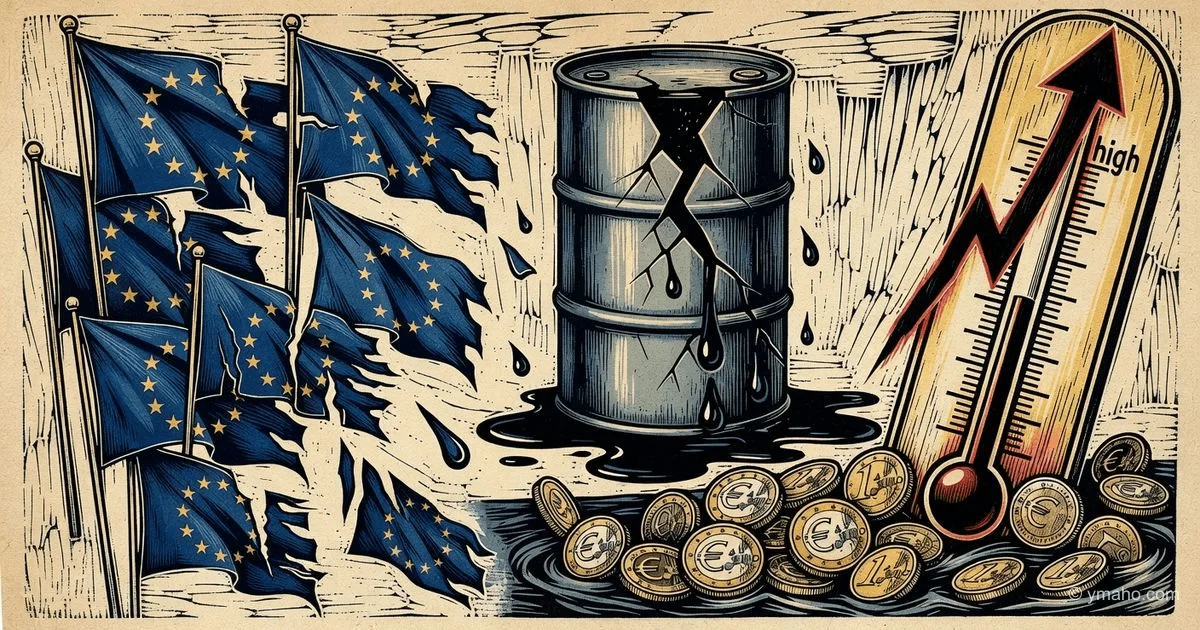
And here's the crucial point: 1.0% GDP growth is no longer a "slowdown." It's pure stagflation: near-zero growth with inflation double the ECB's 2% target. And considering that BNP Paribas forecasts the ECB rate to rise to 2.5% this year, the European economy faces a "double whammy": high energy prices and expensive credit simultaneously.
Timeline and Context
To understand how Europe slid to 1% growth in just two months, we need to trace the evolution of forecasts. In April, BNP Paribas was still optimistic: eurozone GDP growth was expected at 1.6% in 2026, driven by German fiscal measures, increased military spending, and investments in artificial intelligence. The bank then forecast three ECB rate hikes (in June, July, and September), bringing the deposit rate to 2.75%.
But by late May, the tone had changed dramatically. In its updated forecast, BNP Paribas cut its growth estimate to 1.0% and reduced the expected number of rate hikes to two (the first in June). Inflation, which stood at a comfortable 2.1% in 2025, is now forecast at 3.0% in 2026 and 3.3% in 2027.
Why such a sharp revision? The bank's analysts directly cite the cause: "side effects of the Middle East conflict" and the associated "energy shock." At the same time, BNP Paribas insists the economy will "withstand" this shock thanks to investments in defense, AI, and electrification. However, reality looks different.
ING analysts warned back in March: rising oil prices quickly undermine household purchasing power, especially through fuel. They calculated that the share of disposable income German households spend on fuel will rise from 2.8% to 3.5% over the year. For Portuguese households, this figure will reach 4.5%. And these are just direct fuel costs—not counting the higher prices of goods due to increased transport costs.
Winners and Losers
Winner #1: Euro holders, but with caveats. BNP Paribas forecasts the EUR/USD to strengthen to 1.21 by end-2026 and 1.25 by end-2027. The reason is "broader diversification away from the dollar" in global reserves. However, as the National Bank of Canada notes, this scenario depends on de-escalation in the Strait of Hormuz. If the blockade continues, the euro could fall to 1.13.
Winner #2: European banks. As in the US, a high ECB rate (2.5% by year-end) means an expanding net interest margin. BNP Paribas, Deutsche Bank, and UniCredit will profit from the spread between expensive loans and cheap deposits. The problem is that in stagflation, credit default risks rise.
Loser #1: The European consumer, the main driver of the economy (about 55% of GDP). ING data shows that despite real wage growth of 2.6% in 2025, consumers aren't spending—they're saving. The eurozone household savings rate remains at historically high levels: less than €0.85 is spent for every euro earned. The reason is fear of inflation. ECB surveys show that the average inflation expectation among the public for the next year is 4.8%, almost double official forecasts. Households don't believe prices will stabilize and prefer to save for a rainy day. This is a classic trap: high savings → low consumption → low GDP growth → high recession risk.
Loser #2: Producers of energy-intensive goods (chemicals, metallurgy, automotive). Lane from the ECB directly points out: during a global energy shock, not only energy prices rise, but also all imported goods that used energy in their production. European producers lose price competitiveness on global markets because their costs rise faster than those of competitors.
What the Media Isn't Saying
First non-obvious insight: BNP Paribas's forecast of 1.0% GDP growth in 2026 may be optimistic. The bank itself admits that ECB policy tightening "increases uncertainty regarding growth forecasts." And Lane from the ECB warns: with large and persistent shocks, the relationship between energy prices and overall inflation becomes non-linear—small additional shocks can cause disproportionately strong effects.
Second insight: European consumers are a "black swan" that markets are ignoring. Despite rising wages, they refuse to spend. The savings rate in 2025 increased, not decreased, contrary to all forecasts. The key reason, according to ING: the real value of eurozone household financial assets fell from 250% of GDP in 2020 to 220% of GDP in 2024 due to inflation. People feel poorer than five years ago and are now trying to rebuild savings. Restoring consumer confidence will take years, not months.
Third insight (most important for traders): Europe is investing record sums in the "green transition"—€1 billion just for hydrogen projects under the third auction of the European Hydrogen Bank, plus another €1.7 billion from Germany and Spain. But this money will start working in 5-10 years. Hydrogen projects are expected to reach financial close only by 2029, and hydrogen production by 2031. In the short term, this won't solve the problem of expensive oil. Moreover, budget spending on the green agenda diverts resources from direct support for consumers and energy-intensive industries that are suffering here and now.
Forecast: Next 30 Days and 90 Days
Next 30 days (until July 2, 2026):
On June 20, preliminary eurozone PMI indices for June will be released. They are expected to show further deterioration in the services sector and stagnation in industry. The key indicator is consumer confidence. If it falls below April's lows, markets will start pricing in not two but one ECB rate hike in 2026 (or even none). This, in turn, would push the euro down against the dollar to 1.14-1.15.
Next 90 days (until end of August):
By the end of summer, it will become clear that "investments in AI and defense" cannot compensate for the decline in consumer demand, which is structural, not cyclical. European companies will start reporting second-quarter earnings, and many will show profit declines due to margin compression. The Frankfurt DAX index, which largely relies on hopes for a ceasefire, could correct by 8-10%.
The only silver lining is a possible ceasefire in the Middle East and the reopening of the Strait of Hormuz. But even in that case, oil prices are unlikely to fall below $90 per barrel by year-end, meaning inflationary pressure will persist. The reality is that Europe is entering a prolonged period of low growth and high inflation, and there is no way out of this trap without structural reforms (which will take years).
Editorial Forecast
Asset: EUR/USD
Direction: Weak downtrend in the next 48-72 hours. The market is gradually realizing that 1.0% GDP growth is not a "soft landing" but a prelude to recession.
Key levels: Resistance at 1.0850. Support at 1.0720. A break below 1.0720 opens the way to 1.0650 (April 2026 lows).
Confidence level: Medium (60%). BNP Paribas's forecast could be revised in either direction depending on geopolitics.
Main risk to the forecast: If the ECB hints at a third rate hike in 2026 next week (contrary to current forecasts), the euro could temporarily strengthen to 1.0950. However, such a move would exacerbate already weak growth, leading to a euro decline in the medium term. Consider long positions in gold as a hedge against European stagflation.
— Editorial Team