US Inflation Hits 3.8%, Creating Risks for Fed Policy
According to data and forecasts, consumer price acceleration to a three-year high amid expensive oil and tariffs is forcing the Fed to keep rates at 3.5%-3.75% at least until September, delaying easing.
Stagflation on Schedule: Why 3.8% Inflation in the US Is Not a Coincidence but a Result of the K-Shaped Economy
[The Gist]: What Is Really Happening
The 3.8% annual inflation figure currently being discussed by all financial media looks like a typical macroeconomic indicator. BNP Paribas forecasts exactly this level for 2026, linking it to rising oil prices and tariffs. But if you think the Fed is simply "fighting inflation," you are mistaken. In reality, we are witnessing a perfect storm where classic monetary tools are powerless and the regulator is cornered.
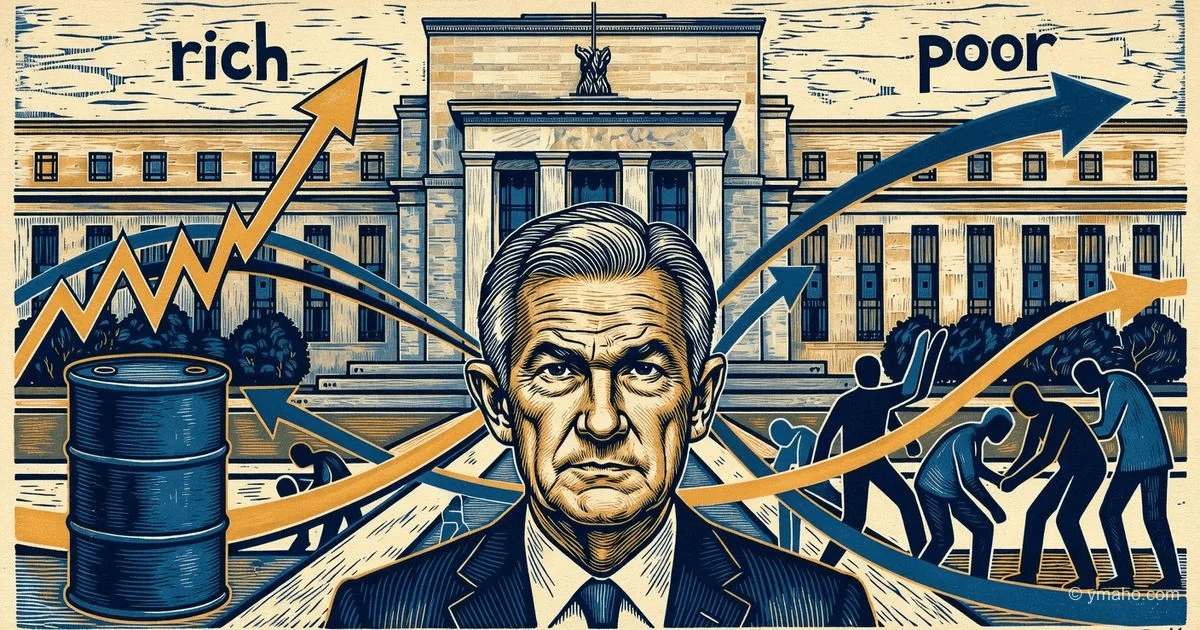
The essence of what is happening is a K-shaped recovery, which BNP Paribas explicitly mentions but the media omits. The US economy is growing at 2.4% per year (above potential), but this growth is unevenly distributed. Investments in artificial intelligence and optimism around technology are pushing the stock market to all-time highs, creating a "wealth effect" for affluent households. At the same time, the middle class and the poor suffer from expensive oil and tariffs, which drive up prices on everyday goods.
It is this duality that is the Fed's main problem. Jerome Powell cannot cut rates because inflation (3.8%) and a strong labor market do not allow it. But he cannot raise rates either, because that would kill consumer demand for the half of the population that does not own stocks. Thus, the Fed finds itself in a "two-sided risk" trap, as BNP Paribas analysts put it: equal readiness for both a hike and a cut. This is not balancing—it is paralysis.
The main takeaway that markets do not want to notice: 3.8% inflation will persist at least until 2028. BNP Paribas forecasts that the oil shock and tariffs will pressure prices for another three years. This means the era of cheap money is over for a long time, and investors need to get used to the "new normal"—high rates with weak growth.
Timeline and Context
To understand how we got here, we need to trace the evolution of forecasts over recent months. As recently as September 2025, Bank of America expected the Fed to cut rates to 3%-3.25% by mid-2026. In March 2026, UBS also mentioned a first cut in September. But reality has adjusted those expectations.
The key factor that changed the calculations was the Middle East conflict, which began on February 28, 2026. Deutsche Bank in mid-April officially abandoned its forecast for a rate cut in 2026, directly citing rising oil prices as the reason. JPMorgan and HSBC joined this view. Today, traders estimate a 69% probability that rates will stay at 3.5%-3.75% through year-end.
Notably, the divergence among major banks' forecasts has become the widest in recent years. BNP Paribas (whose forecast we analyze) maintains an optimistic outlook: GDP +2.4%, inflation 3.8%, dollar gradually weakening against the euro. Goldman Sachs, Morgan Stanley, and Bank of America still expect two rate cuts in the second half of the year. But Deutsche Bank, JPMorgan, and HSBC rule out any easing in 2026.
Who is right? According to UBS data from late May, inflation remains persistent, and the Fed has set a "higher bar" for starting cuts. Nigel Green, head of deVere Group, stated outright that a cut is possible no earlier than October, and "it is far from guaranteed." My analysis leans toward Deutsche Bank's position: if oil stays above $100, forget about rate cuts until 2027.
Who Wins and Who Loses
In this paradoxical situation, the "winners" and "losers" are distributed differently from what classical economics teaches.
Winner #1 — US banks. A high rate of 3.5%-3.75% means a wide interest margin. JPMorgan, Bank of America, and other giants will profit from the difference between funding costs (low, because deposits yield almost nothing) and loan rates (high). In a K-shaped economy, lending to wealthy households and large businesses remains profitable.
Winner #2 — holders of US stocks, especially in the AI sector. The S&P 500 is at all-time highs thanks to "optimism around AI," as BNP Paribas directly states. Wealthy households that own stocks feel the "wealth effect" and continue spending, supporting the economy. This creates a vicious cycle: high stock prices → high consumption by the rich → high inflation → Fed cannot cut rates.
Loser #1 — the middle class and renters. 3.8% inflation hits purchasing power. Expensive oil raises gasoline and airfare prices. Tariffs make imported goods less affordable. Meanwhile, mortgage rates remain high (following the Fed rate), making housing unaffordable for millions of Americans. The K-shaped economy is one where the rich get richer and the poor get poorer.
Loser #2 — international investors holding dollars. BNP Paribas forecasts a gradual weakening of the dollar against the euro: to 1.21 by end-2026 and 1.25 by end-2027. The reason is diversification of global reserves away from the dollar amid geopolitical uncertainty. For a European investor who held dollar assets for three years, this means a 5-10% loss when converting back to euros.
What the Media Leave Out
First non-obvious insight: tariffs, which are talked about so much, actually affect inflation less than expected. BNP Paribas directly states: "although the impact of these appears to be less significant than expected." The main driver of inflation is oil prices due to the Middle East conflict. Tariffs are merely a distraction in public discussion.
Second insight: the Fed no longer looks at the labor market as a reason to cut rates. UBS notes that the regulator "now views zero employment growth as consistent with stable unemployment." This is a fundamental doctrinal change. Previously, a weak labor market was a signal to ease. Now the Fed will ignore it until inflation falls.
Third insight (most important): Core PCE inflation (the Fed's preferred indicator) remains at 3.0% year-over-year, with tariffs contributing 50-75 basis points. This means that even if tariffs were removed, inflation would still be above the 2% target. The Fed has no "magic bullet." It will either have to accept above-target inflation (undermining credibility) or strangle the economy with high rates (causing a recession).
Forecast: Next 30 Days and 90 Days
Next 30 days (until July 2, 2026):
At the end of June, fresh CPI data for May will be released. If inflation comes in above 3.8% (e.g., 4.0% or higher), markets will price in the possibility of a rate hike in 2026. Deutsche Bank already does not rule out this scenario. If inflation is below expectations (3.5-3.6%), talk of a September cut will resume.
Key indicator: Brent crude oil. If it stays above $105 per barrel, the Fed cannot cut rates. If it falls below $95, the regulator will have room to maneuver.
Next 90 days (until end of August):
By late summer, it will become clear that the K-shaped recovery cannot last forever. The AI sector bubble could burst if quarterly reports from major tech companies disappoint. This would trigger a stock market correction, destroying the "wealth effect" and hitting wealthy households' consumption. Then the Fed would face a new dilemma: high inflation with a falling economy—classic stagflation.
I estimate the probability of a US recession by end-2026 at 35-40%. This is higher than the market consensus but lower than panic forecasts. BNP Paribas remains optimistic (GDP +2.4%), but this forecast does not account for a full-scale escalation in the Middle East. And escalation, judging by recent events (missile strikes on Kuwait, Iranian threats), is more than likely.
Editorial Forecast
Asset: EUR/USD
Direction: Up in the next 48-72 hours. The market is gradually realizing that the Fed will not cut rates in the coming months, while the ECB, on the contrary, may hike. The divergence in monetary policy favors the euro.
Key levels: Current level around 1.1800-1.1850. Immediate resistance at 1.1900. A break above this level would open the path to 1.2000 and then to 1.2100 (BNP Paribas forecast for end-2026). Support is at 1.1750.
Confidence level: High (75%). The BNP Paribas forecast is backed by fundamental factors, and the market has not yet fully priced in the Fed-ECB policy divergence.
Main risk to the forecast: A sudden deterioration in the Middle East (e.g., a full blockade of the Strait of Hormuz) would trigger a flight to safe havens. The dollar, as the primary reserve currency, could temporarily strengthen despite fundamental factors. In that case, EUR/USD could fall back to 1.1500-1.1550 within 24-48 hours.
— Editorial Team