Kuwait Intercepts Iranian Missiles Targeting Bases with US Troops
Kuwait's air defense forces and CENTCOM reported the successful interception of two ballistic missiles launched by Iran at facilities where US troops are stationed. There were no casualties among the American contingent.
Kuwait Incident: Why 'Successful Interception' Is an Illusion and the War Already Costs $60 Billion
The Gist: What's Really Happening
The official version, disseminated by CENTCOM and Kuwaiti military, sounds reassuring: Kuwait's air defense forces 'successfully intercepted' two ballistic missiles fired by Iran at American facilities, with no casualties. The reader calms down—the system works, the threat is neutralized, no need to worry.
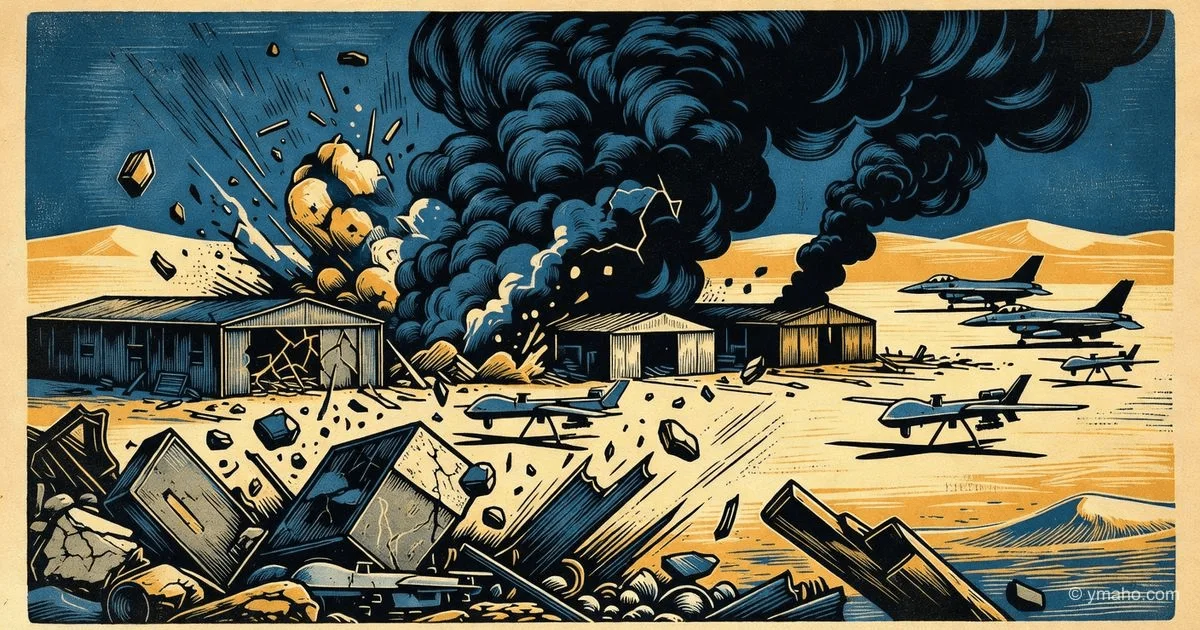
But this is a dangerous illusion, blown up by the media and supported by the military. In reality, a 'successful interception' in modern warfare only means the missile didn't reach its target intact. However, debris is almost as much of a threat as the missile itself. It was debris from an Iranian missile intercepted over Kuwait that damaged Ali Al Salem Air Base, wounded five people (including US military personnel and civilian contractors), and knocked out two MQ-9 Reaper drones, each worth at least $30 million.
You might ask: what's the difference? The difference is that CENTCOM's public rhetoric ('no casualties') and Bloomberg's actual data ('five wounded, two Reapers destroyed') diverge drastically. This is not just a bureaucratic inaccuracy—it's a systematic downplaying of damage that creates a false sense of control.
The true nature of what's happening is far more alarming. Since February 28, 2026, when the war began, Iran has launched over 1,850 ballistic missiles at targets in the region. An analysis by BBC Verify, based on satellite imagery from Planet and Airbus, showed that Iranian attacks have damaged 20 US bases across the Middle East—in Saudi Arabia, UAE, Qatar, Kuwait, Iraq, Jordan, Bahrain, and Oman. Three advanced missile defense systems (including THAAD) were destroyed at bases in the UAE and Jordan. This is not 'precision strikes'—it's systematic attrition of American air defense.
Timeline and Context
The chain of events leading to the attack on Kuwait began not on June 1, but three days earlier—on May 29. According to Bloomberg, that's when Iran first struck Ali Al Salem Air Base using a Fateh-110 ballistic missile. That attack also resulted in casualties and damaged MQ-9 Reapers. But this incident went almost unnoticed amid bigger news.
On May 30–31, the US launched retaliatory strikes. CENTCOM officially stated it attacked Iranian radar stations and drone command posts in Goruk (on mainland Iran) and on Qeshm Island in the Strait of Hormuz. The reason: Iran shot down a US MQ-1 drone flying over international waters. American fighters destroyed Iranian air defense systems, a ground control station, and two attack drones.
On Monday morning, June 1, Iran responded. The Islamic Revolutionary Guard Corps (IRGC) claimed a strike on the US air base. Kuwait's air defense systems activated, and sirens wailed across the country. Two ballistic missiles were intercepted, but their debris still reached the target, causing damage.
An important context that is barely covered: this is already the third ceasefire violation between the US and Iran since April 2026. The first two incidents (May 7 and a week earlier) were downplayed by both sides, and the truce held. But the third incident is no longer a 'stress test'—it's a new normal. The ceasefire is effectively dead, but formally no one has canceled it. This is the most dangerous phase of the conflict—'neither war nor peace,' where each next strike could be the last straw.
Who Wins and Who Loses
From a purely military standpoint, neither the US nor Iran can declare victory. The US shot down several Iranian radars and drones; Iran damaged another base. But there are three categories of players for whom this incident was either a win or a disaster.
Winner #1: Donald Trump. On June 1, the day of the attack on Kuwait, news emerged that Trump demanded a tougher draft agreement with Iran: add stricter language on uranium stockpiles (60% enrichment) and a clear plan to open the Strait of Hormuz. Every new incident is political capital for Trump, who can tell voters: 'I won't go soft on Iran. I demand more.' He has few real levers to influence escalation, but the public doesn't care.
Winner #2: Oil derivatives traders. The price of Brent crude rose over 3% after the strikes. Each such spike means billions of dollars flowing from consumers' pockets to speculators'. Moody's Analytics calculated that since the war began, each American family has spent an average of $447 extra on fuel and airfare. Total additional spending by US consumers has reached $60 billion in just three months. This is money that didn't go to retail, restaurants, or entertainment—i.e., the real economy.
Biggest loser: The Pentagon. US losses since the war began: 14 dead, 409 wounded, at least 20 bases damaged, dozens of expensive equipment units destroyed. The cost of Operation Epic Fury is estimated at $29 billion, and that's likely an undercount. Meanwhile, none of the strategic goals (opening the Strait of Hormuz, nuclear deal) have been achieved. This is a classic 'war of attrition,' but it's the Pentagon, not the enemy, that's being worn down.
Another loser: Kuwait. Formally, Kuwait is a US ally hosting their bases. In reality, it's a hostage. Every time the US and Iran exchange strikes, Kuwait ends up in the line of fire. Missiles don't fly to Washington or Tehran—they fly to Kuwait. Kuwaiti civil aviation was disrupted: several flights were put into holding patterns over the gulf or diverted. Kuwait's air bases are targets, but Kuwait itself cannot influence the decisions that make them targets.
What the Media Leaves Out
First non-obvious insight: Damage to US bases is far more severe than publicly acknowledged. BBC Verify's analysis, using high-resolution satellite imagery from Planet and Airbus DS, revealed something the Pentagon prefers to keep quiet.
At Prince Sultan Air Base in Saudi Arabia, Iranian strikes destroyed an E-3 Sentry AWACS aircraft. Replacement cost: $700 million. At Al Ruwais and Al Sader bases in the UAE, three advanced missile defense systems were destroyed. In Kuwait, at Ali Al Salem Base, fuel depots, hangars, and barracks were destroyed (per Janes estimates). These are not 'minor damages'—they are strategic losses that weaken the US presence in the region for years to come.
Second insight: Iran is deliberately targeting the US missile defense system, not random targets. The fact that THAAD, Patriot, and SM-3 batteries were destroyed indicates a high level of Iranian intelligence. They know where everything is and strike precisely. This means US air defense in the region is operating at its limit—intercepting 90% of targets (as CENTCOM claims) but failing to protect itself. Once the missile defense system loses its key elements, it becomes vulnerable to the next strike.
Third insight (most important for financial markets): Kuwait has already cut oil production. Back in early March, the Kuwait Petroleum Corporation (KPC) announced a production cut due to 'Iranian threats to safe ship passage.' This is not a one-off measure—it's a signal that Persian Gulf oil infrastructure is operating in 'besieged fortress' mode. Each new incident (like the June 1 attack) brings closer the moment when production cuts become permanent, not precautionary. And that's a direct path to $150 per barrel.
Forecast: Next 30 Days and 90 Days
Next 30 days (until July 2, 2026):
The ceasefire will continue to exist formally and be violated formally. We will see another 2-3 'missile-for-missile' exchanges, none of which will be recognized as a 'truce breach.' The key indicator is the number of drones shot down over Kuwait and the UAE. If it exceeds 10 per week, the oil market will start pricing $120 as the baseline scenario.
Negotiations between the US and Iran (mediated by Qatar and Egypt) will not yield a breakthrough. Trump demands tough language on uranium; Iran demands an end to Israeli operations in Lebanon. Neither side is ready to concede. In fact, the talks have become a diplomatic theater masking the reality of escalation.
Next 90 days (until end of August):
By the end of summer, the Pentagon will be forced to admit: the strategy of 'deterrence through presence' has failed. 20 damaged bases are not a coincidence—they are a systemic result. The US will either escalate (strikes on Iranian nuclear facilities) or begin reducing its presence in the region, shifting forces toward Israel and Cyprus. Both options are bad news for oil prices.
For the market, this means one thing: oil volatility will remain high through year-end. The baseline Brent range is $95–$115, but any major incident (tanker destruction, refinery strike) could send prices to $130 within 48 hours. Iran has already shown it can strike accurately—the next strike could hit civilian infrastructure.
Editorial Forecast
Asset: Brent crude (front-month futures)
Direction: Up in the next 48-72 hours as the market realizes the 'ceasefire' is a sham and actual US losses ($700 million AWACS, $60 million Reaper, damaged missile defense systems) are greater than acknowledged. Implied volatility (from options) has already risen but is ready to climb another 15-20%.
Key levels: Current price (reference) — $108-110 per barrel Brent. Resistance — $115 (breakout opens path to $122). Support — $102 (on any news of diplomatic progress).
Confidence level: Medium (65%). The market has already priced in some risk, but the new round of escalation is not fully priced in yet.
Main risk to forecast: Sudden breakthrough in negotiations (e.g., if Trump agrees to an interim deal without public concessions to Iran). Any news that 'sides are close to signing a memorandum' would crash prices by $5-7 per barrel within an hour, triggering stop-losses from algorithmic traders. It is recommended to take partial profits on long positions as prices approach $115.
— Editorial Team