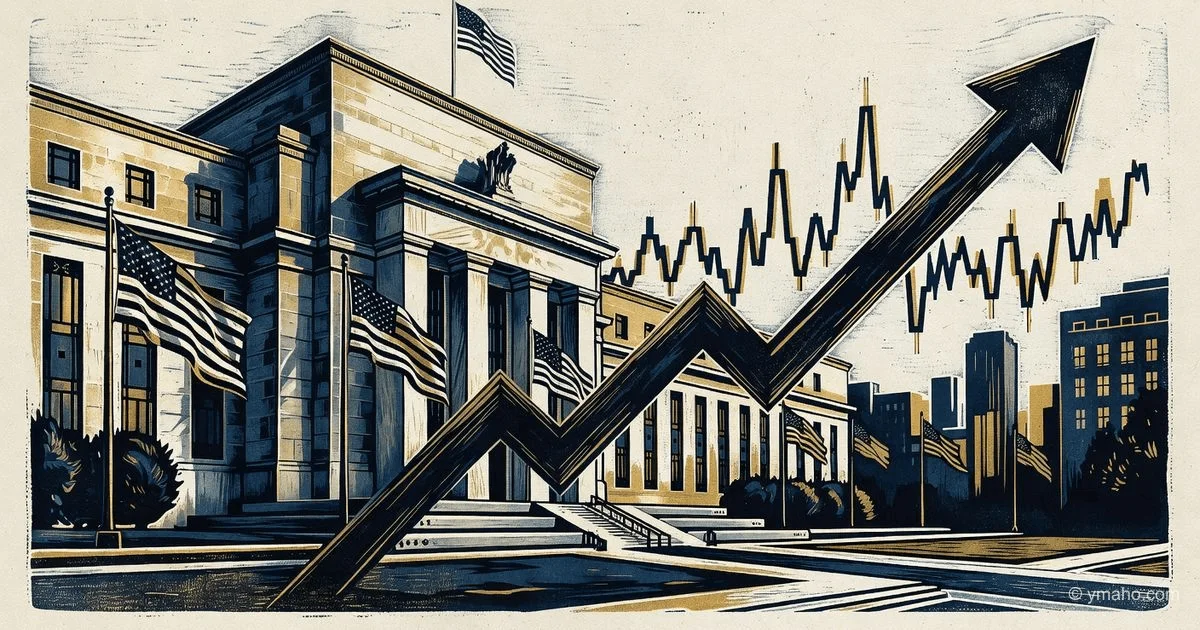
Fed Holds Rate at 5.5% and Delivers Hawkish Signal
Jerome Powell said that 'several more months' of inflation data are needed before the first rate cut. The 10-year Treasury yield surged to 4.72%.
Analytical Breakdown: The Fed's Hawkish Pivot — Rate at 5.5% and a New Course for Warsh
The Core: What's Really Happening
The media presents the Fed's decision to hold rates at 5.5% as a 'hawkish signal,' but that's just the tip of the iceberg. The real story is unfolding behind the scenes, and it's far more dramatic. At the latest Federal Open Market Committee meeting on April 28-29, 2026, the most divided voting process in three decades occurred: four of the 12 committee members dissented, the highest number since 1992.
Note the split: it was not one-directional. One member — Steven Miran, a Trump appointee who left his post on May 22, 2026, making way for Kevin Warsh — voted for a rate cut. The other three voted to remove language from the Fed's statement that implied an 'easing bias.' These three demanded a signal that the next move could be either a hike or a cut. This is not just a 'hawkish signal.' It's a factional war inside the US central bank.
The true essence of what's happening: the Fed is no longer in 'wait-and-see' mode. According to the meeting minutes released on May 20, 2026, 'most participants' indicated that some policy tightening would likely become appropriate if inflation persistently exceeds 2%. Moreover, 'many participants' expressed a preference to remove language from the statement that implied rate cuts. This is a radical shift from the position at the start of the year, when the Fed signaled at least one, possibly two, rate cuts in 2026.
Timeline and Context
To understand how we got here, we need to go back a few months. On May 13, 2026, Kevin Warsh was officially confirmed as the new Fed Chair, replacing Jerome Powell. Warsh, a former Fed governor known for his role in easing the 2008 financial crisis, came with a promise of 'regime changes': reducing communications and tightening the Fed's $6.7 trillion balance sheet. His inauguration took place at the White House on May 22 in the presence of President Trump.
A key point the media misses: the April meeting was the last under Powell's leadership, but it laid the foundation for the hawkish turn. The minutes of that meeting, released three weeks later on May 20, showed that the 'vast majority' of FOMC members believe that returning inflation (PCE) to the 2% target will take longer than previously thought.
What changed in those three weeks? The main culprit is the war in the Middle East, now nearly three months old. The conflict between the US, Israel, and Iran has pushed oil prices up more than 50%, and pressure is beginning to spread beyond the energy sector. The blockade of the Strait of Hormuz, which Iran sees as a leverage tool, has reduced global oil supplies by 8.7 million barrels per day in May — twice as fast as at the start of the conflict.
Add to this the fiscal factor: the 'One Big Beautiful Bill' passed by the Trump administration, according to J.P. Morgan estimates, will increase the US budget deficit by $2.8 trillion over the next decade. Combined with record-high government debt (after Moody's downgrade in 2025), this creates a perfect storm for bond yields.
Winners and Losers
Winners #1: Short sellers of Treasury bonds. The 10-year Treasury yield surged to 4.72% [user case], and the 30-year yield to 5.2%, the highest since 2007. Investors who bet on rising yields (falling bond prices) back in April are now celebrating. A survey of portfolio managers shows that 62% expect the 30-year yield to reach 6%.
Winners #2: The US dollar (USD). Despite a short-term correction after news of talks with Iran, the medium-term trend remains bullish for the US currency. When the Fed discusses rate hikes while the European Central Bank and the Bank of England are in a completely different phase of the cycle, the dollar gains a unique advantage. The interest rate differential will widen, classically strengthening the dollar.
Winners #3: Goldman Sachs and major banks — but not as you think. In periods of high bond yield volatility, banks profit from spreads and volatility. But there's a nuance: high yields mean holding large Treasury portfolios becomes unprofitable due to negative revaluation. Banks that hedged their positions through derivatives will win. Those that didn't will incur losses.
Losers #1: High-multiple tech stocks. The S&P 500 fell for a third consecutive day, and the Nasdaq dropped 0.90% amid rising yields. This is a classic reaction: the discount rate rises, the present value of future cash flows falls. Companies with long payback horizons — most AI and SaaS companies — are especially vulnerable.
Losers #2: Gold. Interestingly, gold, the classic safe-haven asset, came under dual pressure. On one hand, real yields are rising, increasing the opportunity cost of holding gold (which yields no coupon). On the other hand, news emerged that Russia is selling off its gold reserves, dropping them to 73.9 million ounces — a four-year low. This creates additional supply in the market.
Losers #3: Small traders who believed in the 'dovish scenario.' The futures market as early as May was pricing in 1-2 rate cuts by year-end. Those positions are now being closed at a loss. The hardest hit are those who sold 10-year Treasuries (i.e., bet on falling yields) with leverage.
What the Media Isn't Saying
Non-obvious insight #1: AI-driven inflation — a new factor that didn't exist in 2022. In the FOMC minutes, there is a phrase almost no one noticed: 'Several participants noted that price pressures related to large investments in AI are likely to lead to higher costs in a number of industries.' This is an unprecedented acknowledgment. It's not just about Nvidia chips getting more expensive, but also about data centers consuming enormous amounts of energy and AI specialists whose salaries have skyrocketed.
AI-driven inflation is structurally different from post-COVID inflation. It won't disappear with the normalization of supply chains. It will worsen as more companies invest in AI infrastructure. The Fed understands this but rarely speaks about it publicly because 'inflation from technological progress' sounds like an oxymoron.
Non-obvious insight #2: Kevin Warsh is not the 'dove' Trump expects. President Trump has publicly called for rate cuts to 1% or lower and expected Warsh to deliver on that promise. However, Warsh's Senate hearings painted a different picture. He criticized the Fed for reacting too late to inflation in 2022. He pointed to trimmed mean and median inflation measures, which are currently below core PCE — a moderately 'dovish' signal, but nothing more.
The reality: Warsh inherits a committee that has already shifted hawkish. The four dissenters at the April meeting are a signal to him: 'We won't just follow your lead.' Warsh's first meeting on June 16-17, 2026, will likely not bring a rate change, but the rhetoric will be tough.
Non-obvious insight #3: High bond yields are bad for Trump, but he can't stop them. A president running for re-election needs low rates to support the housing market and consumer spending. But the growing deficit (the $2.8 trillion bill) and military spending in the Middle East make it impossible to lower yields. Trump is trapped by his own policies: he increases the deficit, pushing yields up, while simultaneously demanding the Fed cut rates. The bond market is a boss you can't talk down with political statements.
Forecast: Next 30 Days and 90 Days
30 days (through early July 2026): The key event is the FOMC meeting on June 16-17, the first under Warsh. I expect the rate to remain at 5.5%. However, attention will focus on the dot plot and the statement. If Warsh does not remove the language about 'additional adjustments,' which still implies the possibility of a cut, the market may perceive this as a 'dovish' surprise, triggering a short-term rally in stocks and a drop in yields to 4.50-4.55%. The base case: the 10-year yield stays in the 4.65-4.85% range.
The main risk this month is escalation in the Middle East. If Iran actually closes the Strait of Hormuz, Brent crude could spike to $120-130 per barrel, forcing the Fed to talk about rate hikes more aggressively, even before the June meeting. In that scenario, the 10-year yield could break 5% within days.
90 days (through September 2026): Toward the end of summer, the effects of the hawkish pivot on the real economy will become apparent. Rising borrowing costs will begin to slow real estate investment and corporate capital spending. If labor market data (especially the April report due June 5) show a slowdown in hiring, pressure on the Fed to 'not kill the economy' will intensify.
I expect that by September, the 10-year yield will stabilize at 4.90-5.10%, and the dollar will strengthen another 2-3% against a basket of major currencies. The S&P 500 will likely trade in the 5400-5700 range, 5-7% below current levels, with elevated volatility. A rate hike (25 basis points) in 2026 is no longer a 'black swan' scenario — in my estimation, the probability of such an outcome by year-end is 30-35%.
Editorial Forecast
Asset: US dollar (USD) against a basket of currencies (DXY). Direction: Up in the next 24-72 hours. Key levels: Current DXY index around 105.8, nearest resistance at 106.5, then 107.2. Confidence level: Medium (60%). Main risk: A sudden announcement of progress in talks with Iran could lower oil prices and weaken the dollar as the geopolitical premium shrinks. The market has already priced in hawkish rhetoric, so for the dollar to rise further, a real catalyst is needed — for example, confirmation that the June meeting will be even tougher than expected. It is recommended to refrain from opening new long dollar positions until the release of the minutes or Warsh's comments.
— Editorial Team